
Add us as your preferred source on Google to see more of our content in Search.
 Add to Preferred Sources
Food security and child nutrition have improved across the Gaza Strip due to a scale-up in humanitarian assistance and commercial traffic, but the gains remain fragile and could quickly reverse without sustained access, funding, and recovery support, according to a press release issued on 23 July 2026 by the Food and Agriculture Organization (FAO), the United Nations Children’s Fund (UNICEF), and the World Food Programme (WFP). The three United Nations (UN) agencies cautioned that people across the war-torn enclave still struggle to restore their livelihoods, local food systems, and essential services. Latest analysis by the UN-backed IPC food security monitor shows 1.4 million people, or 67 percent of Gaza’s population, remain in crisis-level acute food insecurity or worse. This marks a decrease from 1.6 million people, or 77 percent of the population, at the end of last year. Some 212,000 people, however, remain in emergency conditions, classified as IPC Phase 4.
Humanitarian operations have expanded significantly since the October 2025 ceasefire between Israel and Hamas. Many of those still in emergency conditions live near the Israeli-controlled “Yellow Line,” where access to aid and essential services remains particularly difficult. Only the Kerem Shalom/Abu Salem border crossing in the south remains open, limiting the flow of essential goods. Food rations remain insufficient in quantity, quality, and dietary diversity, while commercial imports of fresh produce and proteins are inconsistent. Most people therefore remain dependent on aid.
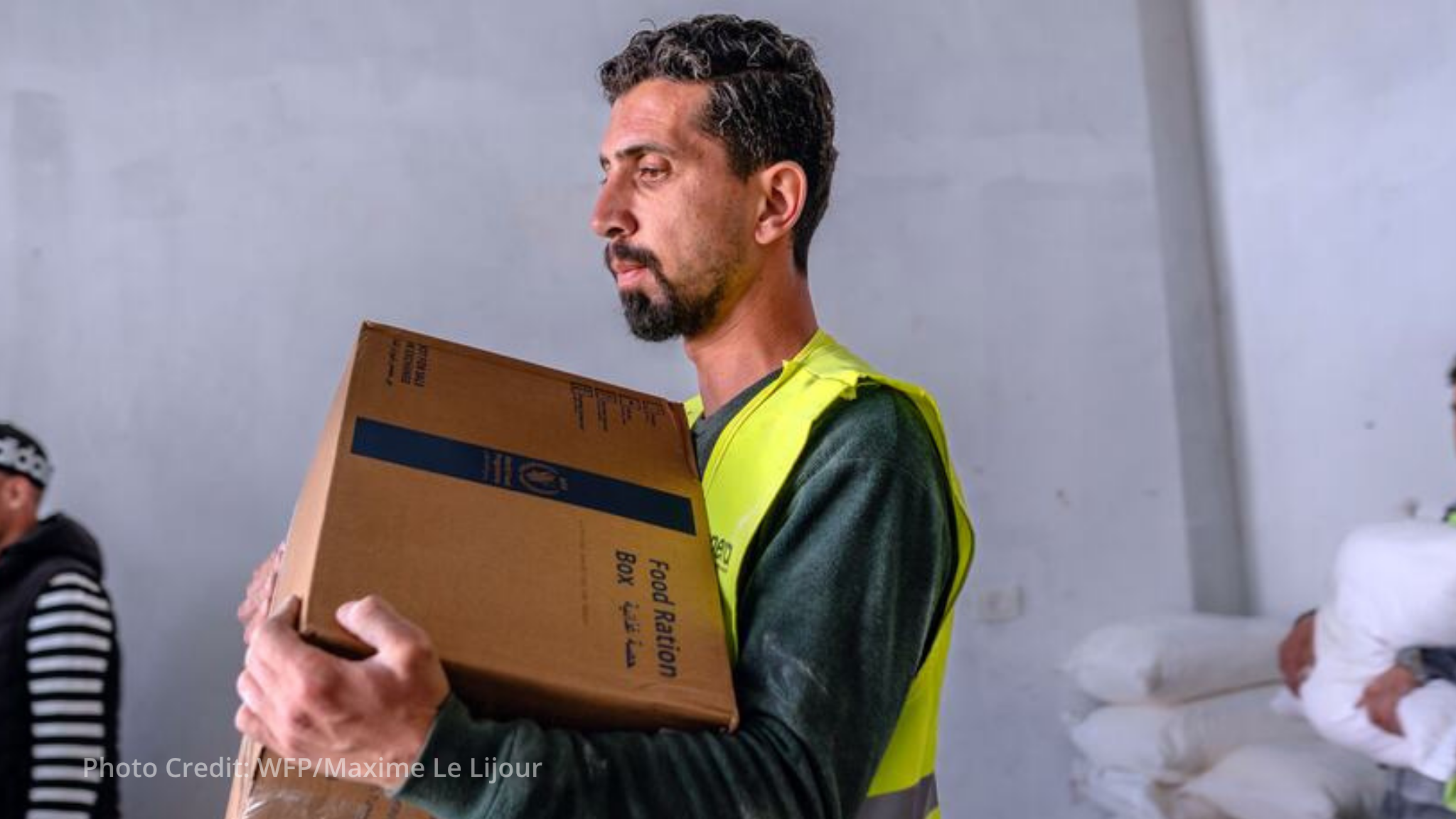
In May alone, food parcels reached around 1.5 million people, multipurpose cash assistance peaked at around 700,000 people, and nutrition support reached 60 percent of children under five. This contrasts sharply with September 2025, when around 500,000 people received food assistance and nutrition coverage for under-fives was below one percent. Malnutrition rates have also improved through the rapid expansion of prevention programs and treatment access. In the coming year, some 74,000 children are expected to require treatment for acute malnutrition, and roughly 25,000 pregnant and breastfeeding women will need nutrition support. Four governorates — North Gaza, Gaza, Deir Al-Balah, and Khan Younis — are projected to face “alert” levels of malnutrition, IPC Phase 2.
“There is progress on food security in Gaza, but it is fragile and can easily be reversed,” said Carl Skau, WFP Acting Executive Director. He added that “the overall humanitarian situation remains brutal: families lack water, sanitation and medicine. We need sustained access, funding and stability so people of Gaza can begin recovery.”
UNICEF Executive Director Catherine Russell warned that “acute malnutrition has fallen, but many children are still going hungry, and some children may never fully recover from prolonged lack of proper nutrition.” Early signs indicate local food production can resume where farmers and herders access cropland, agricultural inputs, and essential services. Sheep inventories have increased by 33 percent in areas where support has been sustained.
More than 70 percent of cropland is not accessible, and only three percent is currently usable, limiting recovery prospects. Communities are restarting small-scale economic activity where conditions allow, though these efforts cannot expand while restrictions remain and large areas of land stay inaccessible.
“Food security in Gaza cannot recover unless local food production starts again and farmers, herders, fishers and other producers can rebuild their livelihoods,” said FAO Director-General Dongyu Qu.
He noted that producers need access to farmland and the sea, along with seeds, tools, livestock supplies, and technical support. The three agencies emphasized that sustaining the recent gains depends on continued humanitarian access, funding, and stability across the enclave.