


Add us as your preferred source on Google to see more of our content in Search.
 Add to Preferred Sources
What remote connectivity can and cannot solve in developing countries
A satellite internet terminal can connect a remote district long before the arrival of a fiber trench, a new road, or a chain of mobile towers. For isolated communities, satellite internet is a practical way to circumnavigate difficult geography, connect to the world, and accelerate progress in key sectors such as education, health, and finance.
Geography, however, is just the first obstacle for connectivity. The terminal needs electricity, a secure site, a local wireless network, functioning devices and somebody who knows what to do when the service fails and, last but not least, the payment of monthly subscription fees.
So, while satellite internet can shorten the distance between a community and the network, it cannot by itself repair weak institutions or make an unaffordable service sustainable.
This distinction is particularly important in developing countries. Satellite links are most valuable where they fill a specific gap, create a back-up route or buy time while other infrastructure develops.
A shortcut across geography
The global digital divide remains large enough to justify the search for alternative connection methods. According to the International Telecommunication Union’s Facts and Figures 2025, 74% of the world’s population used the internet in 2025. This figure reached 94% in high-income countries but only 23% in low-income economies.
Africa’s regional average was 36%, while least developed countries and landlocked developing countries stood at 34% and 38%. The global average therefore reflects two very different realities: constant connectivity for most people in wealthier societies and an ongoing patchiness across many lower-income regions.
Figure 1: Internet use in selected regions and income groups in 2025
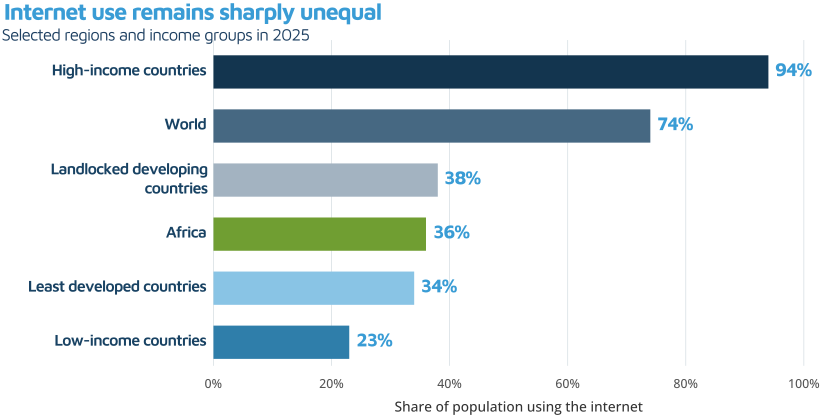
Source: International Telecommunication Union (ITU). Categories are separate groupings and are not additive.
The divide is not only between countries, it also runs through them. The ITU estimates that 85% of urban residents were online in 2025, compared with 58% of rural residents. In low-income countries, only 14% of rural inhabitants used the internet and in Africa, the urban internet-use rate was approximately 2.6 times its rural rate.
Figure 2: Internet use by place of residence in 2025
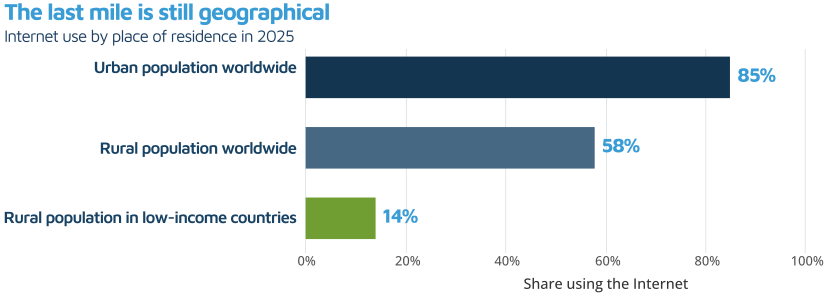
Source: ITU. The chart uses reported global urban and rural rates and the reported rural rate for low-income countries
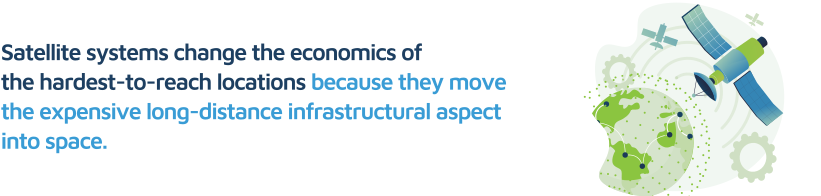
A village no longer needs a continuous line of trenches, poles or relay towers before it can connect to the national backbone. While local installation still costs money, the distance between the site and the nearest city becomes less important.
This is why satellites are attractive to locations such as deserts, mountain districts, small islands, border regions, refugee settlements and places where a lack of safety means that terrestrial construction is slow or dangerous.
Low-Earth-orbit services have made interactive uses more reliable. Their satellites travel much closer to Earth than traditional geostationary platforms such as heavy communication and weather satellites, reducing the delays that often affect video interactions, cloud applications and online teaching.
The African opportunity and the bargaining issue
For many African governments, the appeal is obvious. A satellite service can connect an isolated administrative post while national fiber plans continue to be developed, provide a second option for a landlocked country dependent on connectivity via neighboring countries, or enable communication if a cable is disconnected.
The Sahel, the Horn of Africa, as well as the Congo Basin and remote areas of Southern Africa present very different political and physical conditions. Yet they are all home to locations where an internet connection that does not have to follow a road can be useful.
However, electricity often determines whether a connection will be sustainable. For example, the World Bank’s Tracking SDG 7 report estimated that 565 million people in sub-Saharan Africa lacked electricity in 2023.
Another issue is bargaining power. Satellites, terminals, software, pricing systems and many operational decisions are controlled from abroad. Regulators, appointed by the government, must decide who may sell a service, how the spectrum is coordinated, where data travels and how privacy, cybersecurity and lawful-access rules are applied.
A government that gains geographical coverage but becomes dependent on one foreign platform may have solved one vulnerability by creating another.
That situation calls for a mixed strategy. Fiber should remain the backbone of connectivity where traffic is dense, while mobile networks will continue to provide most individual access. Satellite capacity can reach remote areas, provide a back-up or create redundancy while microwave and community networks can solve local distribution problems.
What connected schools reveal
Schools are useful test sites because a single connection can serve teachers, pupils, administrators and, outside school hours, the surrounding community. They also expose the difference between buying equipment and utilizing the service it can provide. Simply having a terminal does not ensure that students can use it. Schools need power, internal networking, devices, appropriate content, teacher support and a way to measure whether the promised bandwidth is actually delivered.
Recent work by Giga, the UNICEF-ITU school-connectivity initiative, provides concrete examples. Botswana reports having over 700 schools connected with the ability to reach more than 400,000 learners and uses the Giga Meter to monitor connection quality. While there were 659 schools connected in 2025 in Kenya, there are now 1,160, benefiting more than 425,459 students and teachers, including schools hosting refugees in Kakuma and Dadaab. In Rwanda, pooled procurement for a 63-school pilot produced a reported 55% reduction in cost per megabit per second by the winning bid
Figure 3: Scale of selected Giga-supported school-connectivity programs
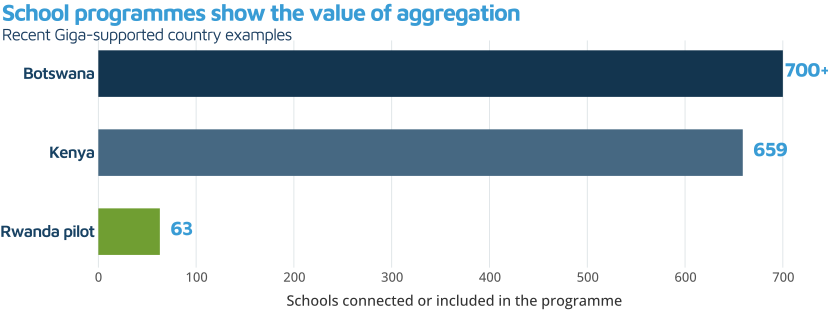
Sources: Giga reports for Botswana, Kenya and Rwanda. Botswana’s figure is reported as more than 700 and is plotted at the conservative lower bound of 700. The programs differ in scope and technology.
These figures should not be read as a league table. The programs differ in size, timing and design, and they use a mixture of terrestrial and wireless technologies rather than satellite links alone. Their importance lies elsewhere. Mapping institutions reveals demand that individual purchasing cannot see. Pooling that demand can attract competition, lower unit prices and make monitoring worthwhile.
Procurement decides whether the service survives
Another powerful impact of continuous connection is indirect and involves the reaction speed of institutions and the continuity of the service. Development strategies often speak about universal connectivity in broad language, but procurement records show what governments are actually prepared to buy.
One useful example is a 2026 Tenderwell record for the purchase of a satellite internet service and 12 months of subscription for 34 schools in Escalante City in the Philippines. The buyer did not request terminals in isolation; it combined connectivity with a defined period of service for a group of schools.
The 12-month term also raises a question that stands at the center of every pilot: what happens in month 13? A strong tender should explain the renewal method, the ownership of the equipment installed, the arrangements for technical support and the process involved in moving to another provider. It should also state how the buyer will verify performance. Without those provisions, an apparently affordable first year can create a subsequent expensive dependency.
What the connection really costs
Retail advertising draws attention to the price of the satellite terminal and the monthly subscription. A public project has a wider cost. Suppose a remote institution needs
US$2,000 to cover the cost of a terminal, mounting, installation, solar generation, battery storage and a modest local network, followed by US$200 per month for connectivity, maintenance and support.
Over five years, the total cost would be approximately US$ 14,000: US$2,000 initially and US$12,000 in recurring fees. One hundred sites would require roughly US$1.4 million before end-user devices, major training, taxes, security improvements or unusually difficult transport are included.
That is an illustrative case. The actual costs would vary by country, terrain, capacity, exchange rate and tax treatment. Its purpose is to show why utilization matters. If a school, clinic and the surrounding community come together and place useful service within the reach of 250 people, the five-year cost would equal US$56 per potential user. If the equipment is locked in an office and used by five employees, the same installation produces a very different public return.
Affordability for households remains a separate problem. The ITU’s 2025 affordability assessment found that fixed broadband, when available, could cost more than one quarter of average income in a low-income country.
Shared institutional access, community networks and mobile services may therefore produce greater development value than subsidizing scattered individual subscriptions.
Competition and European technological sovereignty
Starlink is the most visible commercial entity in many countries, but does not represent the entire market. Eutelsat OneWeb, geostationary operators and future low-earth-orbit systems meet different combinations of consumer, enterprise, government and wholesale demand.
While more providers could improve bargaining power, competition only helps when licensing is clear, technically qualified operators are eligible to compete and public contracts do not make switching prohibitively difficult.
Europe’s planned IRIS2 constellation adds a strategic dimension. This program combines low- and medium-earth orbits and is intended to support secure government communications as well as commercial broadband. Its north-south orbital is designed to extend coverage across Europe and Africa. The success of its development in Africa will depend on price, access conditions, gateways, licensing and partnerships with African operators.
Orbital coverage alone does not determine who receives a usable service. In August 2026, the European Commission reported that its main constellation is planned to comprise 348 satellites, with the first launches expected by 2029. EUSPA similarly reported that services from the multi-orbit constellation were expected from 2029 onward. Governments should not postpone urgent projects while waiting for a system to be available in the future, but neither should they sign onerous contracts that would prevent them from benefiting when better options from the competition emerge. A phased purchasing strategy can meet present needs while leaving room to change providers or add capacity.
The development test
Satellite internet can remove one of the most stubborn obstacles to connectivity: the cost and delay of construction companies crossing difficult terrain. It can connect an institution that would otherwise wait years, restore services during a breakdown and give national planners an alternative to a single cable or terrestrial route. Those are substantial benefits.
The technology should nevertheless be judged from the ground. Will the school remain connected after the pilot program? Can the clinic protect patient data? Is the subscription affordable in the local currency? Can a technician reach the site, and can the government change suppliers without discarding the local network? Do people have devices, skills and services worth using? These questions are more mundane than a product launch, but they determine whether the signal will become the infrastructure.
The central risk is not that satellites fail to reach remote communities. It is that public authorities purchase fast connectivity without building the power systems, contracts, technical capacity and local services that give it lasting value. When those elements are designed together, satellite internet can become a powerful instrument of education, health, administration and resilience. When they are ignored, the signal may pass over the community and thus fail to close the divide beneath it.