
IDB Group and Civil Society discuss sustainable development challenges in Latin America and the Caribbean

Add us as your preferred source on Google to see more of our content in Search.
 Add to Preferred Sources
More than 500 representatives from Latin American and Caribbean Civil Societies organizations met in Santa Cruz, Bolivia, with senior Inter-American Development Bank (IDB) officials to discuss ways to put innovation at the service of sustainable development. The XVII Annual Meeting of the IDB Group-Civil Society is a two-day annual event that includes workshops, discussion panels and direct exchanges.
This year’s meeting focused on the relevance of innovation for sustainable growth from a variety of perspectives, such as the jobs of the future, the use of data to transform cities, the changes brought about by the digital economy, the exponential growth of technology, and social innovation.
“In this constantly changing world, the civil society in Latin America and the Caribbean has a unique chance to profit from disruptive innovation to contribute to improving the living standards of all its citizens,” said the IDB’s Vice President for Countries Alexandre Meira da Rosa. “We must all work together to strengthen our region’s innovation potential and make sure that it plays a pivotal role in the fourth digital revolution.”
Both from its headquarters and its 26 country offices throughout the region, the IDB works alongside the Civil Society on five strategic engagement lines –information, dialogues, public consultations, collaboration, and partnerships– in order to promote inclusion and diversity to combat inequality and poverty, boost productivity and innovation, and foster economic integration among Latin American and Caribbean countries. This engagement with civil society seeks to promote shared sustainable growth of the three main actors of development: governments, private sector and civil society.
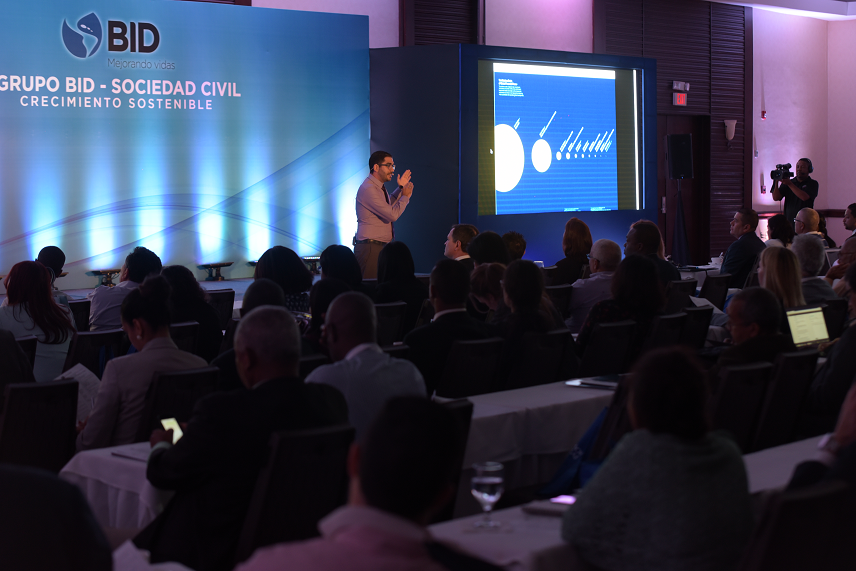
Within this framework, and following deep changes in the region over the past few decades such as consolidation of its democratic systems, decentralization, middle-class expansion, and the technological and social networks revolution, the IDB continues to move forward to multiply the opportunities for sustainable growth. Among other things, during its annual meeting, it conducted public consultations under the Ideatonmethodology that produced valuable input from representatives of the 26 nations’ civil societies. Together with the results of other consultations previously conducted with governments, the private sector and other civil society organizations, this input will help create the strategy for the next IDB Group-Civil Society Engagement towards 2030, which will be presented in 2018.
Besides the IDB Vice President for Countries Alexandre Meira da Rosa, other Annual Meeting speakers included Colombia’s former Information Technologies and Communications Minister Diego Molano, who has produced a “Digital Revolution” in his country by promoting the widespread use of the internet, and Silicon Valley innovation expert Ignacio Peña.
In line with these developments, the IDB has launched WiConnect3, a georeferenced digital platform that helps governments, the private sector, the civil society, the IDB and other development agencies and donors to know who does what, how and where in the different sectors and regions of Latin America and the Caribbean. Their aim is to move forward together to promote the region’s sustainable development and help civil society organizations turn into true social innovation labs.
Original source: IADB
Published on 8 November 2017