

Add us as your preferred source on Google to see more of our content in Search.
 Add to Preferred Sources
As the world gathers in Bonn for the latest round of climate talks, FAO is at the heart of efforts to ensure that agriculture provides the basis for a world without hunger amidst a changing climate and reduces sectoral emissions to help minimize dangerous global temperature rise.
Nations are at the meeting, known as COP23, to lock down ways to implement the pledges made under the Paris Agreement – which seeks to both minimize climate change and help developing nations adapt to changing weather patterns.
“Agriculture and food systems are partly responsible for increased temperatures, but they are also a big part of the solution to mitigate greenhouse gas emissions and promote adaptation,” said FAO Assistant Director-General René Castro Salazar. “As the impacts of climate change increase and become more intense, a global transformation to sustainable agriculture must begin immediately.”
Climate change threatening food security
The statistics demonstrate why we need to act. FAO estimates that 815 million people are chronically hungry. The world must, by 2050, produce 49 percent more food than in 2012 as populations grow and diets change.
Climate change will bring further extreme weather events, land degradation and desertification, water scarcity, rising sea levels, and shifting climates – hampering efforts to feed the planet and achieve the 2030 Agenda for Sustainable Development.
We clearly cannot achieve zero hunger without tackling climate change
Therefore, FAO is further integrating climate action into its work. Earlier this year, FAO released a climate change strategy that aims to deliver the climate solutions the agricultural sectors offer and support member states as they look to meet their Paris Agreement commitments and up ambition.
Around 90 percent of countries’ climate commitments, known as Nationally Determined Contributions (NDCs), include the agricultural sectors – clearly demonstrating the fundamental contribution the sectors, and FAO, can bring.
Financing integrated approaches to ensure food security
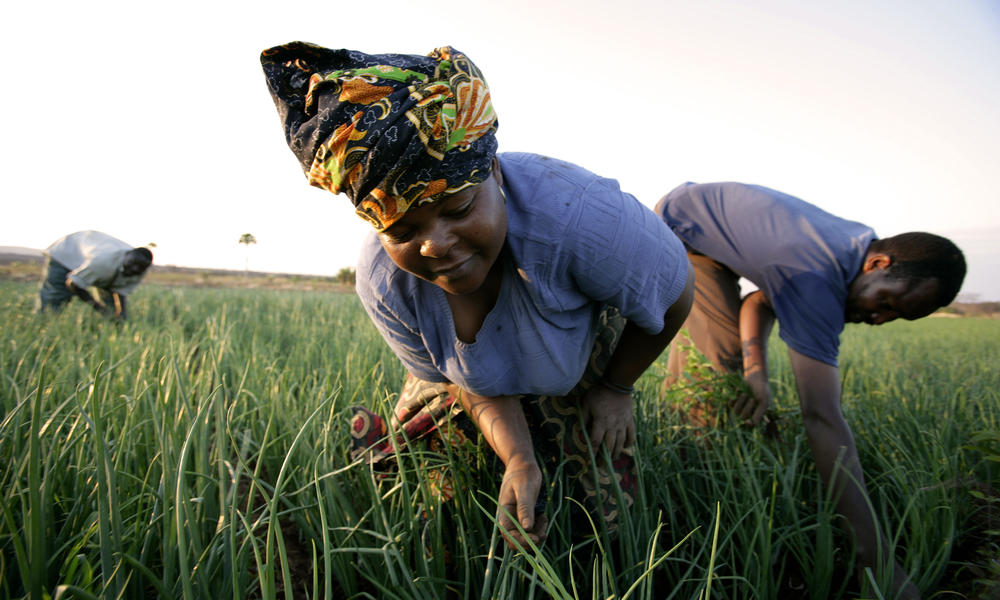
FAO believes that hunger, poverty and climate change can be tackled together by recognizing the links between rural poverty, sustainable agriculture and strategies that boost resource-use efficiency, conserve and restore biodiversity and natural resources, and combat the impacts of climate change.
Pursuing such climate-resilient development pathways that can simultaneously contribute to reducing greenhouse gas emissions calls for long-term, pro-poor development and investment in agriculture.
These are costs that smallholders cannot carry on their own. Channelling public and private investments into agricultural sectors, including through flows of climate finance, can harness their transformative potential.
As the climate talks continue to look at ways to finance change, FAO is striving to ensure that the finance needed to make agriculture a key player in climate action begins to flow.
Huge potential to cut emissions
As things stand, the pledges made under the Paris Agreement are not enough to meet the target of limiting global temperature rise to 2oC this century. Even full implementation of current unconditional and conditional NDCs makes a temperature increase of at least 3oC by 2100 very likely.
Agriculture, however, has enormous potential to help strengthen the Paris Commitments. Rehabilitating agricultural and degraded soils can remove up to 51 billion tonnes of carbon from the atmosphere.
Livestock supply chains account for 14.5 percent of global anthropogenic greenhouse gas emissions. Cattle (beef, dairy) are responsible for about two-thirds of that figure. FAO estimates that the potential to reduce emissions from livestock production, in particular, methane, is about 30 percent of baseline emissions.
Global food loss and waste generate about 8 percent of total annual greenhouse gas emissions, meaning there is massive room for improvement.
Action in these and many more areas in agriculture can help the world build a stronger and more ambitious Paris Agreement that will deliver on the promise we have made to future generations to protect them from climate change.
FAO events at COP23
At the meeting, FAO is organizing side events that will demonstrate its knowledge, expertise and ability to help member states deliver on agriculture’s potential while ensuring that vulnerable communities remain resilient. Highlights include:
Agriculture Action Day (10th November)
The role of agriculture will be reflected in dialogue and presentations facilitated by FAO, as a leader of the Marrakech Partnership thematic events.
The day will cover water scarcity and food waste management, integrated landscape management, low carbon livestock, use of climate data, traditional knowledge systems. FAO will launch its new Sourcebook on Climate-Smart Agriculture to guide policymakers and programme managers to make the agriculture sectors more sustainable, productive and low-carbon.
The High-Level Roundtables on Climate Action and Zero Hunger (14th November)
A dedicated high-level roundtable on SDG 2 as part of the Action Days of the Marrakesh Partnership will focus on how cultivating change by investing in smallholders can spur rural transformation, especially in Small Island Development States. At the SDG 2 high-level political event on rural transformation and urbanization, actors from governments, the private sector and civil society will be assessing what it takes to achieve Zero Hunger and climate resilient, low emission food systems.
Original source: FAO
Published on 8 November 2017