

Add us as your preferred source on Google to see more of our content in Search.
 Add to Preferred Sources
Burmese security forces have committed widespread rape against women and girls as part of a campaign of ethnic cleansing against Rohingya Muslims in Burma’s Rakhine State. Killings, rapes, arbitrary arrests, and mass arson of homes by Burmese security forces in hundreds of predominantly Rohingya villages have forced more than 600,000 Rohingya to flee to neighboring Bangladesh. Rohingya women, men, and children have arrived in Bangladesh in desperate condition—hungry, exhausted, and sometimes with rape, bullet, or burn injuries. The humanitarian crisis caused by Burma’s atrocities against the Rohingya has been staggering in both scale and speed.
The Burmese military’s brutal campaign follows attacks on 30 police posts and an army base by the Arakan Rohingya Salvation Army (ARSA) on the morning of August 25, 2017 in northern Rakhine State. The government reported that 11 security force personnel were killed. While the government had a duty to respond to the attacks, the Burmese military, supported by Border Police and armed ethnic Rakhine villagers, not only pursued those responsible, but immediately launched large-scale attacks against scores of Rohingya villages under the guise of counter-insurgency operations. Human Rights Watch has found that the violations committed by members of Burma’s security forces against the Rohingya population in northern Rakhine State since August 25 amount to crimes against humanity under international law.
This report is based on 52 interviews with Rohingya women and girls, including 29 survivors of rape, who fled to Bangladesh since these operations began. Rape survivors were from 19 different villages in Burma’s Rakhine State, mostly in northern Buthiduang and Maungdaw Townships. They described similarly brutal circumstances of the rapes. Human Rights Watch also spoke to 17 representatives of humanitarian organizations providing health services to women and girls in the refugee camps, including representatives of United Nations agencies and international and national nongovernmental organizations. We also interviewed two Bangladeshi government health officials.
Human Rights Watch found that Burmese security forces raped and sexually assaulted women and girls both during major attacks on villages but also in the weeks prior to these major attacks sometimes after repeated harassment. In every case described to us, the perpetrators were uniformed members of security forces, almost all military personnel. While it is difficult to estimate the numbers of rapes that occurred, humanitarian organizations working with refugees in the camps in Bangladesh have reported receiving dozens or sometimes hundreds of cases.
These likely only represent a proportion of the actual number of women and girls who were raped. Some witnesses reported seeing women raped and then killed. Others do not report rape because of the deep stigma that makes survivors reluctant to seek assistance. Fear of having to pay medical fees that they cannot afford, or the lack of confidence in ever obtaining redress, also are factors. Of the survivors that Human Rights interviewed, almost two-thirds had not reported their rape to authorities or humanitarian organizations.
All but one of the rapes reported to Human Rights Watch were gang rapes, involving two or more perpetrators. In eight cases women and girls reported being raped by five or more soldiers. They described being raped in their homes and while fleeing burning villages. Human Rights Watch documented six cases of “mass rape” by the Burmese military. In these instances, survivors said that soldiers gathered them together in groups and then gang raped or raped them. Ethnic Rakhine villagers, acting alongside and in apparent coordination with government security forces, were also responsible for sexual harassment, often connected with looting.
The rapes were accompanied by further acts of violence, humiliation, and cruelty. Security forces beat women and girls with fists or guns, slapped them, or kicked them with boots. In two cases women reported that their attackers laughed at them during gang rapes, and more frequently attackers threatened their victims either verbally or through actions like putting a gun to their heads. Some attackers also beat women’s children during the attacks.
Rape survivors spoke of enduring numerous abuses at once. In addition to being gang raped, three women described with great distress seeing security forces murder their young children. Other women and girls said they witnessed killings of their elderly parents, their husbands and other family members and neighbors. Many reported witnessing cruelty toward those especially vulnerable, such as a soldier killing a 5-year-old girl who could not keep pace with her fleeing family, or security forces pushing older persons who could not flee back into burning houses.
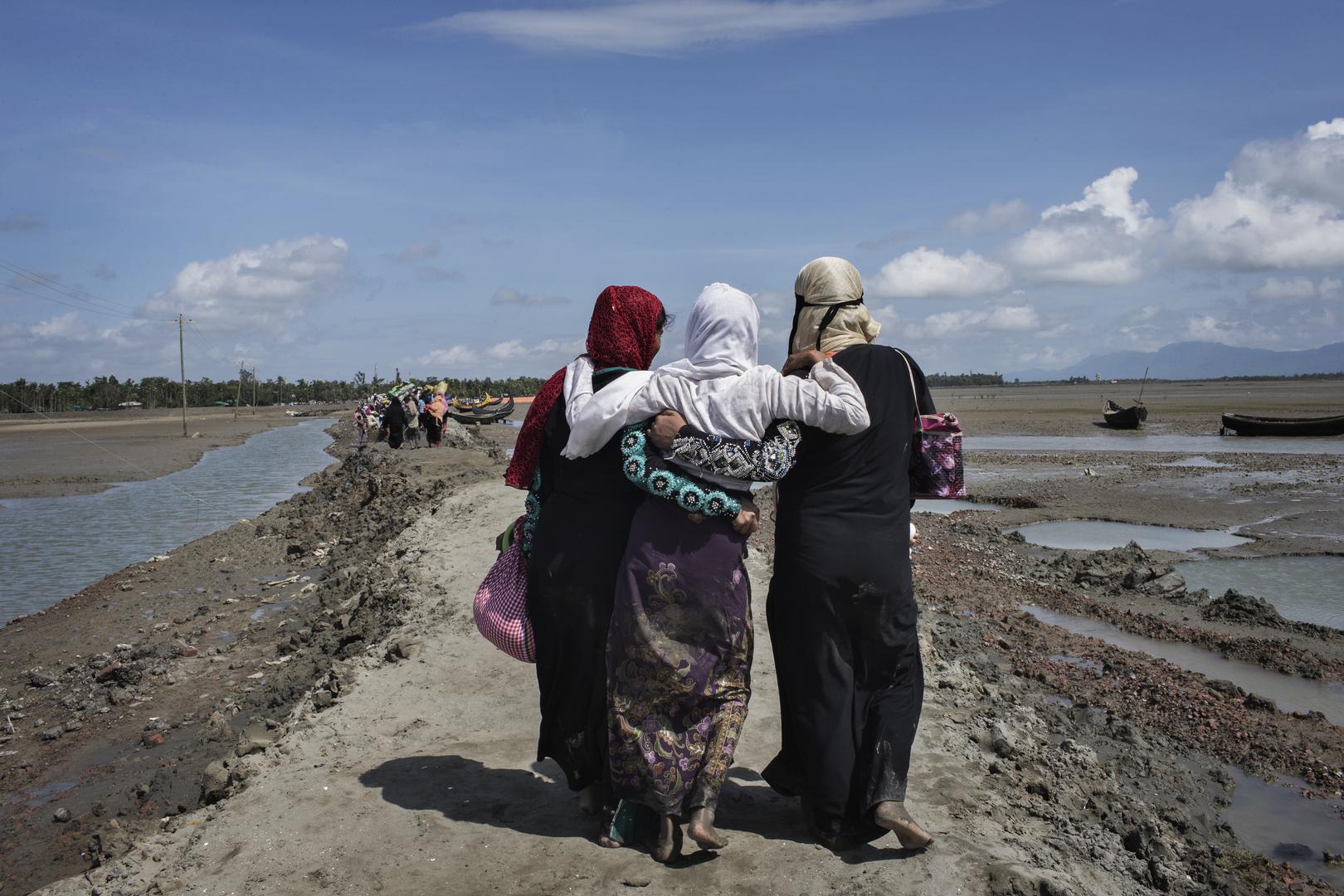
Rohingya women refugees who crossed the Naf River from Burma into Bangladesh continue inland toward refugee camps. Tek Naf, Cox’s Bazar district, Bangladesh.
For those able to flee, the journey toward relative safety in Bangladesh was fraught with pain and hardship. Gang-rape survivors reported days of agony walking with swollen and torn genitals through jungle to Bangladesh. Women in late stages of pregnancy described walking up and down steep hills slippery from monsoon rains, through rivers and dense vegetation, often with little to eat and on sore hips and swollen legs. Three women told us about giving birth during their journey without basic medical supplies or skilled health assistance.
None of the rape survivors we interviewed received post rape care in Burma. They missed access to urgent interventions that must take place within days of the rape, like emergency contraception (120 hours) and prophylaxis against HIV infection (72 hours). The Burmese government obstructs humanitarian access to much of Rakhine State.
Women continued to suffer even after reaching Bangladesh. Human Rights Watch spoke to 10 women who continued to experience physical injuries, including vaginal tears, bleeding, or infections as a result of rape, without accessing care. Many of the women we spoke to reported symptoms of post-traumatic stress disorder (PTSD) or depression.
The Bangladesh government, together with international partners, has provided sanctuary and have allowed Rohingya refugees access to health facilities around the camps as well as specialist care further afield. But a lack of knowledge and chaos in the overcrowded refugee camps together with stigma and shame has prevented many women from obtaining post-rape care.
Read full report here.
Original source: Human Rights Watch
Published on 16 November 2017