
Climate commitments under threat worldwide over poor progress towards greenhouse gas reduction targets

Add us as your preferred source on Google to see more of our content in Search.
 Add to Preferred Sources
The climate policies put in place by developed countries do not fully comply with what they committed to when they signed the Paris Agreement and one developing state – Gambia – has applied measures that will enable it to meet the Agreement’s provisions.
The latest Climate Action Tracker (CAT) report shows that the targets for the reduction in greenhouse gas set by almost every country are insufficient to ensure that global warming does not exceed 1.5 degrees C above pre-industrial levels. This goal is provided for in the Paris Agreement on climate change which is the first universal, legally binding global climate agreement. Adopted in 2015, the Agreement, which was signed by 194 countries plus the European Union, includes commitments from the major emitting countries to cut gas emissions.
The CAT report recently analyzed the updated climate policies of 36 countries plus 27 EU states. Overall, 90 states plus those of the EU submitted their targets for 2030 but 70 others have not yet done so. The former is responsible for 50% of all emissions while the latter produce about a quarter of global emissions. According to the CAT analysis, some countries, such as the USA and EU states, have replaced their targets with more ambitious ones. China and Japan have also announced new targets but have not yet submitted these to the Paris Agreement.
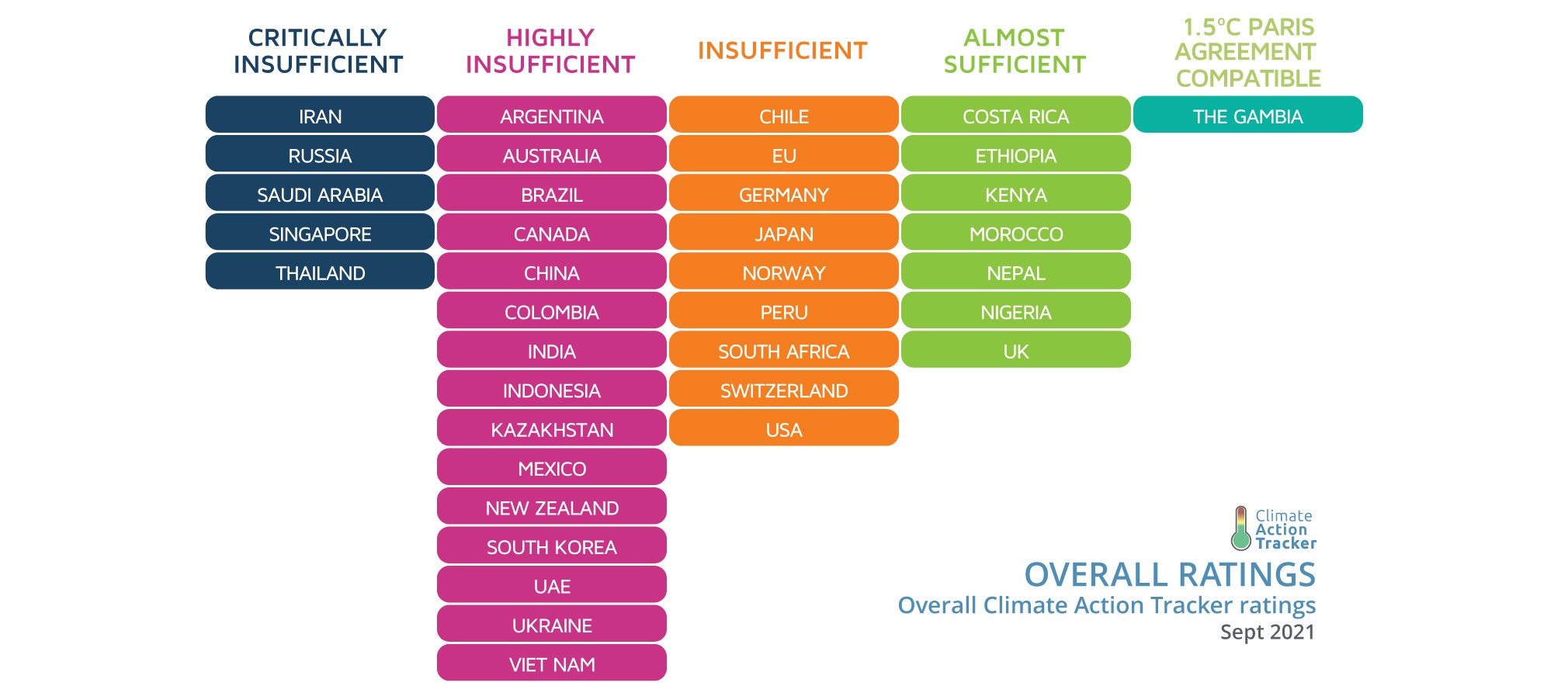
As the graph below shows, only one country has set a target that is compatible with the Paris Agreement, seven have offered almost sufficient greenhouse gas reduction targets, nine insufficient, 15 highly insufficient, and five critically insufficient.
“Of particular concern are Australia, Brazil, Indonesia Mexico, New Zealand, Russia, Singapore, Switzerland, and Vietnam: they have failed to raise their ambitions at all, submitting the same or even less ambitious 2030 targets than those they put forward in 2015. These countries need to rethink their choice,” said Bill Hare, CEO of Climate Analytics in CAT.
Brazil and Mexico have not changed their stance, submitting the same numerical target and, although the proposals from Russia and Vietnam look all very well on paper when it comes to the policies that are actually in place, these do not constitute any real change. Australia and Indonesia have failed to change anything and have instead stuck to their original plans. Singapore has not increased its targets and nor has Switzerland. New Zealand submitted its original target but has committed to deliver a more ambitious plan this year.
The report points out that if each state set a critically insufficient target, as is currently the case with Iran, Russia, Saudi Arabia, Singapore, and Thailand, then global warming would exceed 4 degrees.
The CAT report recognized Chile, Costa Rica, and the EU states as those to have set an “acceptable” zero net target. At the same time, the EU and the UK are the only ones to have borne in mind emissions from international aviation and shipping in their targets.
Gambia, which is the only state to have set targets in line with the Paris Agreement, mostly owes this to setting ambitious conditional targets, i.e., it will implement its planned climate policy if sufficient financial support is available.
The CAT report assesses that coal is the greatest challenge in terms of greenhouse gas reduction. Asia is still a region where many governments are determined to maintain the use of this fuel. China has declared that it intends to phase out coal but nevertheless, in 2020 the country built 75% of all coal-based power plants. Similarly, India, Indonesia, Vietnam, Japan, and South Korea continue to invest in coal-fueled infrastructure.
According to the authors of the publication, if humanity is going to be able to limit global warming to 2 degrees by 2100, 131 countries will have to implement the zero net targets either announced or under consideration but not yet submitted which is still far from the 1.5 degrees assumed by the Paris Agreement.