
Add us as your preferred source on Google to see more of our content in Search.
 Add to Preferred Sources
The Asian Development Bank’s 2016 annual report outlines the bank’s plans to increase its public-private partnerships across Asia while showing its private sector operations fell almost 5 percent in the last financial year.
The bank’s private sector operations were overshadowed by its sovereign operations, which rose 12 percent from US$13.36 billion to US$14.97 billion. The figures undermine the bank’s target of achieving 50 percent approvals from business by 2020, as described in its 2014 mid-term strategy review.
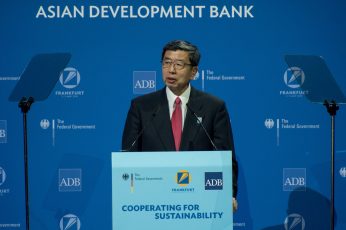
However, the bank’s president, Takehiko Nakao, described “strong progress” in the ADB’s office of public-private partnerships, which he described in an opening speech at the bank’s 50th annual meeting in Yokohama as particularly important to ensure universal health coverage for aging populations in the region. Paraphrasing the report, Takao underscored ADB’s approval of a US$50 million demonstration public–private partnership “for improved elderly care services in Hubei province of the PRC of China, benefitting 25,000 people”.
In 2016, the bank secured five new mandates for public-private partnerships in Bangladesh, Kazakhstan, Malaysia, Sri Lanka, and Vietnam. In Sri Lanka, the public-private partnership team is advising the Sri Lanka Ports Authority on a partnership involving a US$500 million container terminal for 2.4 million additional 20-foot equivalent units at a port in Colombo. The project aims to make the port a major hub for global shipping.
In Malaysia, the team is also advising Melaka Green Technology, a state-owned enterprise, on a project to refurbish over 100,000 road lights using energy-efficient diode lamps, supporting Malaysia’s drive to cut its greenhouse gas emissions by 40 percent by 2020. The Ministry of Health and Social Development of Kazakhstan is also receiving technical assistance to build, equip, and maintain a 300-bed multifunctional teaching hospital. The bank gave a total of approvals for 26 private sector operations in 2016. Of these, 12 have climate change and clean energy aspects, and 11 are located in low-income or lower-middle-income countries.
Source: DevelopmentFinance. Read full article here.
4 May, 2017