What is global literacy and why it is important for the modern world?
By Daniil Filipenco • Jan 16, 2025Literacy is commonly defined as people’s capacity to read, write and comprehend the textual elements of a language. In the modern world, however, the concept of literacy could be extended to a collection of knowledge, expertise, and perceptions in the areas that are required in life based on continuously changing environments. Literacy is a promoter of sustainable development since it contributes to the improvement of living conditions and motivates people to become an integral part of society. It also takes child and family health and nutrition to a higher level, decreases poverty levels, and enhances life opportunities.
Why is literacy important?
- Reading and writing were developed by humans to produce, store, and share a physical record of knowledge with others across time and distance. In doing so, they have encouraged the following generations to build upon the knowledge of those who came before them.
- People require literacy to interact with the written world in everyday life. It is vital for people to be able to read signs, labels, and phone messages. The same applies to writing – today text-based communication emphasizes the need to be able to read.
- Moreover, literacy is critical in transforming children into socially involved citizens. Reading and writing means being able to stay informed, communicate effectively and comprehend the issues that shape our world.
- Literacy is important for employment. At the fundamental stage, without it, searching for or reading a job post, putting together a CV, or reading an employment contract becomes difficult.
- Literacy is also important for civic activity. Besides the fact that a lot of data provided by a government and its associated agencies is written, poor literacy also impairs an individual’s capacity to vote and thus participate in one of democracy’s pillars.
Global literacy rate
Most people take literacy for granted rather than realizing that it is a privilege.
Although the literacy rate at the global level increased from 68% in 1979 to over 86% in 2022, even so, 250 million children still lack fundamental literacy skills. Moreover, around 754 million adults worldwide – 60% of whom are women – cannot read and write.
However, while over the last few decades, the situation has registered a great improvement, the COVID-19 pandemic has exacerbated pre-existing disparities in relation to the opportunity to gain free access to literacy with millions of people suffering from limited access to information.
Statistics of the global literacy rate
- According to the World Population Review, the global literacy rate among males and females over the age of 15 is 86.3%.
- Males – 90%
- Females – 82.7%
- The literacy rate in developed countries is 99.2%
- Only 65% of adults in the least developed countries are literate whereas in developed nations this figure is 96% or above.
- More than 617 million young people fail to meet the basic reading and mathematics competence levels. By the time they complete their primary education, almost half of all children will not meet the minimum proficiency levels.
- 118.5 million girls miss school, according to a 2022 report.
- 70% of children in middle- and low-income countries cannot read a simple paragraph by the time they are 10 years old.
- 44 million teachers need to enroll today in order for the Sustainable Development Goals to be achieved by the end of this decade.
- 202 million young people in sub-Saharan Africa are currently not learning to read or studying mathematics. Furthermore, less than one in three adults (aged 15+) in various sub-Saharan African nations can read and write.
The global variations in literacy rates are depicted on this map.
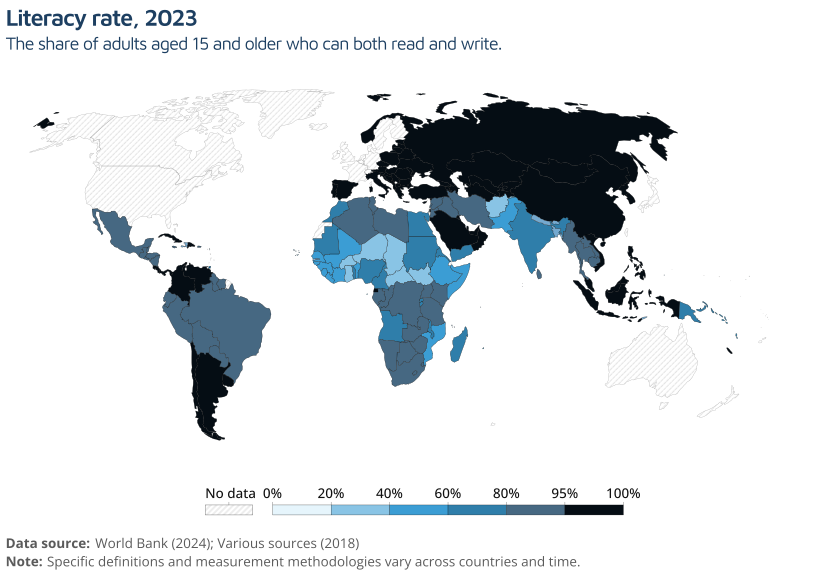
Source: OurWorldinData
Global literacy issues
While the number of children enrolled in schools is currently much higher than ever before but nevertheless, many of today’s youth remain outside of educational institutions. Many children lack basic reading and numeracy skills and there are significant differences both within and across nations.
See also: 100 million children may fall below the minimum reading proficiency level according to UNESCO
According to UNESCO, the goal to increase global education standards by 2030 will most likely not be achieved. Should the current trend continue, around 30% of adults and 20% of youngsters in poor nations will continue to suffer from illiteracy.
There are also access disparities such as barriers to schooling for girls and rural families. The biggest disparity, however, is tied to poverty. According to UNESCO‘s Global Education Monitoring report, in lower- and middle-income nations, children from the poorest 20% of households are eight times more likely to be out of school compared to children from the richest 20%.
According to data from UNESCO’s Global Education Monitoring Report, children from the most disadvantaged 20% of households are eight times more likely to miss school compared to their peers from the wealthiest 20% of households in lower-middle-income countries
Photo Credit: UNICEF/Wathiq Khuzaie
Sub-Saharan Africa education issue
According to recent UNESCO data, there are currently 250 million out-of-school children worldwide representing an increase of 6 million from 2021. The most serious problems are seen in sub-Saharan Africa, where around 60% of young people aged 15 to 17 are out of school.
- 30% of out-of-school children live in sub-Saharan Africa.
- The graduation rate for elementary school pupils in this region is 65% (the global average is 87%).
- 75% of those in the 15–24 age group are literate (the global average in developing countries is 90%).
Afghanistan education issue
With regard to Afghanistan, the UNESCO Director-General, Audrey Azoulay, underlined her grave concern about the Taliban gradually reopening secondary schools but only for boys and male teachers. She warned that a delay in girls resuming attendance at secondary school may lead to a regression in their education and ultimately in their lives.
The UNESCO report released in September 2021 showed that Afghanistan had previously made substantial educational progress in the last two decades.
This country has one of the lowest literacy rates (37%) among the adult population. Women’s literacy rate in the country is 20.6% – one of the lowest figures in the world.
Afghanistan is currently considered to be the most limiting nation for women worldwide and the only one that restricts girls from attending classes beyond the sixth grade.
- In 2022 there were just 5.7 million primary school-age girls and boys, down from 6.8 million in 2019, according to new UNESCO figures.
- Since 2021 at least 1.4 million girls have been excluded from secondary education.
- With 53% fewer students having enrolled at universities since 2021, the statistics in higher education are similarly extremely alarming.
However, these vital benefits for the nation’s development will be jeopardized if females do not return promptly return to school.
