International aid (also known as overseas aid or foreign aid) is defined as the assistance from rich and developed states that is given to developing countries. The donors may be governments, non-governmental organizations, development banks, or various international organizations. The help they provide is channeled for a variety of reasons be they moral, philanthropic, political, or economic. Aid is provided in multiple forms, from loans and grants to donations of agricultural equipment. This article defines the basic types of international aid and reveals some of the latest statistics regarding aid.
Donors may provide support in the following forms:
The majority of transactions occur between developed and developing nations. The latter often lack a robust manufacturing base and are identified by a low Human Development Index.
The purpose of international assistance
- Countries frequently send help to alleviate the suffering generated by man-made or natural calamities such as drought, disease, and violence. Foreign assistance also aims to boost a country’s exports and propagate its culture.
- International aid helps to promote long-term prosperity and the establishment or strengthening of political institutions.
- Nations use foreign aid to tackle a variety of global issues such as disease, terrorism, and climate-related issues.
- Aid can help certain governments to achieve their political goals such as gaining diplomatic advantages or increasing the chances of their diplomats accessing foreign nations.
- Countries offer aid to bolster their own security. Economic help can also be used to prevent friendly nations from falling under the authority of unfriendly régimes.
In terms of the pros and cons of foreign aid, there are multiple arguments on both sides. Take a look at our previous article that considers this.
Types of international aid
🔹 Bilateral aid
This is the most common form of state-run assistance. Bilateral aid describes the situation when one government directly allocates help (in the form of money or other assets) to a receiving nation (usually a developing economy).
Bilateral help is determined by strategic, political, and humanitarian considerations. Some of the goals that donors wish to achieve are to promote democracy, economy, and peace in specific regions.
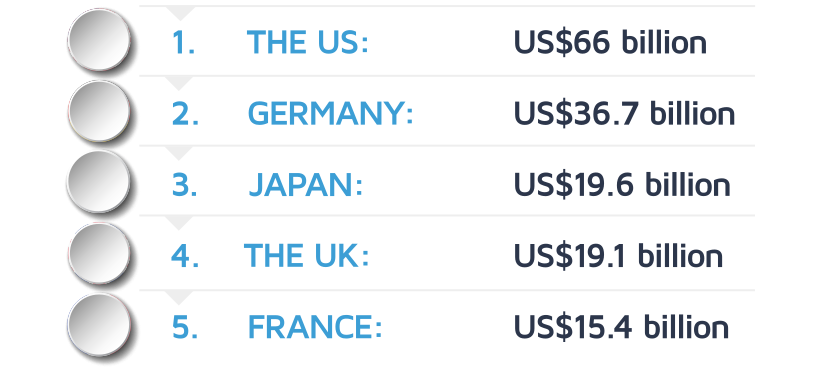
Fig.1. Net official development assistance by country in 2023 (in USD billion)
Source: OECD
🔹 Tied aid
This type of international aid is to be spent by the beneficiary in the nation offering assistance (the donor) or a group of specific nations.
When the donor offers a bilateral loan or grant, it expects that the receiving nation will spend the money on products and services offered by the donor country.
For instance, all food aid, as well as all vehicles needed to administer help, must be imported from the country giving the aid.
🔹 Multilateral aid
This type of foreign aid represents the financial help that one or several developed nations offers to foreign institutions such as the United Nations or the World Bank that, in turn, can use the funding to tackle hunger in poor countries, for example.
🔹 Military aid
This type of international aid is used to help foreign governments or people to defend themselves or to help a poor nation keep sovereignty over its own territory.
Such assistance may come from the donor country in the form of money that can be used to acquire weapons, ammunition, and equipment.
🔹 Project aid
This refers to help that is provided by the donor for a concrete project. It can take the form of construction materials that are to be used to build a new school or hospital.
See also: The main types and the evolution of international aid
International aid statistics
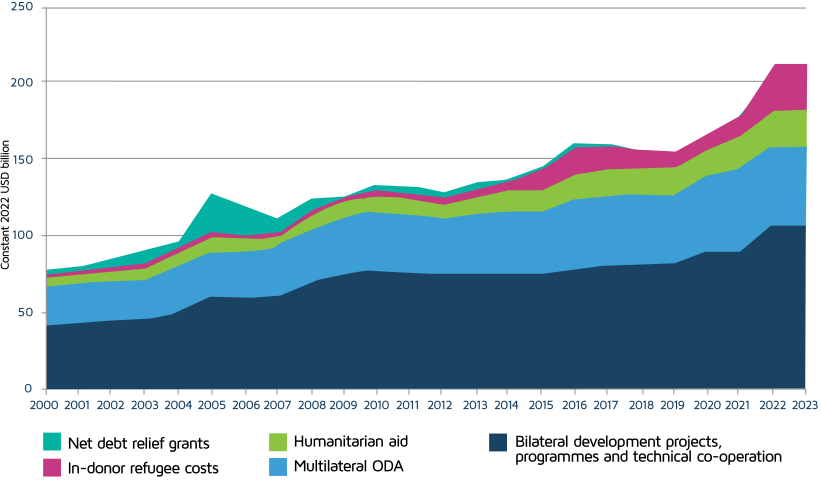
The Organization for Economic Cooperation and Development estimated that as of 2023 its member nations donated a historic amount of Official Development Assistance (ODA) – US$223.7 billion.
- In real terms, the total ODA registered an increase of 1.8% in 2023 over 2022, when it was US$211 billion. Preliminary data gathered by the OECD shows that donor nations increased humanitarian help to Ukraine while decreasing aid to developing nations.
- Initial estimates indicate that in 2023 ODA to the West Bank and Gaza rose by 12% from 2022 and reached US$1.4 billion. Humanitarian assistance constituted about US$758 million of that amount, an increase of 91% from 2022.
- Globally, the level of humanitarian aid registered an increase of 4.8% in 2023, hitting US$25.9 billion.
- ODA allocated to cover refugee costs within donor nations declined by 6.2% in 2023, to US$31 billion, or 13.8% of total ODA, as opposed to 14.7% in 2022.
Fig.2. Components of DAC member countries’ official development assistance (ODA), 2000-23, USD billions (constant 2022 prices)
Source: OECD
The top 5 donors in 2023
Source: OECD
However, international aid involves more than just offering money and resources; it represents a determined effort to reform those sectors that require development. The aid aims to alleviate poverty while also promoting public welfare and encouraging economic progress.
Foreign aid is also intended to combat global diseases, eradicate poverty, mitigate the effects of climate change, and help nations to make progress toward accomplishing the United Nations’ Sustainable Development Goals.