Add us as your preferred source on Google to see more of our content in Search.
 Add to Preferred Sources
Although the post-pandemic recovery introduced new opportunities for countries to invest in the transition to green energy, in 2020 fossil fuel subsidies reached USD5.9 trillion – 7% of global GDP. The Renewables 2022 Global Status Report unveiled by the international think tank, REN 21, warns that the global clean energy transition is unlikely to be achieved due to the ongoing worldwide energy crisis, commodity shortages, and price shocks.
While 2021 was supposed to bring new hope for green recovery, commodity price shocks and ramped-up economic activities put the global energy transition at risk. Last year, solar and wind power provided a record level – around 10% – of worldwide electricity. In 2021, 314.5 GW of new renewable power capacity was installed globally, with the total installed renewable power capacity reaching 3,146 GW. Around USD366 billion was invested in renewables.
Although this achievement sounds laudable, the energy transition progress achieved has not so far been sufficient. Niklas Hagelberg, Coordinator on Climate Change at the United Nations Environment Programme, commenting on the progress, notes:
“This progress is insufficient and has not matched the growth in overall global energy demand. To get back on track, we need to increase the energy transition pace three-fold. A key reason why the transition is not occurring as needed is the ongoing subsidizing of fossil fuels. Between 2018 and 2020, governments spent US$18 trillion – 7% of global GDP in 2020 – on fossil fuel subsidies, in some cases while reducing support for renewables. We don’t need to remove these subsidies from the energy sector but we do need to move towards renewable energy and support the transition.”
In the second half of 2021, rebounding economic activities put pressure on energy demand, increasing this by 4%, much of which was fulfilled by fossil fuels. Furthermore, suppressed demand has boosted energy prices almost all around the world. At the beginning of 2022, the war in Ukraine triggered a commodity shock and energy crisis, further jeopardizing global markets. In response to sharply increased energy prices and commodity shortages and price shocks, many countries have started planning to increase coal production, threatening to exacerbate the situation further.
REN21 Executive Director Rana Adib, talking about the activities taken by countries, notes:
“Instead of putting renewables on the back burner and relying on fossil fuel subsidies to reduce people’s energy bills, governments should directly finance the installation of renewable energy technologies in vulnerable households. In the end, the renewable energy path will come out cheaper, despite the upfront investment.”
For the moment, however, the sharp increase in global energy demand has offset the rise in renewable energy deployment. The share of fossil fuels in final energy consumption (TFEC) has changed slightly since 2009, with around 12.6% of global final energy demand met by renewables in 2020 compared to 8.7% in 2009. The progress made towards renewables has also been uneven across countries. As of 2019, out of 80 countries, only Iceland, Norway, and Sweden, had renewable shares in TFEC of more than 50%.
Fig.1. Renewable energy shares in total final energy consumption for selected countries, 2019
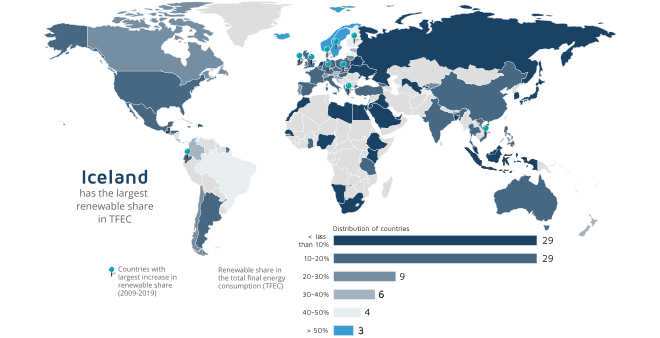
Source: The Renewables 2022 Global Status Report, REN21
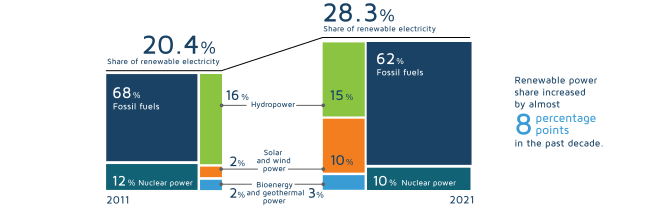
Globally, the share of renewable energy power has increased by eight percentage points since 2011, while the share of renewable electricity reached 28.3% in 2021 compared to 20.4% in 2011. The sharpest rise was recorded in the solar and wind power generation sector as this achieved a 10% share in 2021 compared to 2% in 2011.
Fig.2.Share of renewable energy in power, 2011 and 2021