How did countries cope with violent crime during the COVID-19 era?
By Daniil Filipenco • Aug 23, 2022Violent crimes are defined as criminal offenses that entail the purposeful use of violence (be this the primary goal or a means to an end) against another individual. Homicide, sexual assault, kidnapping, murder, and heists are examples of violent crime although this list varies by nation.
Why do violent crimes occur?
The rate of violent crime varies substantially among nations. The reason behind crimes is often difficult to explain because there are too many elements that can influence crime rates.
Violent crimes are often the result of a high level of income inequality. The populations of nations that register high crime rates commonly face poverty or extreme poverty along with limited job opportunities which pushes them to take desperate action.
There is also a link between criminality and age. The majority of crimes, particularly violent crimes, are perpetrated by people aged between 20 and 30.
Violent crime statistics
It is somewhat difficult to examine and compare violent crime data between different nations or regions. The fundamental problem is that the term “violent crime” encompasses a huge variety of offenses and each country or region defines each crime differently.
Moreover, each region employs its own crime reporting and recording systems. One country may have detailed protocols for recording crime data and issuing annual updates while another may have a system that is far less comprehensive.
When the figures are broken down into specific violent crimes, such as the murder rate by country, the information becomes more credible and valuable (although still not ideal).
Before diving into the violent crime situation over the last couple of years, let’s look at the period before the COVID-19 pandemic.
According to one UN 2019 study, the number of people in the world who fell victim to intentional homicide was 464,000. The report also stated that overall, European nations showed a very low rate of violent crime. Some countries with strict gun restrictions and effective actions carried out by law enforcement had less than one violent crime per 100,000 people which is a tremendous result.
In 2019, the number of people who fell victim to homicide around the globe was a little over 415,000.
In most countries of Europe, North Africa, Asia, and Oceania, the homicide rate was very low. However, in certain nations, there is a completely different picture. In Latin America, for instance, violent crime rates are extremely high, especially in El Salvador, Guatemala, and Venezuela.
Fig.1. The world’s most dangerous nations by murder rate per 100,000 people
Source: Statista
The aforementioned data does not include deaths caused by violent conflicts. While there are many wars around the world, the deaths they bring are not deemed to be murder. This is the reason why homicide rates in Latin America are greater than in Afghanistan, where almost 176,000 civilian casualties were recorded during the 2001 – 2021 period.
 Violent crimes in Latin America
Murders increased dramatically in most Latin American and Caribbean nations in 2021.
- Many people found themselves slipping further into poverty, partly as a result of the COVID-19 crisis.
- Teenagers returned to the streets with little to do after schools were late reopening because of the pandemic and became easy targets for recruitment by criminal gangs.
- Law enforcement was also increasingly challenged by the coronavirus outbreak. Officers were stretched thin, many becoming unwell or required to perform other duties. During this time, organized crime groups discovered new opportunities in a reshaping environment.
Which is the world’s most unsafe nation?
El Salvador is commonly recognized as the deadliest non-war location on the planet. In 2022 El Salvador, home to 6.8 million people, topped the list with 52.02 murders per 100,000 people. San Salvador, the nation’s capital, was ranked 28th in the world for murders followed by numerous Latin American towns as well as North American St. Louis in Missouri, and Cape Town in South Africa.
 Violent crimes in the U.S.
According to the New York Times, the number of murders in the United States has climbed by approximately 40% since 2019, along with the number of shootings and other attacks. In 2020, over 24,500 people were murdered in the U.S.
There are several reasons that can explain the surge of violence in the country:
- The COVID-19 crisis with its lockdowns wreaked havoc on many aspects of life, notably the social agencies that help people to deal with violent acts.
- The high-profile police shootings in 2020, as well as the ensuing protests, weakened police-community ties.
- In recent years, Americans have purchased an unprecedented quantity of firearms (19.9 million in 2021 and 22.8 million in 2020, according to Forbes).
- There is an increasing sense of societal unrest and suspicion in society.
- The nation is politically polarized and faces serious economic issues.
But there are some positive signs as well with some major cities registering a decline in the number of murders.
 Violent crimes in Africa
South Africa
Homicide, rape, and assault cases were among the violent crimes that occurred most in the country.
According to official figures in just three months – between July and September 2021, there were:
- Nearly 10,000 rape cases (+634 compared to 2020)
- Over 6,100 homicides (+1,056 compared to in 2020)
Nigeria
The Nigerian criminal scene is influenced by political turmoil, terrorism, violence, droughts, and population increase. The potential of mass murder, or genocide, is another severe threat in Nigeria.
- In December of 2021 hundreds of civilians were murdered, according to Nigeria’s presidency, amid conflict between herdsmen and farmers in the central Nasarawa state.
- In January 2022 the United Nations reported that due to attacks by armed criminals, around 200 people were killed and 10,000 were forced to leave their homes. The perpetrators acted after military air-raids on their hideouts.
 Violent crimes in the European Union
The overall number of violent crimes in 2019 (the latest year currently available for analysis) among European nations was not very high for certain categories but reached a record for others:
- 3,875 intentional homicides (the lowest over the previous 10 years).
- 36% of homicide victims were women with 40% being from Germany, Croatia, Denmark, and the Czech Republic.
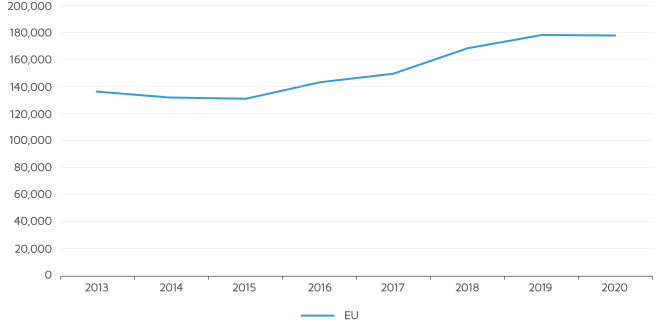
- 178,500 sexual violence offenses (the highest level since 2013).
Fig.2. Sexual violence, 2013-2019
Source: Eurostat
Although the recent post-pandemic pan-European data is yet to be gathered, the COVID-19 crisis has resulted in a substantial drop in most crimes in nations with high crime rates such as Hungary, thanks to a mixture of lockdowns and fewer tourists. In Spain, for instance, street robbery was down 34% in 2021compared to 2019 and violence fell by 22%.
But there is bad news as well. Belgium had the highest number of robberies in the region – three times higher than the average in the EU which is 60 per 100,000 people. In 2017, 2018, and 2019, the number of violent robberies hit 146.7 per 100,000 on average. Belgium was followed by Spain (134.1 robberies per 100,000 people) and Portugal (108 robberies per 100,000 of population).
Final word
Although the term violent crime is defined differently in various regions around the globe, it is clear that the COVID-19 pandemic had an impact on crime as a whole. Some regions registered an increase in violence due to social unrest and increasing poverty, while others showed a significant decrease as a result of lockdowns and a drop in the number of tourists who are among the main criminal targets. However, one of the major causes of violent crimes remains poverty with numerous poor regions registering high violent crime rates.