Women still earn less than men and COVID-19 has made things worse
By Daniil Filipenco • Sep 29, 2022Today the gender gap in employment is still clearly visible, despite this issue being high on the agenda of many countries and making headlines across the globe. Women around the world, even in developed nations, have less opportunity to earn money than men do – only a little more than half of all women are part of the labor force as opposed to 80% of men.
Furthermore, women are also less likely to hold formal jobs and have fewer prospects for professional advancement or business growth. To make things worse, evidence from the latest household surveys shows that the COVID-19 lockdowns have also taken their toll.
Women’s involvement in labor
Overall, surprisingly, the poorest nations boast the highest rate of women involved in the workforce since agriculture is the primary industry of these countries and women play an important role in small-scale farming. However, there is little room for positivity as their employment is informal, the work is hard, and the pay is low.
Middle-income countries have significantly less agricultural activity and therefore fewer women participate in the workforce than in low and high-income nations.
In high-income nations, the female workforce participation rate is higher than in middle-income countries. The reason for this lies in the transition to an economy based on the service industry and women’s free access to higher education.
The COVID-19 crisis and its effect on the gender gap in employment
When COVID-19 first struck the planet in 2019, nobody anticipated it would have such dire effects on economies and businesses. The issue of gender inequality in employment has also worsened during the COVID-19 lockdowns and according to Deloitte Global Economist Network, there are two main reasons explaining this:
- The industries that were most negatively impacted by COVID-19 were hospitality, food services, and personal care – in most countries women make up the majority of the workforce in these industries.
- During lockdowns, when many firms shifted to remote work, women performed a larger proportion of home duties than males did. Additionally, with schools migrating online and childcare facilities barely existing, the majority of women were responsible for taking care of children.
In the period 2019-2020, the unemployment rate among women registered a 4.2% increase with 54 million women losing their jobs. The employment rate among men, however, showed a 3.0% increase (60 million jobs). However, not every region has been impacted equally:
Fig.1. Female vs male employment reduction 2019-2020 (from highest to lowest)
Gender imbalance and the distance to parity
According to data from the Global Gender Gap Report 2021, women have been affected more seriously than men by the COVID-19 crisis, partially widening the disparities that had previously narrowed.
The global distance to parity has decreased by 68% on average which is 0.6%. less than it was in 2020.
To calculate this indicator, the Global Gender Gap Index assessed 156 nations, calculating scores on a scale from 0 to 100, with scores representing the distance to parity (i.e., the amount of the gender imbalance that has been reduced expresses as a percentage).

For instance, women make up:
- 14% of the workforce in cloud computing
- 20% in engineering
- 32% in data and artificial intelligence
The COVID-19 crisis has expedited automation and digitization. Usually, there is a large intake of new talent into the eight clusters (aka “jobs of tomorrow”): 1. Cloud Computing, 2. Engineering, 3. Data and AI, 4. Sales, 5. Product Development, 6. People and Culture, 7. Marketing, 8. Content Production. However, at the moment this influx does not counterbalance gender inequality.
The recent data from the Global Gender Gap Report shows that males continue to hold the majority of those jobs that are on the increase, and these positions remain highly paid.
Gender gaps in the 8 job clusters
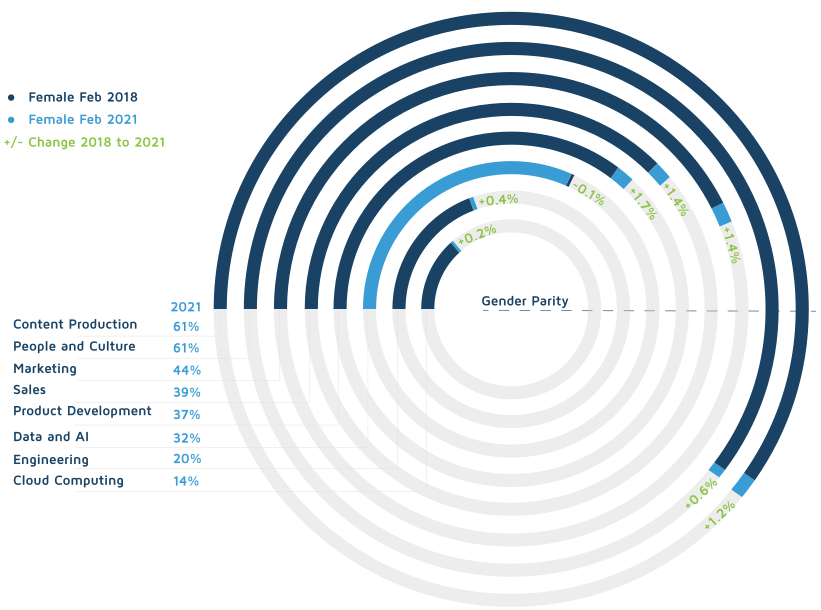
Source: World Economic Forum
Gender wage gap
Despite modest improvement in 2021, the wage gap remained at about 37%, and the income gap stayed at around 51%. This is a problem even for countries like Iceland, which ranks first in the world and has seen 86% of the gap closed.
But there is still good news.
For instance, women are now free to work in jobs that were formerly deemed too risky for them, such as construction and mining, in Bahrain, Montenegro, Saudi Arabia, and Vietnam, according to the World Bank. In its Women, Business and The Law 2021 report, the Bank noted that the regulations that limit women’s economic potential changed a great deal in 2019 – 2020.
Top 10 most gender-equal nations
Western Europe continues to make huge strides towards gender parity, being the most successful region in terms of distance to parity:
- Western Europe: 76.6%
- North America: 76.4%
- Latin America and the Caribbean: 71.2%
- Eastern Europe and Central Asia: 71.1%
- East Asia and the Pacific region: 68.9%
- Sub-Saharan Africa 67.2%
- South Asia: 62.3%
- The Middle East and North Africa: 60.9%
For the 12th consecutive year, Iceland leads the list of global gender equality.
Source: World Economic Forum
Uneven compensation, an imbalance in promotions and instances of sexual harassment are just a few of the ways that gender inequalities at work manifest themselves. These appear to be a consequence of a myriad of practices and beliefs, such as:
- Unfair marriage and divorce procedures
- Unequal service accessibility
- Biased institutional policies
- Discriminatory government regulations
Steps to take to tackle gender discrimination and ensure equality at work
The International Labor Organization states that in order to implement gender-responsive strategies and avoid gender discrimination there is a strong need to:
- Emphasize the care economy since the health, social work, and education sectors provide numerous employment opportunities.
- Make efforts to ensure that everyone has access to complete, effective, and sustainable social protection
- Ensure equitable pay for equally valuable labor
- Eradicate abuse in the workplace. The COVID-19 crisis showed an increase in gender-based discrimination and abuse towards women in the workplace.
- Support women’s involvement in social dialogue and decision-making organizations.
Indeed, North America and other developed regions have shown great success in closing the gender gap in employment. On a global scale, however, this issue still persists and progress is very slow with active steps required to tackle gender stereotypes. So, today we remain far from solving this with uneven pay, sexual harassment, and discrimination still clearly visible in modern society.