
“It’s time to roll up our sleeves” says WWF as global marine community meet in Vancouver to triple ocean protection by 2030
Add us as your preferred source on Google to see more of our content in Search.
 Add to Preferred Sources
Coming shortly in the wake of COP15, at the Fifth International Marine Protected Areas Congress (IMPAC5) beginning in Vancouver, Canad (3-9 February), WWF is calling on the thousands of policymakers and practitioners attending to ‘roll up their sleeves’ to accelerate global ocean protection from 8% to 30% in just eight short years.
The goal to protect and conserve at least 30% of the world’s marine and coastal areas were adopted by 196 countries under the Global Biodiversity Framework (GBF) at COP15 in Montreal, in December. IMPAC5 is the first subsequent opportunity for the global ocean community to come together to share lessons and strategies to implement these targets.
“COP15 marked a historic inflection point in conservation efforts for nature, but now we need to see how high-level government commitments can be operationalized on an everyday basis to enable well-managed, scientifically designed protected area networks,” says Pepe Clarke, Practice Leader for Oceans at WWF International.
“If successful, the 2030 target to halt and reverse nature loss will be met through large-scale international initiatives alongside local, community-led conservation measures that directly support livelihoods and well-being – and many other efforts that fit between those ends of the spectrum. There are many paths to success, but all require that the rights and knowledge of indigenous people and coastal communities are recognized and honored. IMPAC5 will be a space for sharing, learning, and listening to one another. Inclusive decision-making and long-term conservation finance will be critical to the success of the nature-positive future we envision for our ocean,” Clarke adds.
The global meeting comes as momentum builds around the long-awaited High Seas Treaty – anticipated to be finalized in March this year – which would finally provide a globally recognized mechanism to designate representative networks of protected areas in this great global commons. The waters beyond national jurisdiction, known as the high seas, comprise nearly two-thirds of the ocean’s area, but staggeringly, only roughly 1% of this huge swath of the planet is protected.
The world’s ocean has experienced dramatic change over the past century, with unsustainable fishing driving declines in wild fish populations in every region of the world. The effects of overfishing on the ocean are compounded by coastal development and habitat destruction, pollution, climate change, and ocean acidification.
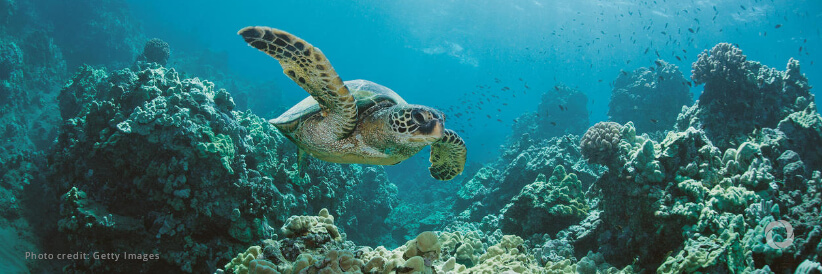
Many ocean areas play a key role for important species of sharks, tuna, whales, and sea turtles, and support billions of dollars annually in economic activity. As WWF outlined in its “Reviving the Ocean Economy” report, the goods and services that flow from the ocean and coasts are worth at least US$2.5 trillion each year, and the overall value of the ocean as an asset is 10 times that.
The ocean also faces new potential threats such as deep seabed mining, a nascent industry with the potential to cause irreparable harm to fragile deep-sea ecosystems. WWF is supporting global calls for a moratorium on deep seabed mining. WWF believes a nature-positive future for the ocean can be forged by using proven approaches and tools that allow marine ecosystems to recover over time such as targeted species conservation efforts, science-based fisheries management, community-led coastal conservation, and marine protected and conserved areas.