Financing clean energy in the developing world: A path to tackling energy poverty
By Juliet MacDowell • Mar 23, 2023Overcoming Energy Poverty in Developing Countries
In many developing nations, where 840 million people lack access to electricity and 2 billion lack clean cooking fuels, energy poverty is a recurring problem. Blackouts and fuel insecurity have negative effects on various industries, including small companies, agriculture, and education as well as information access. For example, blackouts alone cause around 2% of the annual GDP of sub-Saharan African countries to be lost. Increasing the availability of renewable energy is essential to eradicating poverty and advancing sustainable development.
The Economic Costs of Energy Poverty
Energy poverty has enormous economic costs and inhibits growth in important industries, including agriculture, education, and small companies. Many communities lack access to the information and other resources required for economic development when modern energy sources are unavailable.
Clean Energy: The Solution to Energy Poverty
According to the United Nations, the solution lies in clean energy, not just in providing access to this but also in avoiding the negative health and environmental impacts of traditional and polluting energy sources. Clean energy can reduce indoor air pollution and its associated health risks, particularly for women and children exposed to household air pollution.
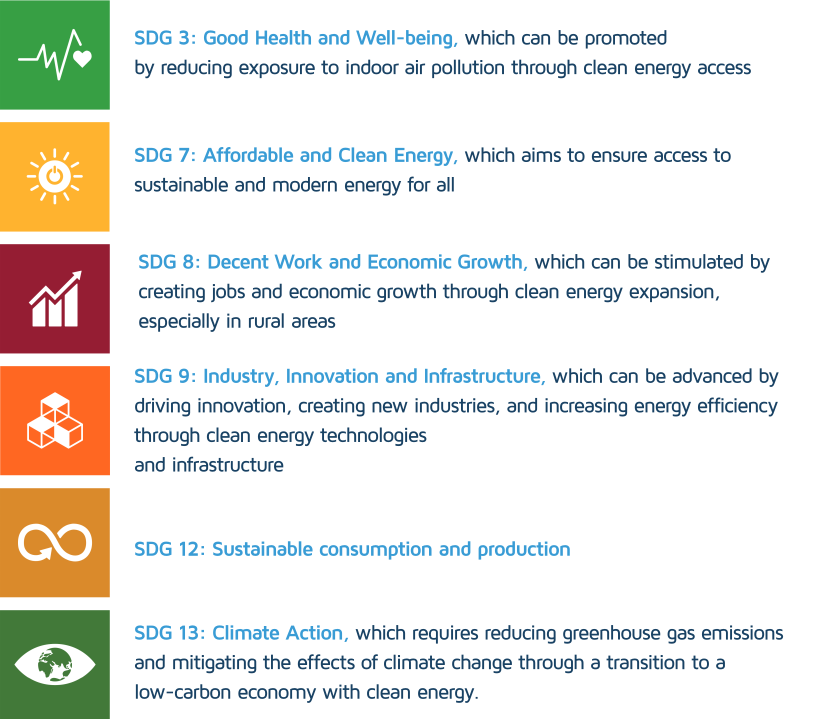
Moreover, clean energy is essential to achieving at least 6 of the United Nations’ 17 Sustainable Development Goals (SDGs).
Clean energy is essential to achieve some of the SDGs:
Financing Clean Energy for Development
Providing universal access to electricity and increasing the share of renewable energy in the world’s energy mix requires colossal investment. The UN and the International Energy Agency estimate that a yearly expenditure ranging from US$50 billion to US$150 billion is needed to achieve these challenging goals. Clean energy has the potential to significantly improve the lives of millions of people in developing nations with the appropriate funding and assistance which international institutions like the World Bank, private investment, the governments of poor nations, carbon markets, and foreign aid could finance.
Key Donors to Clean Energy in Developing Countries
There are several key donors to clean energy in developing countries. The Asian Development Bank, the European Union, the International Finance Corporation, the United Nations Development Programme, and the World Bank Group are just a few of the major multilateral donors to sustainable energy in developing nations. Government funders, such as AFD, DANIDA, FCDO, RVO, NORAD, SDC, SIDA, and USAID, also support clean energy initiatives which are also financed by foundations such as the Rockefeller Foundation, the Bezos Earth Fund, and the Bill & Melinda Gates Foundation.
Additionally, the Sustainable Energy Fund for Africa (SEFA), run by the African Development Bank, offers technical support and catalytic financing to encourage private sector investment in energy efficiency and renewable energy sources. Green Baseload (GBL), Green Mini-Grids (GMG), and Energy Efficiency (EE) are three strategic goals that SEFA supports.
If you are an NGO striving to secure financial support for clean energy projects, the following list of organizations that offer funding and resources for clean energy initiatives may be useful to explore potential opportunities that align with your goals and values.
Multilateral Donors:
- Asian Development Bank – funding and technical assistance for clean energy initiatives in Asia and Pacific
- European Union – funding for clean energy projects across Europe through programs such as Horizon 2020 and NER300
- International Finance Corporation – invests in renewable energy projects and energy-efficient practices
- United Nations Development Programme – funding and support for clean energy, including renewable energy and energy efficiency in developing countries
- World Bank Group – financing and technical assistance for clean energy projects, including renewable energy and energy efficiency, in developing countries
Government Donors:
- AFD – French Development Agency
- DANIDA – Danish International Development Agency
- Netherlands Enterprise Agency (RVO)
- NORAD – Norwegian Agency for Development Cooperation
- SDC – Swiss Agency for Development and Cooperation
- SIDA – Swedish International Development Cooperation Agency
- USAID – US Agency for International Development
Foundations:
- Bill & Melinda Gates Foundation – funding for clean energy initiatives in developing countries
- Bezos Earth Fund – funding for clean energy initiatives to reduce carbon emissions
- The Chan Zuckerberg Initiative – funding for clean energy initiatives
- Bloomberg Philanthropies – funding for clean energy initiatives as part of its broader mission to address global challenges related to public health, the environment, and social justice.
- Crankstart Foundation – funding for clean energy projects in developing countries
- Gordon and Betty Moore Foundation – Provides funding for clean energy initiatives as part of its broader mission to promote environmental conservation and scientific research.
- Ikea Foundation – funding for clean energy projects in developing countries
- McKnight Foundation – Provides funding for clean energy initiatives as part of its broader mission to promote social, economic, and environmental sustainability.
- Rockefeller Foundation – Provides funding for clean energy initiatives with a focus on helping cities transition to low-carbon energy and build resilience to climate change.
- Sea Change Foundation – Provides funding for clean energy initiatives in developing countries and other climate-related advocacy work.
Conclusion: The Path to a Clean Energy Future in the Developing World
By 2030, a US$150 billion annual investment will be required to guarantee that everyone has access to power and to quadruple the share of renewable energy in the world’s energy mix. Governments of developing countries, carbon markets, private investment, international aid, and international organizations like the World Bank can all help to finance renewable energy. With proper funding and assistance, the lives of millions of people in developing nations could be significantly improved by renewable energy.
References:
- International Energy Agency (2019). Energy Access Outlook 2019.
- United Nations (2015). Sustainable Development Goals.
- United Nations Development Programme (2021). Energy Access.
- World Bank Group (2021). Energy Access and Renewables.
- International Renewable Energy Agency (2021). Renewable Energy Statistics 2021.
- The Climate Group (2021). Energy Poverty and Climate Change.
- United Nations Environment Programme (2021). The State of Sustainable Energy Access.
- United Nations Framework Convention on Climate Change (2021). Financing Clean Energy in Developing Countries.
- Energy for All Partnership (2021). Energy Poverty and Economic Development.
- The Global Alliance for Clean Cookstoves (2021). Household Energy and Health.