

Add us as your preferred source on Google to see more of our content in Search.
 Add to Preferred Sources
UN forced to make ‘appalling choice’ following the ban on women nationals, protection from climate change requires strong health systems and supporting the winterization response in Ukraine. Here is what you missed from last week’s headlines in the international development sector.
Afghanistan: UN forced to make ‘appalling choice’ following ban on women nationals
The UN has launched an operational review in Afghanistan and told national staff to remain at home, following the decision by the Taliban de facto authorities to ban Afghan women from working with the Organization.
“UN national personnel – women and men – have been instructed not to report to UN offices, with only limited and calibrated exceptions made for critical tasks,” according to a statement issued by its office in Afghanistan.
The ban is the latest in a series of discriminatory measures that restrict Afghan women and girls from participating in most areas of public and daily life, implemented in the wake of the Taliban’s return to power in August 2021.
Protection from climate change requires strong health systems
The health impacts of climate change will not be addressed without strong public health systems. To mark World Health Day the joint WMO–WHO Office on Climate and Health took a look at the role of universal healthcare systems in protecting people from the myriad of growing health risks tied to the changing environment.
A community health center becomes flooded and loses power during a severe storm and is unable to provide essential obstetrics care and treat the injured people showing up for help. An agriculture worker experiences heat stroke but is unable to receive life-saving medical treatment without access to health insurance and ambulatory care. A national health system overwhelmed by a cholera outbreak following a flood finds the little capacity to focus on other health crises.
These scenarios are just a few examples of the wide range of impacts the health sector faces as it increasingly grapples with extreme weather, disease epidemics, displacements, economic downturns, and infrastructure failures driven by climate change. When these shocks occur, critical services can be hindered just as people need them most – compounding risk and resulting in more illness and lives lost.
Supporting the winterization response in Ukraine
With the government of Japan and local partners, UNOPS is supporting people in Ukraine’s Kharkiv Region, who are especially vulnerable to the ongoing conflict amid a cold winter. The escalation of conflict in Ukraine has brought massive devastation in urban centers. The widescale loss of vital infrastructure, including residential buildings and energy networks, has severely disrupted critical public services and left millions of people in crisis – a situation made even direr by the freezing winter temperatures.
“At this critical time for the country, we are working closely with the government of Ukraine, both on national and local levels, to help accelerate winterization, and prepare for early recovery and reconstruction,” said Jens Wandel, UNOPS Acting Executive Director.
”We focus on urgent humanitarian assistance and strengthening the civilian resilience of the Ukrainian people. We will continue to support in the form of generators and other emergency supplies for winterization”, said H.E. Mr. Matsuda Kuninori – Ambassador of Japan to Ukraine
According to Ukrainian authorities, the Kharkiv region has seen the second-highest levels of destruction to civilian infrastructure, accounting for approximately 23 per cent of the total damage in Ukraine.
DevelopmentAid Editorials
Main reasons aid donors blacklist companies in international development
It is essential for aid donors to combat scams, fraud, corruption, and other forms of misdemeanors to achieve the best value for money through their procurements processes which can help aid donors attain socioeconomic growth and tackle poverty.
Donors anticipate that their money will be spent wisely and ethically in order to further their goals. However, corruption, fraud, and scams involving aid funds can lead to money being misappropriated and ending up in the hands of corrupt people or organizations. This can lead to a reduction in funding for vital community-beneficial initiatives and services and therefore reduce the effect of aid.
Read the full article.
Could vertical farming be the solution to halt climate change and end world hunger? | Experts’ Opinions
Given that the pandemic and drought have affected crop farming, food production and main distribution chains, specialists have turned their attention to other, less resource-consuming methods and shorter value chains. One of those methods is the concept of indoor vertical farming which is possible today thanks to advanced technologies. Vertical indoor farms offer multiple advantages, including the limited space required – often in urban premises – and also absolute control over the factors that influence plant development, such as light and water. In this context, many wonder if vertical farming could become one of the solutions that can put climate change on pause and end world hunger. Let’s see what international agricultural experts think in this regard.
Key Takeaways:
- Vertical farming aims to be significantly more efficient and sustainable than traditional farming
- In vertical farms, pesticides are not used during production. The necessary nutrition for the plants is provided by means of the nutrient substrate or directly from water enriched with nutrients.
- According to Grand View Research, the global vertical farming market is expected to grow from US$5.37 billion in 2021 to US$33.02 billion by 2030.
- However, agricultural experts are skeptical whether vertical farming has the power to fight climate change or end world hunger.
Read the full article.
Here’s what else has happened
ADB, GEAPP: The Asian Development Bank (ADB) joined the Global Energy Alliance for People and Planet (GEAPP) to announce $35 million to help boost energy access and the energy transition in South and Southeast Asia.
Gavi: Gavi, the Vaccine Alliance (Gavi) has launched the Zero-Dose Learning Hub (ZDLH), a new mechanism to improve how data and evidence are leveraged to successfully identify and reach the millions of children who have not yet received a single routine vaccine shot – “zero-dose” children – and the missed communities in which they live.
INTERPOL and UNICEF: INTERPOL Secretary General Jürgen Stock and UNICEF Executive Director Catherine Russell have signed an agreement of cooperation that will support national governments around the world to prevent and address online child sexual exploitation and abuse and other child protection issues.
Japan: The United Nations World Food Programme (WFP) has welcomed a US$ 1.5 million contribution from the Government of Japan to provide emergency food and nutrition assistance to more than 52,000 people affected by the conflict in northern Mozambique.
Yemen: Talks between Saudi and Omani delegations with officials from the Houthi rebel movement in Yemen’s capital Sana’a were described as “a welcome step towards the de-escalation of tensions”, by the UN Spokesperson.
Reports
For every $1 the IMF encouraged a set of poor countries to spend on public goods, it has told them to cut four times more through austerity measures
An important International Monetary Fund (IMF) initiative to shore up poor people in the Global South from the worst effects of its own austerity measures and the global economic crisis is in tatters.
A new analysis by Oxfam finds that the IMF’s ‘Social Spending Floors’ —targets designed to help borrowing governments protect minimum levels of social spending— are proving largely powerless against its own austerity policies that instead force countries to cut public funding.
The IMF’s ‘Social Spending Floors’ encouraged raising inflation-adjusted social spending by about $1 billion over the second year of its loan programs compared to the first year, across the 13 countries that participated where data is available. By comparison, the IMF’s austerity drive has required most of those same governments to rip away over $5 billion worth of state spending over the same period.
Women’s equality in agrifood systems could boost the global economy by $1 trillion, reduce food insecurity by 45 million: new FAO report
Tackling gender inequalities in agrifood systems and empowering women reduces hunger, boosts the economy, and reinforces resilience to shocks like climate change and the COVID-19 pandemic, reveals a new report by the Food and Agriculture Organization of the United Nations (FAO).
The status of women in agrifood Systems report, the first of its kind since 2010, goes beyond agriculture to provide a comprehensive picture of the status of women working across agrifood systems— from production to distribution and consumption.
A Triple Dividend: Fully financing the HIV response in Africa
Research and analysis by Economist Impact, conducted across 13 African countries, demonstrates that fully financing the HIV response will save millions of lives and would produce substantial health, social and economic gains. Not only would there be between 40% and 90% fewer new HIV infections, depending on the country, but investing in the HIV epidemic would also enhance educational outcomes, especially for young women and girls, reduce gender inequalities and boost economic growth.
The report, A Triple Dividend: The Health, Social and Economic Gains from Financing the HIV Response in Africa, demonstrates that failing to mobilize the required funding to end AIDS as a public health threat by 2030 has substantial health, social and economic costs.
Events
Doing Business with AfDB: Latest Updates on Procurement Policy | Webinar

📅 4 May 2023 at 10 am (Brussels)/4 pm (Beijing)
DevelopmentAid, in collaboration with the AfDB, invites you to attend the webinar on “Doing Business with AfDB: Latest Updates on Procurement Policy” which will take place on 4 May 2023 at 10 am (Brussels)/4 pm (Beijing).
Key takeaways
- Get to know the AfDB and its mission
- Learn about AfDB’s portfolio and operations
- Discover the specifics of the AfDB’s procurement policy
- Understand how to properly prepare for upcoming bids
Speaker
Ashraf Ayad, Lead Procurement Policy Officer at the African Development Bank.
Ashraf has over 24 years of experience in procurement and project management as a result of his involvement in many development projects in Africa and the Middle East. He has a thorough understanding of the procurement policies of international development institutions e.g., the AfDB, WB, IsDB, and the EU.
Host
Elizaveta Gładun, External Relations & Events Coordinator at DevelopmentAid
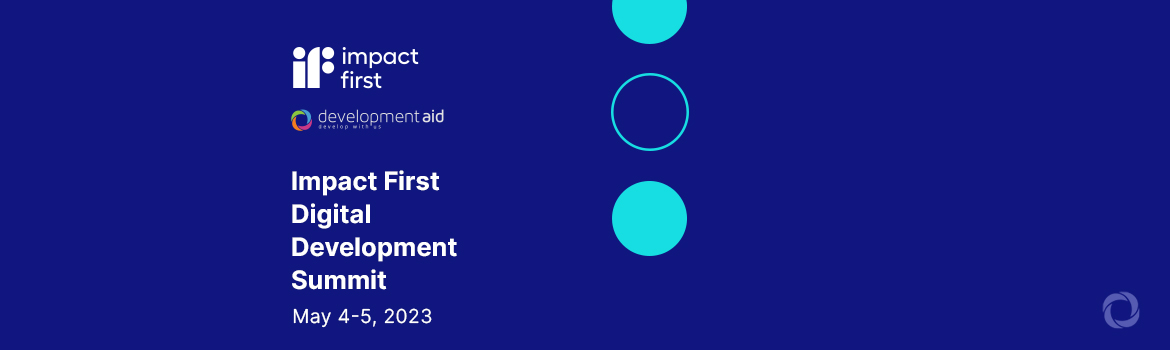
Impact First Digital Development Summit
📅 4-5 May 2023
Centro Cultural de Belém, Lisbon
The Impact First Summit, hosted by BAO Systems, will take place from May 4-5, 2023 in Lisbon, Portugal and is a global event that brings together speakers and organizations from the global health and development sector where together we explore the possibilities of achieving impact through technology and data innovations.
We believe digital technology is core to the future of the development sector, capable of improving development outcomes, driving economic growth, and lifting millions out of poverty. The rapidly changing data and technology landscape means that we have more information, evidence and insights than ever before, but efforts must be coordinated to ensure all countries have the tools, knowledge, and resources to use information effectively. By understanding the broad application of technologies across agriculture, health, education, governance, and environmental sectors, we can make meaningful gains.
The summit is designed to provide a forum for participants to engage in meaningful discussions, share ideas, and explore new opportunities to collaborate and make a positive difference in the world.
The Summit will feature plenary and breakout sessions, panel discussions, exhibitor tables, and networking opportunities. The venue offers excellent spaces for presentations, networking, and in-depth discussions, not to mention the scenic location by the waterfront in Lisbon. Join us as we spend two days discussing cutting-edge technologies and approaches to address the world´s most pressing development challenges.
If you are passionate about creating impact, whether you are an established leader, entrepreneur, investor, or simply interested in learning more about the field, then the Impact First Summit in Lisbon is an ideal event for you to attend. Join these organizations and more.
Who should attend
- Social entrepreneurs who are creating innovative solutions to social and environmental problems.
- Investors who are interested in supporting impact-driven businesses and initiatives.
- Business leaders who want to integrate sustainability and impact into their corporate strategies.
- Government officials and policy makers who are working to create a more sustainable and equitable future.
- Academics and researchers who are studying impact-driven approaches and solutions.
- Non-profit organizations and activists who are working towards social and environmental justice
The discount code DevelopmentAid gives a $150 discount, making the ticket cost $500.