

Add us as your preferred source on Google to see more of our content in Search.
 Add to Preferred Sources
Human immunodeficiency virus, HIV, targets cells that assist the human body’s ability to fight off infection, thus weakening the resistance of the immune system. HIV can cause acquired immunodeficiency syndrome, AIDS, if not properly treated. This means that a person is vulnerable to numerous fatal diseases and disorders.
What do we know about HIV treatment?
Antiretroviral therapy (ART) is a highly effective treatment for HIV that involves adhering to a prescribed medication regimen under the guidance of a healthcare provider.
When taken consistently and as directed, ART can suppress the viral load in the body to undetectable levels, meaning that the virus is no longer detectable by standard tests.
ART is available in two main forms: oral pills and long-acting injectable treatments.
- Pills are typically recommended for individuals at the initial stage of HIV treatment.
- Depending on the treatment plan, long-acting injections may be administered either monthly or bi-monthly, providing an alternative to daily oral medication.
Currently, there is no HIV treatment that completely cures the condition which means that if someone has HIV, it will remain in the body for that person’s entire life. However, the majority of HIV-positive people can live long, healthy lives thanks to extremely effective pharmaceutical treatments.
Global HIV statistics
Source: WHO
Significant progress in reducing HIV infections recorded, but challenges remain
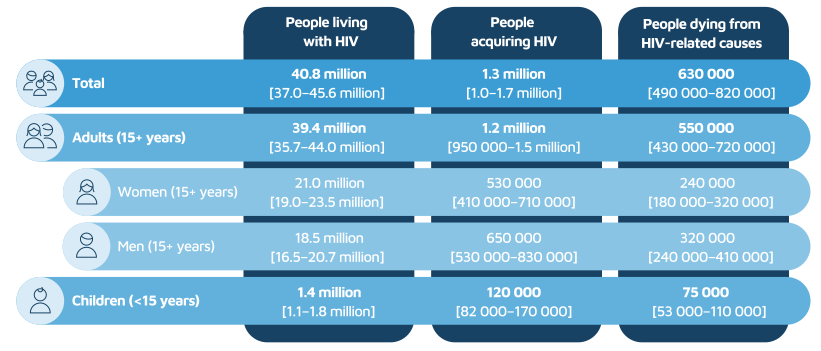
Based on the latest data from the World Health Organization, approximately 40.8 million HIV-infected people had been registered by the end of 2024:
- 1.4 million is the number of children living with HIV (0-14 years old)
- 39.4 million is the number of people living with HIV and aged 15+
- On average, 87% [69 – 98%] of HIV-positive people were aware of their status
- Nearly 73% [66 – 82%] of people who have HIV had suppressed viral loads. This means that the ART suppresses the virus in the human body to a very low level, which is vital for a person’s health, as well as for avoiding transmission
HIV in 2024 and HIV in 2010: What has changed?
- WHO outlines that there were 27% more people living with HIV in 2024 than in 2010.
- The annual number of new HIV infections dropped by 40%.
- The annual number of HIV-related deaths dropped by 54%.
At the same time, the share of people who undergo testing, treatment, and viral load suppression registered a considerable increase:
- In 2010, the number of new registered HIV infections was around 2.2 million, and the 2024 figures show this has reduced by 40%.
- The number of those who acquired HIV also decreased to 0.16 per 1000 uninfected population, in contrast to 0.32 in 2010.
- In 2010, the average number of fatalities from AIDS-related illnesses around the world was 1.4 million, and in 2024, this decreased to 630,000.
People with HIV who received antiretroviral therapy
The data for 2024 shows that 31.6 million, or 77% [62 – 90%] of HIV-positive people were undergoing antiretroviral therapy:
- 55% [40 – 73%] were children
- 78% [62 – 91%] were adults
Share of people with HIV by region (2024)
Source: WHO
To meet the 95-95-95 objective for testing, treatment, and viral suppression, another 3.2 million people living with HIV must be aware of their HIV status.
Source: WHO
In its report, the World Health Organization explained that cuts to foreign assistance can potentially undo years of progress. Namely, between 2025 and 2029, the number of HIV-related deaths could increase by 4 million from the 630,000 registered in 2024, while the number of new infections could exceed 6 million.
HIV infections among women and girls
In 2023, of all new HIV infections, 44% was attributed to women and girls, according to UNAIDS.
In terms of the AIDS-related mortality rate, since 2010, this has fallen by 58% among women and girls whereas among males, this figure has declined by 50%.
At the same time, some concerning data has been provided by UNAIDS regarding sub-Saharan Africa, where experts have observed a 62% rise in new infections among women and girls.
UNAIDS also outlines that women and girls of every generation make up 63% of all new HIV infections in the same African regions.
On a global scale, around 4,000 weekly HIV infections were registered among females aged 15 to 24, with most – 3,300 – occurring in sub-Saharan Africa.
The lives of more than 18 million HIV-infected people were saved between 2000 and 2021 thanks to ART. In addition, the treatment formula led to a 39% drop in new HIV infections and a staggering 51% decrease in fatalities linked with the virus.

HIV statistics in 2024 by region (based on data from the WHO)
In 2023, advances towards meeting the 95-95-95 objectives for HIV testing, treatment, and viral suppression varied. These targets are defined as:
- 95% living with HIV (PL-HIV) should be diagnosed
- 95% of those diagnosed should be receiving ART
- 95% of those receiving ART should achieve viral suppression.
The latest WHO data (as of 2024) shows that the global figures are currently at: 87-77-73.
The estimated total of HIV-related fatalities, all ages, 2010, 2023, 2024
The estimated total of people with HIV, all ages, 2010,2023, 2024
HIV in the African Region (2024)

- The number of newly infected people in this region registered a decrease from 1.7 [1.3–2.3] per 1,000 uninfected in 2010 to around 0.53 [0.4–0.71] in 2024.
- The number of annual fatalities linked to HIV also decreased drastically by 59%, reaching a total of 380,000 [310,000–490,000].
HIV in South-East Asia (2024)

- This region has witnessed a decrease in the number of newly infected, from 0.11 [<0.1–0.16] per 1000 uninfected in 2010 to <0.1 [<0.1–<0.1] in 2024.
- In addition, the number of deaths also decreased, showing a drop of 77% from 50,000 [32,000–76,000] deaths registered in 2010.
HIV in Europe

*In 2024, there was no publicly available information on the number of people diagnosed or virally suppressed due to a lack of the latest modelled estimations from several nations.
The data on newly infected cases has been taken from the WHO’s HIV/AIDS surveillance in Europe report.
- Europe remained at the same level in terms of newly infected people in both 2010 and 2024, namely 0.17 [0.14–0.19] per 1000 uninfected.
- The annual number of people who fell victim to the illness increased by 37%, reaching 51,000 [39,000–62,000].
HIV in the Americas (2024)

- A slight decrease in the number of people acquiring HIV was registered in the Americas. The figures dropped to 0.16 [0.13–0.21] per 1,000 uninfected population from 0.18 [0.15–0.23] in 2010.
- Other positive news is the decrease by 41% of the number of HIV-related deaths, which in 2024 was 38,000 [28,000–50,000].
HIV in the Eastern Mediterranean Region (2024)

- The level of the HIV-infected population in the region remained unchanged between 2010 and 2024 – <0.1 [<0.1–0.12] per 1000 uninfected.
- At the same time, the number of fatalities linked to HIV sky-rocketed noticeably from 2010, namely by 88%, reaching a figure of 23,000 [18,000–31,000].
HIV in the Western Pacific Region (2024)

- The number of newly infected people in the region did not change from 2010 to 2024, remaining at <0.1 [<0.1–<0.1] per 1000 uninfected population
- The number of HIV-related fatalities showed a slight drop of 8%, reaching 83,000 [66,000–100,000] deaths.
Top 10 countries with the highest rates of new HIV infections globally (2024)
Sub-Saharan Africa exhibits the highest rates of HIV globally, with Eswatini, South Africa, and Lesotho leading in the number of adults infected with the virus, according to 2024 data from the World Bank.
HIV prevalence (% of population ages 15-49)
 Eswatini
In Eswatini, HIV is the major cause of death, affecting around 23.4% of the population based on the WB data, although according to Doctors Without Borders, this figure is as high as 25%.
Around 30% of women between 15 and 49 are infected with HIV, and social stigma exacerbates the issue, which leads to low uptake of the oral PrEP* with just 11% of eligible individuals taking it.
*Pre-exposure prophylaxis (PrEP) – refers to a pill taken daily by HIV-negative people to avoid HIV acquisition.
The data from UNAIDS shows that there are 220,000 people in a country of 1.2 million living with HIV, but the good news is that the coverage of people receiving ART is 94%.
Although the country has made significant progress regarding the issue (in the period 2011-2016 the rate of newly-infected citizens was cut by half), HIV remains a key problem.
Together with various organizations, the government is attempting to tackle the issue by increasing access to HIV testing and subsequent treatment. It is of note that those most affected are sex workers, with over 60.5% being HIV-positive.
 South Africa
According to Spotlight – a prominent health-journalism media outlet in South Africa – the number of HIV-positive individuals has for the first time reached 8 million people (around 12.8% of the country’s population), with roughly 6.2 million being on treatment.
Latest estimations showed:
- 178,000 new HIV infections (from mid-2023 to mid-2024)
- Around 105,000 HIV-positive people died of which 53,000 as a result of HIV-related causes.
- 95% of people with HIV were aware of their status in 2024
- 78% were on ART
- 92% of people who were on treatment had viral suppression
More people are undergoing ART, which has increased life expectancy, and more people with HIV are beginning to live longer lives.
 Lesotho
Around 270,000 individuals in this nation of 2.3 – 2.4 million people are living with HIV, according to Lesotho’s National HIV Estimates report of July 2024.
HIV prevalence among adults is 17.1% according to the WB data, while data from the report shows a figure of 18.5%, the second-highest in the world.
Based on the National HIV estimates Report, 4,800 new HIV infections were registered in 2023, which represents a 6% decline from 2022, and a decrease of over 60% compared to the 2004 peak, when this figure hit 24,500.
For the fiscal year 2024-2025, the Government of Lesotho has dedicated 233 million Maloti (about US$15 million) for ART procurement, confirming the nation’s commitment to tackling the HIV-related issue.
Final word
To safeguard our well-being and reduce the stigma associated with HIV and AIDS, it is essential to carry out awareness-raising activities around the globe. Moreover, increased accessibility to diagnosis and treatment (especially in the most vulnerable nations) is crucial to decreasing the rate of AIDS-related deaths.