

Add us as your preferred source on Google to see more of our content in Search.
 Add to Preferred Sources
Millions more children face hunger as Black Sea Grain corridor not renewed, heatwaves highlight importance of health early warnings and action plans, and €12 million EU partnership agreement to support marginalised communities in Afghanistan. Here is what you missed from last week’s headlines in the international development sector.
Millions more children face hunger as Black Sea Grain corridor not renewed
Failure to renew the Black Sea Grain Initiative means millions more children around the world will face devastating hunger, Save the Children said. Signed in July 2022, the deal opened up export routes from Ukraine that had been frozen when the war escalated in February of that year.
The initiative enabled nearly 33 million tons of grain and food staples to move via Black Sea ports to 45 countries, with developing nations receiving the largest share of food exports. It helped bring down food prices, stabilized the market, and put supplies on the tables of the most vulnerable children.
“Failure to renew the Black Sea Initiative today is a huge, life-threatening blow to vulnerable children living in countries in Africa and the Middle East who rely on grain staples. The grain deal was a lifeline to millions of boys and girls facing devastating hunger. Not renewing this initiative will prove catastrophic for children around the world and cost thousands of lives,” said Nana Ndeda, Humanitarian Advocacy and Policy Lead, Save the Children.
Heatwaves highlight importance of health early warnings and action plans
The World Meteorological Organization is stepping up efforts to strengthen heat-health early warnings and integrated action plans for heatwaves, which are among the deadliest natural hazards. Heat is a rapidly growing health risk, due to burgeoning urbanization, an increase in high-temperature extremes, and demographic changes in countries with aging populations. Hundreds of thousands of people die from preventable heat-related causes each year.
Global temperatures have been at unprecedented levels for several weeks. The extensive and intense heatwaves this year are alarming, but not surprising because unfortunately, the conditions being observed are in accordance with projections from the Intergovernmental Panel on Climate Change.
The impacts on people, economies, and the natural and built environment are serious.
€12 million EU partnership agreement to support marginalised communities in Afghanistan
The Aga Khan Foundation (AKF) has signed a €12m partnership agreement with the European Union in Afghanistan. This will support vulnerable people to meet their basic needs and build resilience by safeguarding vulnerable livelihoods and improving economic opportunities.
Support includes assistance to ensure sustainable food production, climate-smart agriculture and resilient infrastructure, community-based employment, income-generation and savings opportunities, and market-oriented business development. The work will directly benefit over 70,000 individuals (of which 62 percent are women) and close to 500,000 household members across seven provinces in rural, underserved areas.
“This project will support efforts to safeguard the livelihoods of some of the most marginalized communities in Afghanistan and build their resilience to external shocks and stressors. The funding will directly contribute to improved food and income security for vulnerable households, and promote their self-reliance”, said Dr Najmuddin Najm, CEO of AKF Afghanistan.
DevelopmentAid Editorials
South Korea launches “K-Rice Belt” initiative with 8 African countries
On July 10, 2023, South Korea’s Ministry of Agriculture, Food, and Rural Affairs signed a memorandum of understanding (MOU) with eight African nations to launch a brand-new project to improve rice yields in those countries, known as the “K-Rice Belt Initiative.”
The new initiative is part of Seoul’s official development assistance (ODA) and is designed to help African nations build irrigation systems and provide technical assistance and equipment to improve rice cultivation and distribution in Cameroon, The Gambia, Ghana, Guinea (Bissau), Kenya, Senegal, and Uganda.
“Our goal is to help each partner nation better meet their needs and to achieve tangible results. The K-Belt Rice Initiative goes beyond donating food aid, as we seek to help them grow crops on their own,” said Chung Hwang-keun, the South Korean Minister of Agriculture, Food, and Rural Affairs, at the launch of the new initiative.
Russia withdraws from the Black Sea grain deal after an explosion on the Crimea bridge
A few hours after the June 16th explosion on the bridge connecting Russia with occupied Crimea, the Kremlin announced the termination of the year-old U.N.-mediated agreement that allows Ukraine to transport grain across the Black Sea. At the same time, the country’s foreign ministry said the explosion had nothing to do with the withdrawal from the grain deal.
Moscow has stated that the main reason for announcing the cessation of the agreement was the failure to loosen constraints on Russian exports of food and fertilizer.
The Black Sea Grain Deal participants – the United Nations, Turkey, and Ukraine – have all been informed by Russia’s foreign ministry that the deal will cease on Monday, July 17.
Britain announces bold plan to increase ODA spending in 2024
The UK’s Foreign, Commonwealth, and Development Office (FCDO), in its annual report, announced bold plans to dramatically increase Official Development Assistance (ODA) spend in 2024 on a number of countries and sectors. After three years of drastic cuts to its overseas aid budget, Britain’s new proposals will see the country spend a projected £8.3 billion on both multilateral and bilateral aid, compared to £7.4 billion this year and just £6.9 billion in 2022.
The proposed increase was announced by Andrew Mitchell, the Minister of State for Development and Africa, who said that he was “confident” in the figures because of expected economic growth in Britain and planned cuts in spending on housing and feeding refugees.
“Because we managed to exert that control over the budget, the figures [on ODA spend] for next year are up very sharply,” said Mitchell.
Here’s what else has happened
UNDP: Over the past three years, poverty rates in poor countries have surged, with the number of additional individuals living on less than $3.65-a-day reaching 165 million by 2023 according to a new policy brief from the United Nations Development Programme (UNDP), titled “The Human Cost of Inaction: Poverty, Social Protection and Debt Servicing, 2020–2023”.
USAID: United States, through its Agriculture Resilience Initiative-Ukraine (AGRI-Ukraine), is providing an additional $250 million to support Ukraine’s agriculture sector that has been battered by Russia’s aggression. This brings the U.S. government’s total investment in the AGRI-Ukraine initiative to $350 million.
IFAD: The partnership between the Government of Brazil and the UN International Fund for Agricultural Development (IFAD) aims to achieve unprecedented levels of results in the coming years to transform the lives of people living in rural areas.
FAO: The Food and Agriculture Organization of the United Nations (FAO) has launched an Action Plan designed to support the implementation of its ambitious Strategy on Climate Change 2022-2031. The Strategy, which was endorsed in June 2022 by FAO’s executive body, the Council, envisages agrifood systems as sustainable, inclusive, resilient, and adaptive to climate change.
UNFPA and UNICEF: UNICEF and UNFPA, the UN sexual and reproductive health agency, welcome the commitment of CA $35 million by the Government of Canada to support the third phase of the Global Programme to End Child Marriage until 2030.
Reports
Less than 1 percent of women and girls live in a country with high women’s empowerment and high gender parity
No country has achieved full gender parity and fewer than 1 percent of women and girls live in a country with high women’s empowerment and a small gender gap, according to a new global report launched by UN Women and UNDP at the Women Deliver Conference. The report provides—for the first time—a more comprehensive picture of progress in women and girls’ human development.
Closer dialogue between producers and consumers needed to ensure security of gas supply
Tensions in gas markets have eased significantly since the beginning of 2023, according to the latest edition of the IEA’s annual Global Gas Security Review. Yet the new analysis notes that deeper coordination among market participants remains essential, given momentous shifts in how gas markets function.
AIIB issues new impact report demonstrating the bank’s commitment to climate financing
Since its establishment in 2016, the Asian Infrastructure Investment Bank (AIIB) has been committed to promoting sustainable infrastructure development and sustainable development finance. With the issuance of the latest edition of its annual Sustainable Development Bonds Impact Report, AIIB demonstrates how its financing supports economic development in Asia and beyond.
Events
GCF Regional Dialogue with Latin America and Workshop for Direct Access Entities in Latin America and the Caribbean
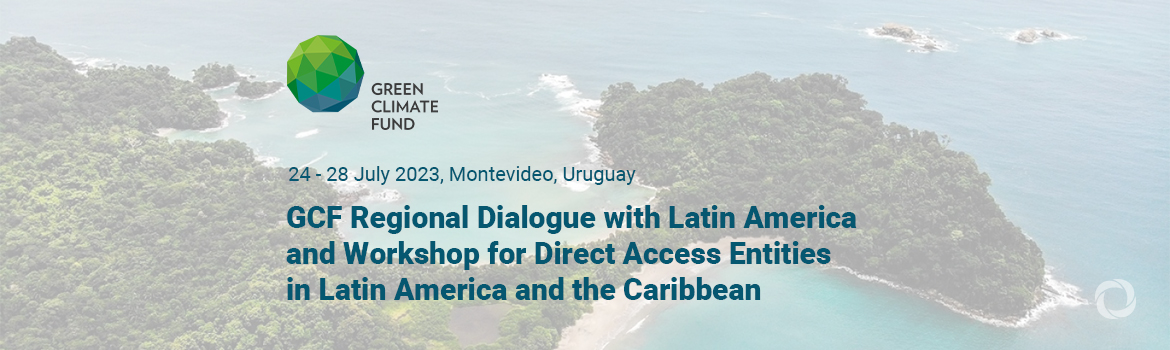
📅 24 – 28 July 2023
Montevideo, Uruguay
The GCF Regional Dialogue with Latin America is scheduled to be held from 24-26 July. This will be followed by the GCF Workshop for Direct Access Entities (DAEs) in Latin America and the Caribbean, which is scheduled for 27-28 July. Both events will be held in Montevideo, Uruguay.