Almost 70 countries face severe ecological threats, half of them in Africa - report
By Sam Ursu • Nov 08, 2023A total of 66 countries are now facing at least one severe ecological threat and 30 “hotspot” countries are classified as extremely vulnerable, according to the 2023 Ecological Threat Report. The document, published by the Institute for Economics and Peace (IEP) on November 1, 2023, also pinpointed that 19 of the “hotspot” countries are in sub-Saharan Africa, with Ethiopia, Niger, Somalia, and South Sudan topping the list of at-risk countries. Only Europe and North America were classified as not being at risk for ecological threats.
More than 1.8 billion people are now living in an area facing a severe ecological threat, with the number expected to rise to 2.8 billion people by 2050, according to the 2023 Ecological Threat Report. The document published also pinpointed that 2 billion people currently do not have access to safe drinking water, and nearly 4 billion people live in an area that is experiencing high or severe food insecurity.
“Without concerted international action, current levels of ecological degradation will substantially worsen, thereby intensify a range of issues such as malnutrition and forced migration, and many of the current conflicts will escalate and multiply, creating future global insecurity,” said Steve Killelea, the founder of IEP.
Key findings
A number of worrying statistics were revealed in this year’s Ecological Threat Report, including:
- 38% of all subnational administrative areas globally are facing at least one severe ecological threat.
- 103 sub-national administrative areas (home to 217 million people) are facing a severe ecological threat.
- 1.8 billion people live in an area facing at least one severe ecological threat.
- 66 countries have at least one severe ecological threat.
- In the Asia-Pacific region, two countries are classified as hotspots along with five in the Middle East and North Africa (MENA) region and 19 in sub-Saharan Africa.
- 69 million people living in just four subnational administrative areas in Ethiopia and Niger are facing severe threats across four dimensions.
- Food prices are 33% higher now than in 2016, thus exacerbating global food insecurity.
- 42 countries currently struggle with severe food insecurity, of which 35 are in sub-Saharan Africa.
- A total of 77 countries have an elevated risk of inadequate access to clean drinking water.
- 44 countries are facing the double threat of a high risk of a natural disaster and low resilience to cope with one.
- Over 40% of the regions of the world are expected to record a population growth of at least 20% between now and 2050.
- Food security is strongly linked to armed conflict as areas of high crop yields are often also areas of significant conflict.
- Conflict over global commons issues such as fisheries is expected to become increasingly common as well as conflicts over freshwater sharing.
- Currently, there are 33 megacities in the world. By 2050, it is projected that there will be at least 50, mostly in Africa and Asia.
- Of the 20 most polluted cities in the world, only three are not in India or China.
- The number of forcibly displaced people has increased 500% over the past 20 years.
The Ecological Threat Report examined data from 221 countries and territories, divided into 3,594 sub-national areas, covering 99.99% of the world’s population.
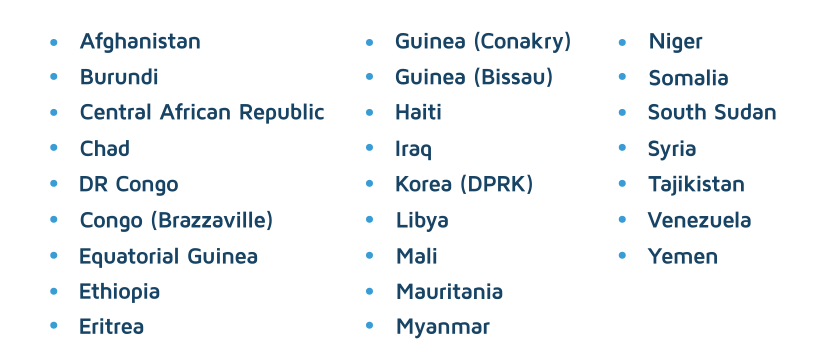
These are the 30 countries facing the biggest threats:
Policy recommendations
In order to try and reverse the worrying trends identified in the 2023 Ecological Threat Report, the authors offered a number of policy recommendations formulated after speaking with experts from development organizations, governments, think tanks, and military institutions:
- Building resilience must be a holistic affair that recognizes the connection between ecological change, sustainable development, human security, and global action.
- Stronger multilateral cooperation is required to address threats, and inclusion and input from non-state actors is important.
- The combined global budget of all international agencies is insufficient and must be amplified with funding from the private sector.
- Some solutions to ecological problems can generate money, so businesses need to be educated on how to garner a profitable return from ecological positive investments.
- Community cooperatives must be enlarged and strengthened.
- Community-led approaches to development lead to better program design, easier implementation, and more accurate evaluations.
- In creating systemic change, smaller “nudges” are more effective than large-scale interventions.
- Most governments, multilateral institutions, and other development organizations do not address their initiatives systematically, leading to unforeseen consequences and less successful outcomes.
The authors of the 2023 Ecological Threat Report have created their own in-house system to empower practitioners to build a more holistic systems picture of societal challenges called HALO. The HALO system breaks down the analysis of societal systems into 24 building blocks, allowing for an adaptive approach which can be tailored to accommodate the size of the societal system and the sophistication required in the analysis. The authors believe that widespread adoption of their HALO system will help governments, institutions, and communities build greater resilience.
The 2023 Ecological Threat Report also included several successful resilience-building programs for inspiration. These include building 30 sand dams (which collect water that can be used for agricultural purposes) in Kenya, installing chlorination dispensers at water collection points in Zomba, Malawi (which reduce the need to boil water), sustainably sourcing water via engineer wetlands in villages in the Dongjiang River Basin in China, the Farmer Managed Natural Regeneration (FMNR) developed by World Vision, and the Coffee Farmer Resilience Initiative (CFRI), which gives smallholder coffee farmers technical assistance on rehabilitation and climate-smart agricultural practices.
2023 marks the fourth year that the Institute for Economics and Peace (IEP) has published their Ecological Threat Report. The IEP is a think tank headquartered in Sydney, Australia, and also publishes a yearly Global Peace Index (GPI) which is collected and collated by the Economist Intelligence Unit, the research and analysis arm of The Economist Group.