


Add us as your preferred source on Google to see more of our content in Search.
 Add to Preferred Sources
Technological progress has had an enormous effect on work, jobs, and skills, as well as employment throughout the history of mankind. One of the more recent and most impactful examples is the 19th century’s Industrial Revolution when machines replaced many of the professions that had previously required manual labor. This was a pivotal moment in human history and one that fundamentally changed modern society.
Artificial Intelligence and machine learning, cloud computing, and cybersecurity – today, the pace of technological evolution is staggering, and its impact on employment has sparked strong debates and even greater concerns. New technologies bring fear that many people will be redundant, which is partly true.
In this article, we will dive into this complex topic and try to answer a number of questions regarding the impact of technology on employment, both positive and negative, and the overall future of work.
Previously, experts predicted that AI could potentially displace up to 300 million full-time jobs globally. Based on more recent estimates, however, the picture is a little more nuanced.
According to data from Goldman Sachs Research, if current AI use was extended across the entire U.S. economy, around 2.5% of US employment would be displaced (3.9-4.0 million people out of 158 million).
If we analyze the U.S. and European economies, then around 60% of jobs can be automated. But it’s important to understand that this automation does not mean elimination. For most roles, AI is more likely to reshape the tasks undertaken by a certain role rather than replace the job entirely.
This brings certain advantages for employees with information posted on the World Economic Forum, mentioning that, compared to other positions, AI-related jobs are about three times more likely to offer remote work and approximately twice as likely to include maternity leave benefits.
Anthropic research into the impact of AI on the labor market
Anthropic, the U.S. company that developed Claude, shared several findings on AI in its research entitled “Labor market impacts of AI: A new measure and early evidence”, and one of these is that AI is more likely to change the responsibilities of a certain position rather than completely replace it.
The research found that computer programmers had the highest exposure level at 75%.
This doesn’t mean that a lot of these professionals will be “replaced”, but experts noted that hiring for those highly-exposed positions has registered a slow decline for people aged 22-25.
However, 30% of all jobs fell into the “zero” category, meaning that people in certain positions barely need AI to perform their tasks in a meaningful way. This included cooks, bartenders, pool lifeguards, and dishwashers, in other words, people who perform physical jobs.
The table below shows which occupations are the most exposed (i.e., employers use AI the most for their work)
The research shows that the impact of AI is real but subtle, and this can mainly be seen in hiring patterns and changes to job roles rather than mass layoffs.
University of Oxford research
Research undertaken by the University of Oxford examined 10 million job postings between 2018 and 2024 and compared the advertised salaries for fairly identical roles (same job title, same industry, same seniority) where the only difference was whether the posting mentioned AI skills or not.
This is what the study found:
If two candidates are equally suitable for the same role but one has AI skills and the other doesn’t, the one with the skills is likely to receive a 23% higher paycheck. This is because companies are in search of people with AI skills, and there are not enough candidates who possess them.
For contrast, a candidate with a Master’s degree is likely to be paid 13% more than a candidate without a degree.
In a nutshell, today, credentials and academic degrees matter less than skills, and because there is a lack of skilled AI workers, they are being paid more.
International job market statistics and trends
The latest Future of Jobs Report 2025, published by the influential World Economic Forum, highlights that despite the rapid technological evolution, workers around the globe are adapting to the challenges posed:
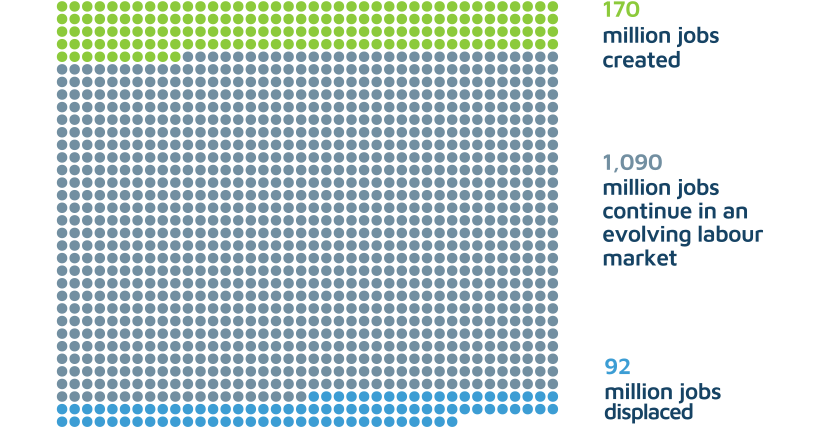
- An estimated 170 million new positions have been and will be generated between 2020 and 2030, which represents 14% of today’s employment.
- The above-mentioned trends will also lead to the loss of 92 million roles (8% of all jobs).
Net employment is thus expected to increase by 78 million jobs (7%).
- Workers can expect that, on average, 39% of their current skill sets will change or become obsolete by 2030.
This change is happening a little more slowly now than previously, as it was 57% in 2020 and 44% in 2023. This is likely to be because more people are now undertaking training or learning new skills.
However, we are witnessing a positive growth trend: 57% in 2020, 44% in 2023, and 39% by 2030.
About the Future of Jobs 2025 report
The paper contains information gathered from more than 1,000 leading employers around the world, which together represent over 14 million workers throughout 22 industry clusters and 55 economies.
The report attempts to offer a perspective as to how macrotrends such as economic uncertainty, demographic upheavals, technological advances, geoeconomic fragmentation, and the shift towards sustainability might affect jobs and skills over the next few years.
Top three key trends expected to reshape the job market by 2030
These figures show how many employers taking part in the Future of Jobs 2025 report believe each trend will change their company by 2030.
Trend #1: Broadening digital access
This trend is expected to be the most transformational, among both technology-related trends and overall, with 60% of employers believing it will change their company’s operations the most. This umbrella trend is fueled by several digitalization processes:
- AI and information processing (86%)
- Robotics and automation (58%)
- Energy generation, storage, and distribution (41%)
Trend #2: Rising cost of living
50% of businesses believe that rising living costs will impact their operations, despite a predicted decline in global inflation
Together with a general economic slowdown (42%), the consequences of this trend will result in the loss of 1.6 million jobs worldwide, while inflation will have a mixed effect on net job creation until 2030.
Trend #3: Climate-change mitigation
The report shows that nearly half of all the companies surveyed (47%) believe that climate-change mitigation will impact their operations, which in turn will lead to increases in roles such as renewable energy engineers, environmental engineers, and electric vehicle specialists.
AI and big data are the fastest-growing skills today, followed closely by networks and cybersecurity, and technology literacy.
The graph shows the top 10 skills that are expected to increase between 2025 and 2030, according to the Future of Jobs 2025 report.
Source: Future of Jobs 2025 report
These skills will be complemented by a number of core skills such as analytical thinking, resilience, flexibility, and agility.
Seven out of ten businesses believe that analytical thinking will remain the most in-demand key skill for employers.
Top 10 core skills
The graph shows the share of employers who believe these will be the core skills for the workforce
Source: Future of Jobs 2025 report
In contrast, significant net losses in the demand for abilities such as manual skills, endurance, and precision are evident, with 24% of those polled anticipating a decline in their significance.
Promoting the health and well-being of employees is expected to be the number one priority for attracting talent, as companies have identified this as an important tactic to boost the pool of available talent.
Top 5 fastest-growing jobs of the future
Even though there is a growing need for tech-driven jobs, more traditional sectors are seeing the biggest increases in employment in terms of raw numbers.
The top five occupations predicted to experience the highest net growth by 2030, based on estimates featuring data from the International Labour Organization and corporate surveys, are:
- Farmworkers – top of the list, with 35 million new jobs anticipated by 2030 as a result of the green transition, the growth of digital access, and growing costs of living
- Delivery drivers
- Software developers
- Building construction workers
- Retail sales personnel
Other roles showing significant growth include food processing workers and care jobs (e.g., nurses, social workers, counselors), driven by aging populations and increased healthcare needs.
- In absolute terms, frontline work roles (farmworkers, delivery drivers, etc.) are expected to experience the most increase in volume.
- In percentage terms, jobs involving technology are those with the fastest rate of growth.
- The biggest drop in absolute numbers is expected to be for secretarial and clerical workers (cashiers, administrative assistants, etc.)
Technology replaces jobs and creates new working opportunities, right?
Undoubtedly, the biggest concern that people have had over the past few years is the sudden rapid evolution of AI and its much-hyped products such as ChatGPT and Midjourney. AI tools have already managed to automate numerous tasks previously done by humans and have the potential to make some significant shifts in the job market in the near future. Today, AI is already being used in healthcare, biotech, finance, and other industries.
Suggested reading: AI will not replace you, but someone who uses it might | Opinion
In the near future, many routine jobs will be replaced and this process is already happening. Thus, data entry, assembly line work and even, in some cases, customer service will become automated.
But technology is also “to blame” for the creation of new jobs that require specialists with specific skills and responsibilities, including social media managers, cybersecurity experts, and data analysts. Furthermore, technological advances have led to the development of the gig econom,y with more freelancers and contract employees appearing on the job market.

The graph below illustrates the share of tasks completed mostly by technologies, by people and mixed, today and by 2030.

Source: Future of Jobs 2025 report
AI skills – the shadow influencers of the job market
Research published by the World Economic Forum states that older applicants without a degree achieved a much better callback rate when AI skills appeared on their resumes.
According to a number of studies carried out by Boston Consulting Group (BCG), Harvard Business Review (HBR), and Anthropic, AI is changing work at a faster pace than it is eliminating it.
- A 2026 study by BCG shows that in the United States, 50-55% of jobs are being reshaped, meaning that many tasks are being automated, and many roles are undergoing some type of evolution. At the same time, only 10-15% can actually be eliminated over the next few years, the research states.
- Based on the results from the HBR study, job listings for highly automatable/ repetitive positions decreased by around 13%, whereas job openings for analytical/creative/AI-enhanced positions increased by over 20%.
- The study from Anthropic found that 49% of jobs now use AI in at least a quarter of their tasks, and that AI is changing the way people work.
Technology’s benefits for the job market
As previously mentioned, technological evolution will impact the labor market both positively and negatively. In this section, we’ll take a closer look at the benefits.
1️⃣ Technological advances generate new jobs, but there’s a catch
According to MIT economist David Autor’s landmark study of 80 years of U.S. Census data, 60% of employees working today are engaged in activities and professions that did not even exist 80 years ago (software developers, data analysts, etc.). An 85% increase in employment since 1940 can be explained by the evolution of technology, which has been responsible for new jobs emerging.
The AI era could potentially follow a similar path, meaning that jobs that are impossible to define today will turn out to be mainstream occupations within a generation.
At the same time, there’s one important fact to note: researchers found that between 1980 and 2018, automation eliminated twice as many occupations as it had done between 1940 and 1980. Although automation created jobs, there were fewer than the number eliminated due to automation.
The study warns that new job creation has been favoring higher-skilled workers, which means that today people require access to training and education that will help them to remain up-to-date with technological advances.
2️⃣ Technological progress provides better working conditions
Today, advanced machinery, powered by software and in some cases even by AI, carries out dangerous tasks such as lifting heavy items, stirring 2000°C molten metal, and operating in polluted surroundings. This in turn, has led to a considerable reduction in the number of injuries in the workplace with humans focusing on more skilled and less repetitive operations.
But besides increasing safety, technology has also led to a higher number of remote and hybrid jobs, which has allowed millions of people to gain greater control over their working environment and schedule, as well as their physical well-being.
For many people, especially those with disabilities or caregiving responsibilities, such flexibility has opened doors that were previously closed.
3️⃣ Technology increases productivity
There’s no doubt that technological evolution has allowed employees to significantly improve their levels of efficiency which means that companies have started to produce more in less time which in turn has led to an increase in revenues and wages.
When we consider AI’s ability to speed up certain processes, the Anthropic Economic Index discovered that, with AI assistance, complex tasks that required a college-level education were completed up to 12 times faster.
While for companies using such tech this means higher output, for employees, the picture is mixed. This is because when technology makes companies more productive, the extra money the firm generates tends to go to workers who have valuable skills and are harder to replace, while everyone else (low-skilled workers) sees little difference in their paycheck.
4️⃣ Technology significantly improves communication
Video conferencing, online education, and telehealth have all become possible due to technological advances. These gained even more popularity during the COVID-19 pandemic and are now part of the new normal with an increasing number of freelancers and contract employees benefiting from flexible working hours.
Employers may now hire from across the globe, while employees can use cloud-based tools, collaboration platforms, and video calling – opportunities previously restricted by geographical position.
Such possibilities are especially useful for those living in remote areas, emerging economies, or people with limited mobility.
5️⃣ Technology produces more opportunities for education
Today, virtually anyone can take online courses, and children in remote areas can benefit from online education. This can considerably improve literacy levels and allow people to acquire new skills that can help them to get better jobs. China is one of the countries that is widely implementing digital literacy programs to improve the skills of various workers. For instance, farmers can now use livestreaming to advertise their produce, analyze data related to customer needs, and create unique offers.
Today, online platforms allow anyone with an internet connection to upgrade their skills or learn new ones, which is vital for anyone looking for a job who is willing to upskill or reskill quickly.
In 2025, the World Economic Forum’s Future of Jobs report predicted that by the end of the decade, about 39% of the skill sets that workers have today will have evolved or become outdated. This means that accessible ongoing learning will become essential.
Livestreaming farmers
Technology’s negative impact on employment
Employment continues to be impacted by technology, as it has always been. Some jobs either disappear completely or are replaced by machines and this is an ongoing process. Let’s explore the negative effects that technology has on the job market:
1️⃣ Technology leads to job displacement
Without a shadow of a doubt, the major impact of technology on employment is replacing humans as a result of the automation of routine and manual operations. One example is the self-service checkout machines that continue to appear at stores around the world, while another is AI-powered robots undertaking mundane tasks in factories.
Experts have recently warned that, on a global scale, the latest advances in AI could lead to around 300 million full-time jobs being replaced by machines. Both in the U.S. and Europe, around 60% of jobs could be partially or fully automated with about 25% of these being carried out by AI.
In the United States alone, there were around 1.17 million layoffs in 2025 (the highest figure since the 2020 pandemic), of which nearly 55,000 were directly linked to AI (4%).
A high-profile example is Amazon cutting 14,000 corporate roles, explaining this move was due to having the goal of becoming more adaptable in an AI-driven age and reducing bureaucracy, according to Axios.
Robots building 3D printers
2️⃣ Skills mismatch
Since technology is advancing at a fast pace, not everyone is able to keep up with it. This has led to a mismatch between the skills that employees possess and those that are required in the contemporary working environment.
Because an increasing number of workers have problems adapting to the changes brought about by technological evolution, they cannot meet the requirements of certain positions on the job market. Thus, the skills gap is growing with more new positions appearing on the market but very few workers with the appropriate skills able to fill those roles.
The importance of upskilling
Upskilling involves acquiring new, improved abilities that are related to a person’s position – a “leveling up” of their abilities. Since every company aspires to stay competitive in the digital age, upskilling is no longer simply an option but a necessity.

3️⃣ Technology contributes to employee burnout and stress
Because communicating has become easier thanks to various online tools, many employees face the problem of being permanently linked to their jobs and thus the line between their private life and work becomes blurred which can cause stress and burnout. Furthermore, according to a study published in the Journal of Occupational Health Psychology, people working in high-pressure sectors such as finance and technology experience a great deal of stress as a result of several factors, including high workloads and job insecurity.
4️⃣ Technological advances create job insecurity
Full-time jobs are usually under protection by employment law in virtually every country. However, things are different for freelancers. When an employer needs to lay off some staff so that the company can stay afloat during difficult times, the first to leave are more likely to be freelancers.
It is interesting to note that in 2022, a study carried out by the American Psychological Association showed that employees from the U.S. and parts of Asia felt job insecurity that was triggered by robots. What is even more interesting is that even people from industries where robots were not employed felt job insecurity. These fears are somewhat subjective, but nevertheless have been expressed by employees.
Technology’s impact on employment, FAQ
1. How does technology impact employment?
The process has been happening for centuries. Machines replace humans to do certain tasks, new industries appear that generate new jobs, leading to workers gradually moving between them. Probably the main difference today is speed in that AI is changing job requirements extremely quickly; in fact, its pace is outrunning that of the training systems intended to help humans to learn new skills to keep up.
2. Is technology (AI) contributing to job losses?
It is, but it may not be as catastrophic as many headlines suggest. However, fewer young people are being hired for entry-level positions, and we are witnessing layoffs by high-profile corporations that can partly be attributed to AI.
Experts believe that by saying that the layoffs are due to AI, many companies are simply seeking to justify cuts that are actually more driven by financial losses.
In addition, a Resume.org survey showed that 59% of companies admit to focusing on AI’s role in layoffs simply because, for stakeholders, it sounds better than citing financial constraints.
3. What jobs will no longer exist in 2030?
Any repetitive job, such as data entry, telemarketing, basic customer support, or routine financial reporting – all pattern-based tasks are likely to be taken over by AI.
As for the roles that will be harder to replace, these are where physical presence and real human connection are important, for example, healthcare professionals, educators and trainers, creative directors, and skilled trades as well as heat, ventilation, and air conditioning technicians, electricians, and plumbers.
4. Which jobs are growing fastest because of technology?
Big data experts, fintech engineers, AI and machine learning professionals, software and applications developers, security management experts.
5. What are the negative effects of technology on employment?
There are trends that suggest fewer people (especially in fields such as tech, finance, and media) are being hired for entry-level jobs due to AI.
There is also a growing gap between those who have invested in upskilling and those who have not.
It is becoming more difficult for smaller companies to attract technical talent, since they cannot outbid the larger players on the market who have the ability to invest in employee training and AI development.
6. What is upskilling and why is it important in the digital age?
Upskilling is learning skills that complement those you already have. Usually, upskilling involves engaging in shorter, more targeted learning rather than being going back to school for years.
Even though upskilling cannot guarantee you will get hired, it’s still much better than doing nothing, which obviously carries more risk.
7. How does technology improve working conditions?
Technology improves working conditions more than most people realize. For instance, AI-related jobs are much more likely to have remote work options and stronger benefits. Automation helps to perform repetitive tasks, allowing you to focus on more interesting and less tiresome tasks.
Technology also improves workplace safety and offers data-driven tools for better task management via robotics and sensors.
Final word
The effects that technological development has on employment are somewhat complex, bringing about both positive and negative consequences. From one perspective, AI will automate various tasks, leaving a large number of people without a job, and leading to a widening skills gap. However, from another perspective, this technological progress will create new jobs and contribute to economic growth.
Upskilling has become extremely important and, in an attempt to remain competitive, companies try to attract AI-skilled talent. To do this effectively, they must offer more than simply an attractive salary because more workers are choosing jobs that offer AI training.
Companies able to invest in skills development will be more likely to attract the best talent and hold onto it.