
Add us as your preferred source on Google to see more of our content in Search.
 Add to Preferred Sources
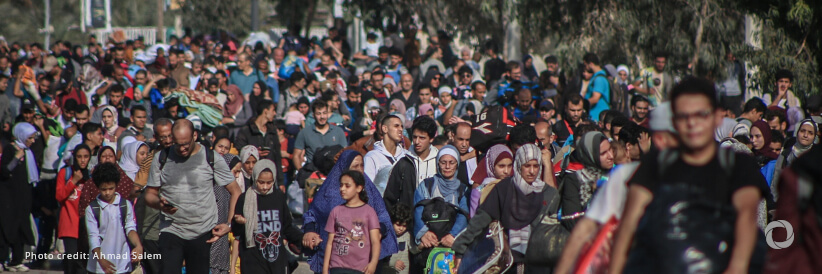
Large parts of the city of Rafah are a “ghost town”, with UN humanitarians reporting that some 450,000 Gazans have been forcibly displaced from the southernmost city by Israeli evacuation orders.
“Empty streets in Rafah as families continue to flee in search of safety… UNRWA estimates that nearly 450,000 people have been forcibly displaced from Rafah since 6 May. Inland in Rafah is now a ghost town. It’s hard to believe there were over one million people sheltering here just a week ago. People face constant exhaustion, hunger and fear. Nowhere is safe. An immediate ceasefire is the only hope,” said the UN agency for Palestinian refugees, in a post from western Rafah on X.
North and South bombed
The development comes as airstrikes continued to hit northern and southern Gaza, amid reports that the Israeli military said that it had hit 120 targets in the past 24-hour period.
“Ground incursions and heavy fighting continue to be reported in eastern Rafah, as well Gaza City and the Jabaliya Refugee Camp,” the UN Aid Coordination Office, OCHA, said in its latest situation update.
Many of those forced to leave eastern Rafah had already been displaced multiple times in the past seven months, the UN office explained.
In the north, evacuation orders were also issued “amid ongoing Israeli bombardment there”, OCHA said, noting that some 100,000 people have left their homes and shelters so far.
“OCHA remains deeply concerned about the lack of protection for civilians – and the lack of safety for humanitarian operations. Civilians must be protected and have their basic needs met, whether they move or stay. Those who leave must have enough time to do so, as well as a safe route and a safe place to go,” the UN agency said, noting that one-fifth of Gaza’s population had been displaced.
Deep concerns remain about a lack of lifesaving aid reaching the enclave since Israeli troops seized the Rafah crossing and restricted access to the nearby Kerem Shalom crossing, in response to a deadly rocket attack by Hamas fighters.
Empty streets in #Rafah as families continue to flee in search of safety.@UNRWA estimates that nearly 450,000 people have been forcibly displaced from Rafah since 6 May.
People face constant exhaustion, hunger and fear. Nowhere is safe. An immediate #ceasefire is the only hope pic.twitter.com/cwRWL6iF06
— UNRWA (@UNRWA) May 14, 2024
“Rafah crossing remains closed,” OCHA said, “and there is a continued lack of safe and logistically viable access to the Kerem Shalom crossing”.
Echoing fears for the people of Gaza, the UN World Health Organization (WHO) reported that the incursion into Rafah had jeopardized access to health care, the provision of health services, and the delivery of lifesaving supplies.
The UN health agency noted that partners working on medical relief in Gaza “require a minimum of 46,000 liters of fuel every day just for their operations”.
Death toll data defended
In a related development, UN agencies pushed back at erroneous claims that the number of Gazans killed and injured had been scaled down after the enclave’s ministry of Health announced that some 25,000 of the 35,000 reported fatalities have now been identified.
“We’re basically talking about 35,000 people who are dead and really that’s all that matters, isn’t it? We know that many and many of those are women and children. And there are thousands missing under the rubble,” said Liz Throssell, spokesperson for the UN human rights office, OHCHR, in response to journalists’ questions in Geneva.
Echoing that message, the UN World Health Organization (WHO) insisted that the system of verification of the dead by the ministry of Health would necessarily take time, given that in Gaza, the “numbers are huge”.
An estimated 18,0000 individuals have yet to be identified or found, comprising 10,000 whose bodies have been recovered and another 8,000 who have not, said WHO spokesperson Christian Lindmeier.
Of the 24,686 identified fatalities, 40 per cent were men (10,006), 20 per cent were women (4,959) and 32 per cent were children (7,797). In a separate category the elderly accounted for eight per cent of all identified deaths (1,924), Mr. Lindmeier explained.
Among the 10,000 unidentified victims, the WHO official suggested that there was a “high likelihood” of finding the bodies of more women and children from destroyed houses, “because they are the ones staying at home, while the men are out looking for food, looking for business and supplies” for their families.
“Every single (one) of these figures is a person with a name and a history and a family,” he told journalists. “So as people are still under the rubble, dead in mass graves, somewhere out there on the side of the road (and) couldn’t get picked up in a conflict area in a so-called safe zone, but still not reachable because there’s firing going, as long as all this is happening, there are still people out there which can’t be identified.”
Welcoming ongoing efforts to ascertain the identities of all those killed in more than seven months of the war in Gaza as part of the civilian casualty monitoring process, OHCHR’s Liz Throssell insisted that “the bottom line is we are talking about people who have lost their lives”.