
Add us as your preferred source on Google to see more of our content in Search.
 Add to Preferred Sources
As the war drags on in Gaza, UN human rights chief Volker Türk condemned Israel’s “relentless” attacks across the war-shattered enclave, while repeating longstanding calls for the release of all remaining hostages.
In his traditional opening address to the Human Rights Council in session in Geneva, the UN High Commissioner for Human Rights also reiterated serious concerns raised by his Office that war crimes have been committed by all sides since conflict erupted on 7 October, sparked by Hamas-led terror attacks on multiple targets in Israel.
120,000 killed or injured in the enclave
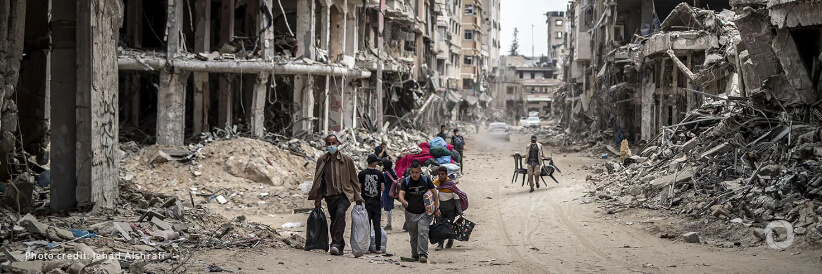
“There has been unconscionable death and suffering,” the UN rights chief told Member States, as he highlighted the widespread destruction caused by more than eight months of heavy fighting. “More than 120,000 people in Gaza, overwhelmingly women and children, have been killed or injured since 7 October, as a result of the intensive Israeli offensives,” he said.
Rafah fallout
In addition to those maimed or killed by intense Israeli bombardment, Mr. Türk noted that since Israeli forces escalated operations into Rafah in early May, almost one million Palestinians have been uprooted “yet again”, while aid deliveries have been squeezed, affecting humanitarian access even further.
See also: Surviving amidst destruction: the daily struggles of Gaza’s residents post-invasion
“The arbitrary denial and obstruction of humanitarian aid have continued, and Israel continues to detain arbitrarily thousands of Palestinians. This must end,” the UN rights chief insisted, echoing concerns raised by UN humanitarians who described how thousands of families sheltering in Deir A-Balah live in overcrowded conditions lacking sanitation, with access to just 0.7 liters of water per person, per day.
“Food distributions are irregular, and residents reported a range of health issues, such as hepatitis A, skin diseases, and respiratory illnesses,” said the UN aid coordination office, OCHA, in an update.
West Bank is in crisis, too
Linked to the emergency in Gaza, Mr. Türk also warned of the “dramatically deteriorating” situation in the occupied West Bank, amid rising attacks against Palestinians and the targeting of Israeli soldiers.
“As of 15 June, 528 Palestinians, 133 of them children, had been killed by Israeli security forces and/or settlers since October, in many cases raising serious concerns of unlawful killings,” Mr. Türk said. “In the same period, 23 Israelis have been killed in the West Bank and Israel in clashes with or attacks by Palestinians, including eight members of Israeli security forces.”
Lebanon connection
Linked to the Gaza conflict, the UN rights chief expressed deep concern over the possibility of a “full-scale war” between Lebanon and Israel.
“We are tired of displacement, not knowing where to go, fear haunting us everywhere, and the sounds of bombing and explosions,” says 9-year-old Janna.
More than 8 months of war have turned #Gaza into hell on earth for thousands of displaced families.#CeasefireNow #WRD2024 pic.twitter.com/o5Hy3GKjdT
— UNRWA (@UNRWA) June 18, 2024
Continuing rocket attacks and exchange of fire across the shared border have killed 401 people in Lebanon, including paramedics and journalists, Mr. Türk said, while more than 90,000 people have been displaced in the country too.
In Israel, some 60,000 people have been forced to leave their homes and 25 Israelis have been killed.
“Thousands of buildings have been destroyed. I reiterate my call for a cessation of hostilities and for actors with influence to take all possible measures to avert a full-scale war,” the High Commissioner said.
The global cost of war
In a withering assessment of the impact of war around the world, the UN High Commissioner for Human Rights also noted that the number of civilian deaths in armed conflict last year soared by 72 per cent. Data gathered by Mr. Türk’s Office showed that the proportion of women killed in 2023 doubled and that of children tripled, compared to 2023.
“Killings and injuries of civilians have become a daily occurrence,” Mr. Türk said. “Destruction of vital infrastructure a daily occurrence. Devastating and reckless. Children shot at. Hospitals bombed. Heavy artillery was launched on entire communities. All along with hateful, divisive, and dehumanizing rhetoric.”
Ukraine appeal
Turning to Ukraine, the UN rights chief said that the Russian armed forces’ ground offensive into the Kharkiv region had “destroyed entire communities”. Residents “hid in basements, without electricity, water or adequate food, as the area came under intense attacks by explosive weapons with wide area effects”, Mr. Türk continued, before condemning “repeated waves of large-scale attacks on energy infrastructure” that have crippled 68 per cent of Ukraine’s electricity production capacity.