Over the last few decades, many countries around the world have successfully managed to tackle poverty, with millions of people escaping it for good and yet many other nations continue to lack basic needs such as access to clean water, education, and proper healthcare.
Today, it can definitely be said that the world is still far from meeting Sustainable Development Goal 1: End poverty in all its forms by 2030. Why is this battle not being won? What are the causes of poverty? Which regions have managed to achieve impressive results and which are still struggling? Before answering these questions, let’s consider the definition of poverty.
What is global poverty?
It is somewhat surprising that there is no universally accepted definition of poverty. As well as involving a lack of sufficient income, poverty also encompasses a variety of diverse socioeconomic aspects such as social status, job opportunities, and the freedom to express views, among others. Numerous abuses of labor and human rights also stem from poverty.
To quantify poverty on a worldwide scale, a poverty line that is universally accepted must be used.
The international poverty line
The international poverty line is the worldwide-accepted monetary cut-off point whereby if a person’s income is less than this threshold, they are considered to be living in extreme poverty.
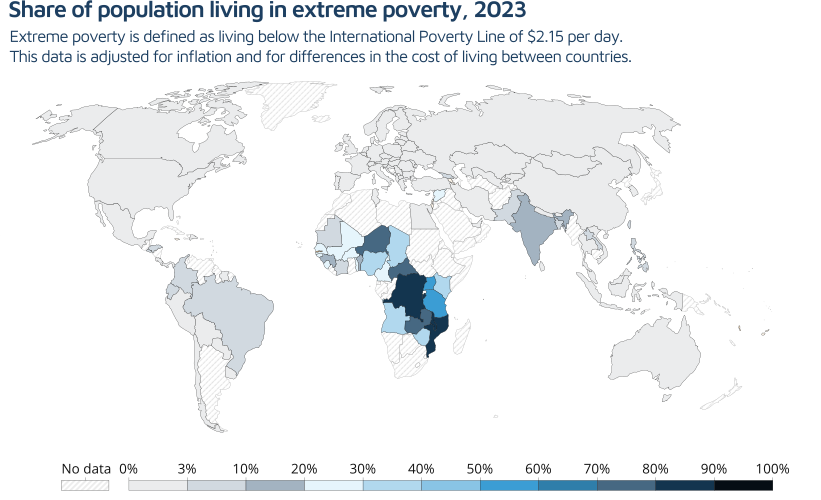
The international poverty line is established by identifying the poverty threshold of each nation based on the cost of items that are necessary to support one adult per day and converting this to U.S. dollars. As of today, the worldwide poverty line stands at US$2.15 per person.
Source: OurWorldInData
Brief statistics about global poverty
- Today, around 712 million people are facing extreme poverty, which is 23 million more compared to 2019.
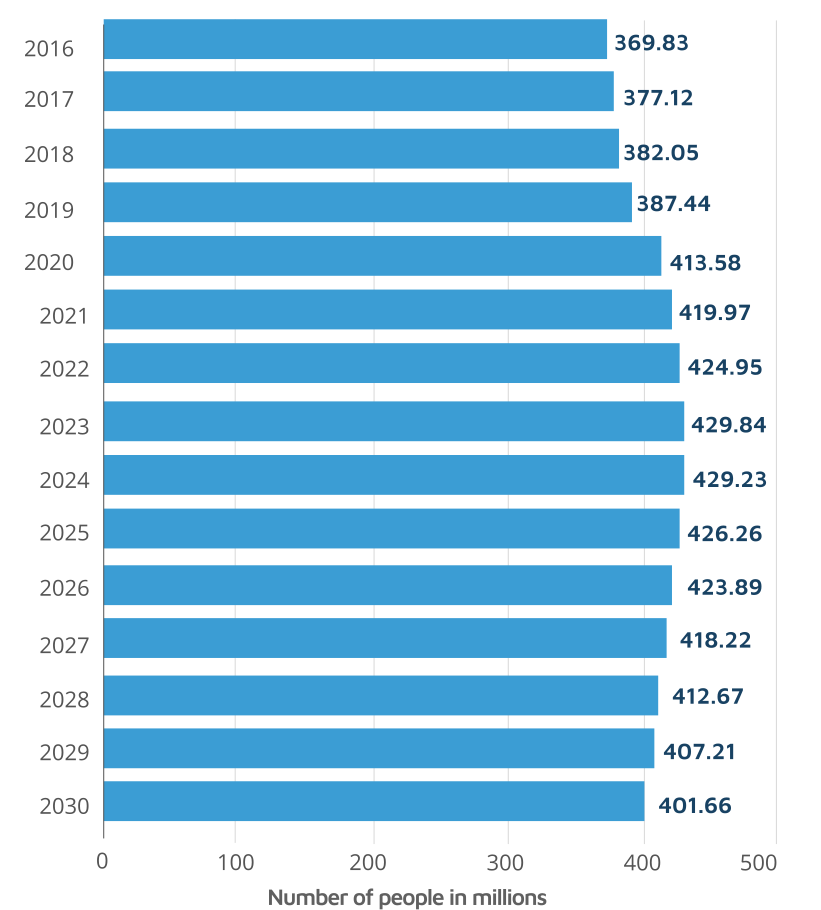
- 429 million people in Africa live in extreme poverty (as of 2024).
- Some countries in the sub-Saharan region are those most affected by poverty – around 35% of people living here face the issue.
- UNICEF points out that over the last decade, the proportion of children in sub-Saharan Africa who face poverty decreased by 5 percentage points, from 45% to 40%.
- Multidimensional poverty* today affects 1.1 billion people, of whom 566 million are children.
* An index designed to provide a more comprehensive view of poverty by calculating the proportion of households in a nation that lack access to necessary infrastructure services, education, and financial poverty.

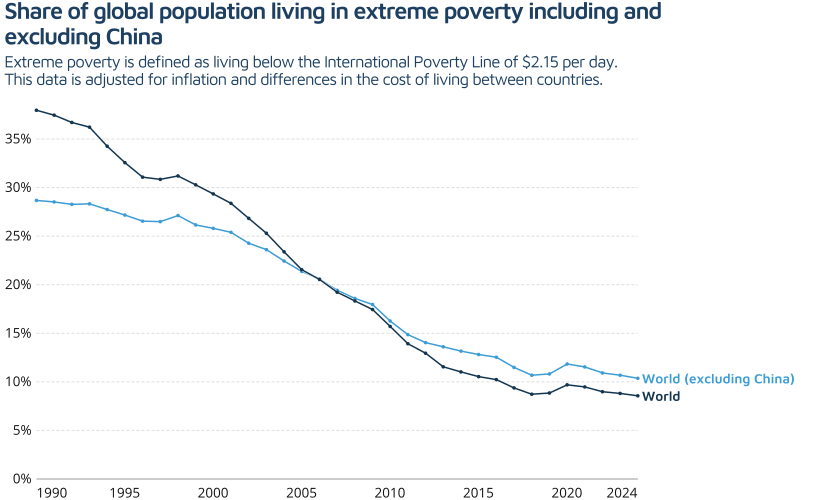
One of the main reasons why the world has witnessed a drop in poverty since 1990 is China’s impressive economic development which has allowed around 800 million people to escape poverty.
Source: OurWorldInData
Global causes of poverty
People become trapped in poverty for a variety of reasons with some of the major causes being:
- Inequality – people who are discriminated against based on gender, age, health, or social status have fewer opportunities to thrive in life.
- Conflict – wars can last for years, forcing people to flee their homes, and to lose their source of income and the ability to gain a quality education.
- Lack of education – most people who live in extreme poverty do not go to school, and vice-versa with people who do not go to school being more likely to end up in monetary poverty.
- Hunger – this issue affects the immune system and causes people to become extremely vulnerable to diseases. This is particularly detrimental for mothers and babies.
- Poor healthcare systems – many people have to travel great distances to see a doctor and the lack of medicines aggravates the issue.
- No access to sanitary facilities and clean water – large numbers of residents in poor countries have to walk long distances to provide their families with clean water. These hours could have been spent on education or employment.
Suggested reading: Ten ways to reduce poverty in the world
Poverty trends
Over the last few decades, the world has managed to register amazing progress in tackling extreme poverty.
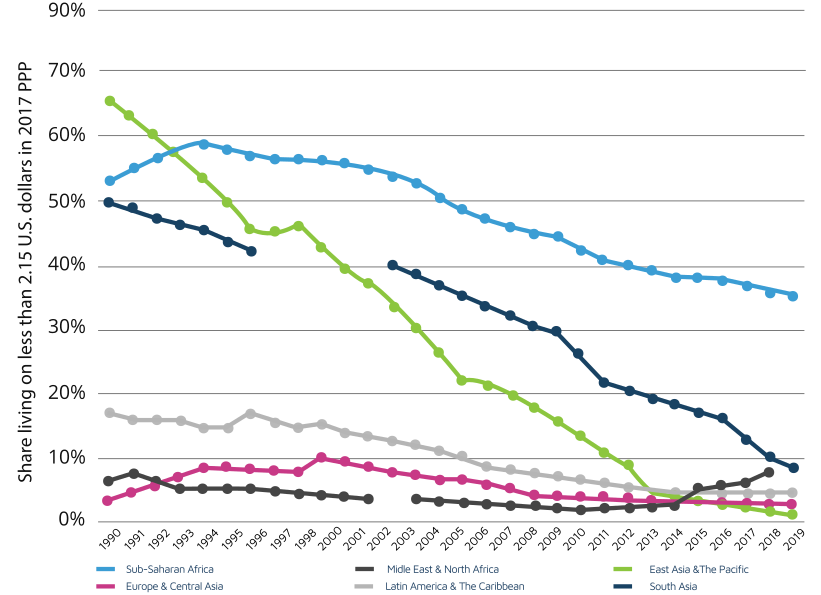
In 1990, people living in East and South Asia faced high levels of poverty. However, over the following 30 years, the level of extreme poverty has dramatically declined in these regions from over 65% to 1%, mainly due to a spectacularly fast improvement in living standards in China and the entire region.
Regional distribution of the global population living on less than 2.15 US dollars (1990 – 2019)
Source: Statista
In sub-Saharan Africa, the number of people living in extreme poverty has steadily grown in the last eight years. Some of the major reasons include rapid population increase and a lack of economic development in a number of conflict-ridden and climate change-affected nations.
Source: Statista
However, poverty in Africa is predicted to gradually decrease in the forthcoming years and it is expected that by the end of the decade, there will be just over 400 million people living below the poverty line.
It is significant that not all 54 African countries face difficulties in fighting poverty with 11 of the TOP-20 fastest growing economies on the planet being on that continent. According to the African Development Bank, Niger, Senegal, Ivory Coast, Democratic Republic of the Congo, and Rwanda are expected to see the most significant progress in development in Africa in 2024.
Top 10 of the world’s poorest countries today
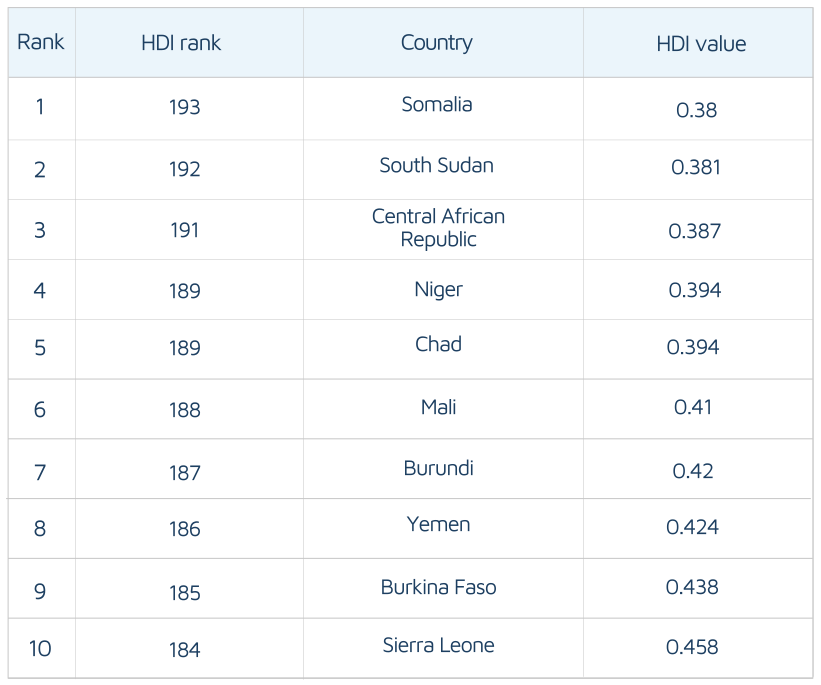
As most vulnerable nations often have insufficient data, using GDP as a ranking metric ignores certain aspects of the economic health of a country. It is therefore more useful to consider and compare statistics from the United Nations’s 2023-24 Human Development Index (HDI) which analyzes a number of parameters, including Gross National Income (GNI) per capita and life expectancy at birth.
According to the HDI index, the top 10 poorest countries in the world are:
Source: UNDP
Final word
Despite significant progress having been made to address poverty, millions of people worldwide continue to struggle with either living on less than US$2.15 per day or with a lack of basic necessities. While East and South Asia have largely succeeded in overcoming poverty, many countries in sub-Saharan Africa still face challenges. However, not all African nations are experiencing widespread poverty and, since 1990, various efforts have been made to stimulate economic growth and reduce extreme poverty across the continent, although progress has been somewhat slow.