Learn how Kenya tackles period poverty in an environmentally friendly way
By Dennis Mithika • Jan 17, 2025It is a little-known fact that two out of three Kenyan women are unable to afford sanitary pads and almost 1 million school-aged girls miss an average of four academic days per month due to period poverty and the menstrual cycle. With over 27 million women and girls living in the country, these statistics represent distinct disadvantages for the country’s economy and hinder efforts towards poverty eradication.
Among multiple initiatives proposed by the authorities with donor support and the involvement of non-profit organizations, eco-friendly sanitary pads are emerging as a sustainable solution to address period poverty.
In this article, we explore the initiatives and projects in Kenya that are promoting environmentally sustainable solutions for a healthier and equitable future for women and girls.
Unraveling period poverty: What does it mean?
Period poverty is the inability to access the menstrual hygiene products, education, and sanitary facilities that are necessary to manage with dignity the monthly menstruation needs of women and girls. In the developing world, period poverty is caused by abject poverty, stigma relating to menstruation, the high cost of sanitary pads, inadequate health education, and ineffective infrastructure in low-income communities.
According to a 2024 USAID report, 65% of the 27 million women in Kenya cannot afford the basic requirements to manage their periods. Without accessibility to sustainable, affordable, and safe menstrual products, girls in Kenya are absent from school and women are missing from work, as well as facing health risks, and experiencing social stigma.
Furthermore, period poverty in Kenya leads to environmental pollution due to limited access to waste disposal systems for used sanitary pads. Due to inadequate sanitary disposal facilities in low-income, rural areas, used pads are discarded inappropriately and end up in waterways where they cause pollution.
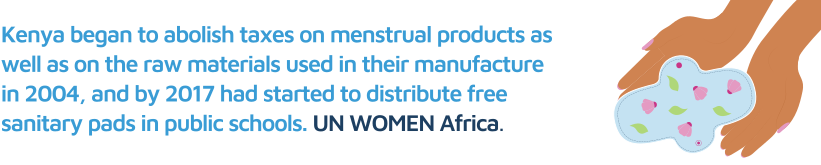
Consequences of period poverty in Kenya
The lack of affordable menstrual hygiene products causes girls to miss school to avoid feeling uncomfortable and facing social stigma. One of the reasons why girls do not use period hygiene products is their high cost and this leads to one million school-age girls missing four school days per month. This absence disrupts child education and limits the ability of girls to gain the skills needed to participate in economic activities as well as hindering gender equality and women’s emancipation.
Period poverty also exposes girls to health risks, as concluded by a survey conducted by the Heart Education organization and Procter & Gamble. The results of the survey indicate that 42% of Kenyan school girls have never used sanitary pads and instead use alternatives such as rags and blankets. Utilizing improvised alternatives such as cotton wool exposes girls and women to infections, irritation, and reproductive health infections as the material is not designed for menstrual hygiene.
Furthermore, 2015 research indicated that disposable alternatives for menstruation that are made from cotton and rayon cause acidification and eutrophication of water reservoirs.
Eco-Friendly pads: Kenya’s solution to period poverty
International donors, in partnership with local government and the private sector, are addressing period poverty in Kenya by facilitating the manufacturing of eco-friendly pads. Some of the most well-known initiatives that currently dominate the landscape include:
- Ahadi reusable pads: Produced by a social entrepreneur, with effective care these menstrual pads can be reused for almost 24 months thus reducing the level of waste compared to non-biodegradable pads. The pads are designed for reliability, sustainability, and cost-effectiveness, and can be used for 4 to 6 hours depending on the intensity of the period.
- USAID-funded I-Care pads: the United States Agency for International Development (USAID) has partnered with Afri-Can Trust to manufacture cost-effective and reusable sanitary pads called I-Care Pads. A single I-Care kit contains four pads that can be utilized for at least one year. The pads are 45% less costly than expensive disposable alternatives. This initiative increases the product’s accessibility for women living below the poverty line, especially in rural areas of Kenya. The USAID initiative also provides teachers with training, savings clubs, and free product samples, empowering girls with the resources and knowledge to combat period poverty.
- ZanaAfrica Nia pads: The ZanaAfrica foundation provides sanitary pads and underpants to meet the needs of two out of three women who cannot access menstrual health products. The free Nia sanitary pads are good quality and cost-effective, with aspirational designs information about accessing health and the right resources printed on the packaging. ZanaAfrica Nia pads have a Nia Health Link that provides digital education on menstrual health.
- Eco-Bana biodegradable sanitary products: The Eco-Bana Foundation manufactures pads from natural banana fiber and these are compostable and able to be absorbed following disposal. The pad’s top material is prepared from organic, non-woven cotton, ensuring softness and gentleness to the skin. Its raw materials ensure girls and women are comfortable and healthy during menstruation cycles. The pads are wrapped with plastic-free materials, making them eco-friendly.
- PadMad pads: The PadMad enterprise reduces period poverty by manufacturing biodegradable, reusable sanitary pads that are made from 100% cotton. It also offers education on menstrual health management and reproductive health among Kenyan women.
Progress in addressing period poverty in Kenya
Despite the reportedly low production quantities and still limited use, eco-friendly pads are a clear signal of sustainable incentives in the sector.
- Ahadi reusable pads reduce waste as only 1200 pads are being disposed of yearly, against the 36,000 conventional disposable pads that would have been used.
- Afri-Can Trust has distributed I-Care reusable sanitary pad kits to approximately 20,000 poor women and girls in Kenya.
- ZanaAfrica sells approximately 8,000 two-packs of Safi sanitary pads each quarter, increasing their accessibility and cost-effectiveness.
- For PadMad pads, with at least 10,000 beneficiaries, around 8 million disposable pads are saved from landfills over five years, reducing environmental impact.
Final word
Despite the challenges in addressing period poverty, Kenya is making progress in this area by promoting eco-friendly sanitary pads that improve the accessibility, affordability, and sustainability of women’s menstrual hygiene. promote At the same time, by reducing waste via biodegradable and reusable pads, the eco-friendly design of the products ensures environmental sustainability.