New countries do not emerge every day and the process of a nation’s ‘birth’ is somewhat complex and has to culminate in international recognition. However, newly created states typically arise as a result of the division or breakup of an existing nation so it is virtually impossible for a large group of people to simply express their desire or intention to become a country.
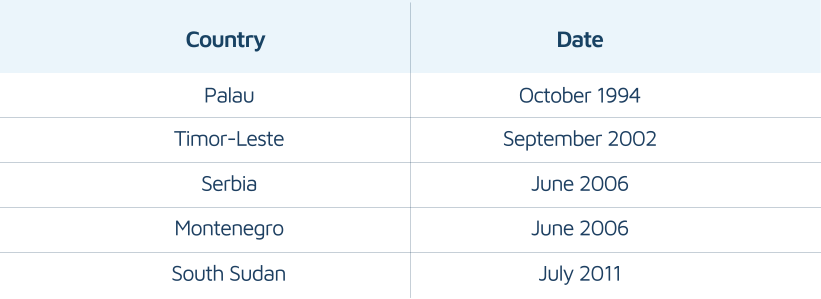
The youngest country in the world, South Sudan, gained recognition by the United Nations 14 years ago in 2011 and this article will look at the other four countries that make up the list of the Top 5 youngest states out of the 193 recognized by the United Nations as of 2025. We will also examine their GDP per capita, their location, and current internal social and economic situations.
Suggested reading: 15 Interesting Facts about the United Nations that you didn’t know
Five youngest countries in the world
 South Sudan – the youngest country in the world
Gained independence: 2011
GDP per capita: US$1,078 (2015)
The Republic of South Sudan, an African nation that gained sovereignty from Sudan on July 9, 2011, is the world’s newest formally acknowledged nation (as of 2025, according to Britannica).
Today, the nation faces high poverty levels and, according to UNICEF, has experienced numerous severe droughts which have caused a large number of fatalities, and livestock losses.
South Sudan’s economic outlook
The breakouts of civil war in 2013 and 2016, the ineffective administration of public resources, and political rivalry have weakened the socio-economic situation in South Sudan since the country gained independence.
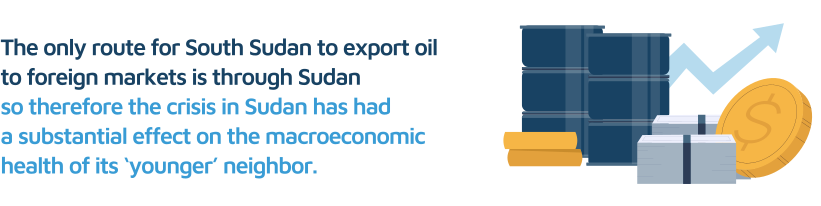
In addition to the oil sector, the nation’s industries of iron, diamond, copper, nickel, marble, and gold, as assessed by the African Development Bank, all have potential. If stability and peace were to be established, the chances that investments in manufacturing plants and agriculture would grow are high.
- Export partners: China, Italy, Singapore, Japan, United Arab Emirates
- Exported commodities: Crude petroleum, refined petroleum, gold, forage crops
- Import partners: United Arab Emirates, Kenya, China, United States, India
- Imported products: Cars, t-shirts, packaged medicaments, delivery trucks, men’s suits.
 Montenegro
Gained independence: June, 2006
GDP per capita: US$12,016 (2023)
Located on the Balkan Peninsula in Southeast Europe, Montenegro proclaimed its independence from the State Union of Serbia and Montenegro in 2006 and joined the UN as its 192nd member on June 28 of that year.
The country has an open economy and hopes to join the European Union in 2025. Due to its reliance on foreign capital inflows to support its economic growth, its economy is susceptible to shocks from the outside world.
Montenegro’s economic outlook
According to the U.S. International Trade Administration, the tourist sector officially contributes to roughly 30% of Montenegro’s GDP.

- Export partners: South Korea, Serbia, Italy, Switzerland
- Exported commodities: Copper ore, electricity, raw aluminum
- Import partners: Serbia, China, Italy, Croatia, Greece
- Imported products: Electricity, refined petroleum, raw aluminum, cars, packaged medicaments
 Serbia
Gained independence: June, 2006
GDP per capita: US$12,281 (2023)
Serbia is a landlocked nation located in the west-central region of the Balkans. On June 5, 2006, the Republic of Serbia declared its independence from the State Union of Serbia and Montenegro.
Serbia’s economic outlook
The country’s economic development has improved following a lengthy period of stagnation and the most recent data from the World Bank shows that the country is registering a robust rebound in the energy industry and achieving impressive results in the construction and agriculture sectors.

Some of Europe’s greatest copper reserves are found in Serbia, according to Serbian CorD Magazine.
Serbia does not have any nuclear power plants; its main energy sources include coal and hydroelectricity.
- Export partners: Germany, Bosnia and Herzegovina, Italy, Hungary, Romania
- Exported commodities: Insulated wire, copper ore, electricity, rubber tires, and electric motors
- Import partners: Germany, China, Hungary, Russia, Italy
- Imported products: Electricity, crude petroleum, petroleum gas, packaged medicaments, cars
 Timor-Leste (or East-Timor)
Gained independence: May, 2002
GDP per capita: US$1,502 (2023)
The Democratic Republic of Timor-Leste in Southeast Asia gained independence in May 2002 and became the 191st member of the UN in September 2002.
Even with the continuing progress made by this island nation, there remains a high unemployment rate, and roughly 40% of the population live below the poverty level.
Timor-Leste’s economic outlook
The Timor Sea’s oil reserves make up 80% of the country’s GDP, according to the Ministry of Tourism, Arts and Culture, but these resources are running out, and therefore economic diversification is urgently needed.

The public sector is witnessing growth, and more small enterprises are being established, mostly in construction, wholesale, and retail.
- Export partners: China, Japan, South Korea, Thailand
- Exported commodities: Crude petroleum, coffee, petroleum gas
- Import partners: Indonesia, China, Singapore, Australia, Malaysia
- Imported products: Refined petroleum, rice, cars, coal briquettes, cranes
 Palau
Gained independence: October, 1994
GDP per capita: US$15,899 (2023)
Every year on October 1st, Palau celebrates its Independence Day, which commemorates the country’s release from the US-run United Nations Trusteeship.
Palau’s economic outlook
Subsistence agriculture, tourism, and fishing are the main drivers of the economy. The government employs a large portion of the labor force and depends on U.S. funding.
- Export partners: Greece, Japan, France, Chinese Taipei, the United States
- Exported commodities: Recreational and cargo ships, computers, office machine parts, scrap iron
- Import partners: China, the United States, South Korea, Japan, Italy
- Imported products: Refined petroleum, special-purpose ships, and recreational boats.
Final word
Not many new countries have appeared on the world map over the last few decades and of those that have, each are at a different level of development, and most struggle with social and economic issues to a various degree. Still, they all hold great potential, particularly the youngest nation, South Sudan, which is rich in resources but is currently experiencing high socio-economic instability. Peace is one of the major goals that a nation has to achieve to start moving forward towards progress at every level – political, economic, and social.