
Add us as your preferred source on Google to see more of our content in Search.
 Add to Preferred Sources
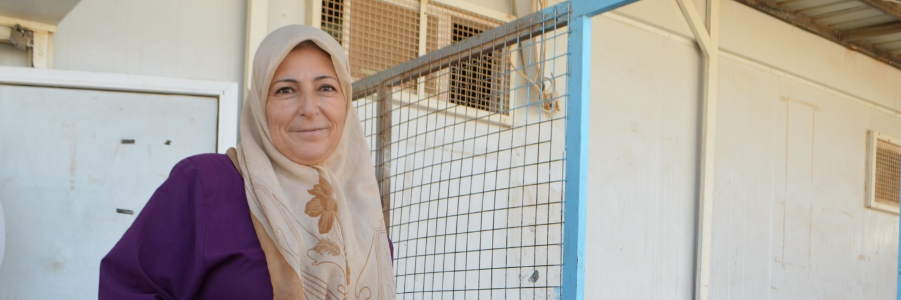
In the Azraq refugee camp in Jordan, Syrian refugees queue in supermarkets where cashiers are equipped with iris scanners. Once identified using biometric registration data from the United Nations High Commissioner for Refugees (UNHCR), they can spend food vouchers provided by the UN World Food Program (WFP).
Food voucher transactions for 100,000 refugees in Jordan are now recorded on the WFP’s Ethereum-based blockchain, a system called Building Blocks. By the end of 2018, WFP’s Director of Innovation and Change Management Robert Opp hopes that Building Blocks will serve 500,000 people — WFP’s entire caseload in Jordan.
“If that works well it becomes the beginning of a blockchain ecosystem that can underpin the humanitarian system as a whole,“ said Opp. “Why should the most vulnerable people in the world wait for technology to trickle down?”

Most of WFP’s budget is spent on emergencies like the refugee crisis caused by the war in Syria. The organization needs technology which helps it feed as many people, as efficiently as possible, by reducing costs and systemic risks. Before Building Blocks, banks were used to fund the food voucher accounts of refugees, track transactions, and perform reconciliation.
The shift to blockchain could save WFP $150,000 a month in Jordan alone by eliminating 98 percent of the bank fees related to transfers. Blockchain has also eliminated the risk involved in advancing large sums of money to financial service providers and sharing confidential beneficiary data with them.
But cost savings are not the only, or even the main, potential advantage of blockchain for the WFP. “We think we will be able to demonstrate better accountability and transparency in terms of stewardship of aid dollars and aid goods because of the traceability aspect of blockchain,” said Opp.
Blockchain in the Food Aid Supply Chain
WFP operates a massive physical supply chain which moves between two and three million tons of physical commodities a year. The agency is investigating how blockchain could be used to improve its efficiency.
Blockchain’s shared ledger can be updated and validated in real time by multiple parties, allowing real-time tracking of the location of an asset, who owns it, and what condition it’s in. Loss or delay of shipping documentation for perishable goods is also a serious issue in current supply chains and can cost up to a fifth of the total expense of transportation. Blockchain could solve this problem so many large companies are working on commercializing the technology. IBM, for example, is creating a new blockchain company with shipping giant Maersk after running a pilot in 2016 which traced a container of flowers from Mombasa, Kenya to Rotterdam in the Netherlands.
WFP thinks that blockchain could improve the transparency and efficiency of its supply chain while reducing theft and fraud, which is a particular problem when delivering food aid in developing countries. A pilot is planned in East Africa, most likely Ethiopia, in the coming months.
“What we are looking at is tracking the status and location of goods between multiple actors, between the port of Djibouti and our delivery hub in Addis Abiba” said Jamie Green, a Y-combinator alumnus and project manager at the WFP’s Innovation Accelerator in Munich. “We don’t always know where our trucks are. Sometimes they get held at certain points. Sometimes there are issues with tracking the location of the goods and making sure that we have a consistent delivery.”

Developing Building Blocks
Building Blocks started life at a WFP blockchain brainstorm at the end of 2016. “We had a very thoughtful finance officer (Houman Haddad) at WFP headquarters who had already been doing a lot of thinking about our capital expenses,” said Opp. “He came forward with the idea that we could probably leverage the ledger aspects of blockchain.” Towards the end of 2016, Building Blocks entered the WFP’s innovation accelerator program for early stage ideas. At that time, awareness of blockchain was much lower than it is now.“The first thing to get over with blockchain was that people don’t even know what it is,” said Opp. “The first assumption was that we are going to be paying refugees in Bitcoin, that we are speculating in cryptocurrency.”
Educating stakeholders at WFP about blockchain’s potential uses, the variations between implementations and the potential risks was an important part of the work. Aid organizations like WFP have good reasons to be cautious about immature technology. Over 60 governments, corporations and individual donors underwrite the humanitarian and development projects of WFP. The agency has to consider the financial and reputational risks associated with a rocky or failed rollout.
The fact that Building Blocks had an champion outside the innovation organization was crucial in convincing WFP’s leadership to try blockchain.
“It was a big plus that we had someone from the finance division that was the organizational champion for this,” said Opp. “Otherwise it really is a solution looking for a problem. This was somebody who was living with the problem [of reducing WFP’s capital expenses].”
In January 2017, a pilot in Pakistan tested the basic principles with 100 people. Within months, a larger pilot was managing the food vouchers of 10,000 refugees in Jordan. WFP cannot afford to let thousands of refugees go hungry because of a technology glitch so redundancy was crucial during the pilot.
“We had our entire existing system still ready to be rolled out immediately if we encountered any serious challenges,” said Green. “We had all the old [voucher] cards still in the offices, all live with a zero balance waiting in case we discovered some fundamental flaws.” Fortunately, they weren’t needed.
Original source: Built to Adapt
Published on 5 March 2018