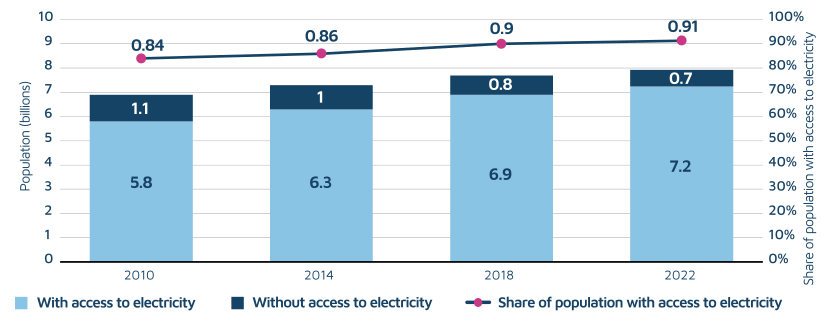
The latest data shows that nine out of 10 people, or 90% of the 8 billion people who currently live on planet Earth, now have access to electricity which is a considerable increase from the 84% in 2010, when the global population was 1 billion less.
Nevertheless, around 685 million people still do not have access to electricity which reverses the long-term trend of increasing the pace of electrification.
The largest number of households without electricity are in sub-Saharan Africa and the least developed nations, where violence, instability, and remoteness continue to hinder development. In fact, remoteness is a key factor that stands in the way of electrification.
See also: Global energy consumption patterns: statistics and analysis
If current trends continue, approximately 660 million people will remain without access to electricity by 2030.
Global access to electricity and population growth
According to the Energy Progress Report 2024 by the Energy Sector Management Assistance Program, global access to energy increased by just 7 percentage points, from 84% to 91%, between 2010 and 2022, although this stall in progress was due to worldwide shocks such as:
- COVID-19 pandemic
- War in Ukraine which disrupted energy market.
- Increasing frequency and severity of regional climate events such as floods and droughts.
The global gains in electricity access along with population growth between 2010 and 2022:
Source: Energy Progress Report 2024
Approximately 94 million more people were connected to the electricity grid between 2020 and 2022, surpassing the 65 million growth in the world population during the same time frame.
Central and Southern Asia have enjoyed the most significant progress, adding 40.1 million new electricity connections annually, double the population growth rate of 21 million. India has registered the most impressive results with the number of people with no access to electricity dropping from 49 million to around 11 million among India’s population of more than 1.4 billion people.
Electricity access statistics by region
Progress in the level of electrification varies greatly between different regions.
Central and Southern Asia have achieved great results: in 2010, 36.8% of people living in this region faced an electricity deficit but by 2022, this figure had fallen to just 4.8%.
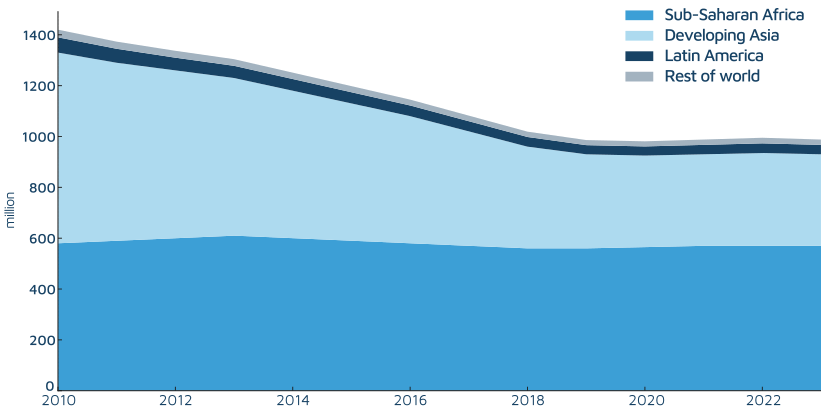
Conversely, sub-Saharan Africa, a region beset by instability, conflict, and violence, experienced a notable increase in its proportion of the worldwide electricity deficit:
- In 2010, the region accounted for 49.6% of the world’s lack of electricity access.
- By 2022, this had risen to 83.3% with 571 million people still not connected to the grid.
The number of people lacking access to electricity (by region, in millions, from 2010 to 2023)
Source: IEA
Urban vs rural electrification
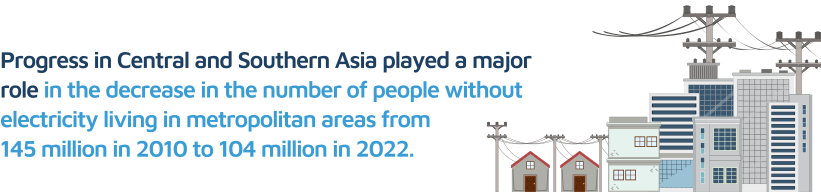
Globally, rural electrification has seen significant improvements. Between 2010 and 2022, the number of rural people with no access to electricity fell from 886 million to 562 million, according to the same ESMAP report:
- Central and Southern Asia registered the best results with the number of rural residents without access to electricity dropping from 383 million to 24 million.
- Sub-Saharan Africa, however, showed an increase of nearly 100 million people, from 376 million to 473 million.
Urban areas have also witnessed gradual improvement, but the pace of electrification is slower compared to rural regions.
Top 10 countries with the largest electrification deficits
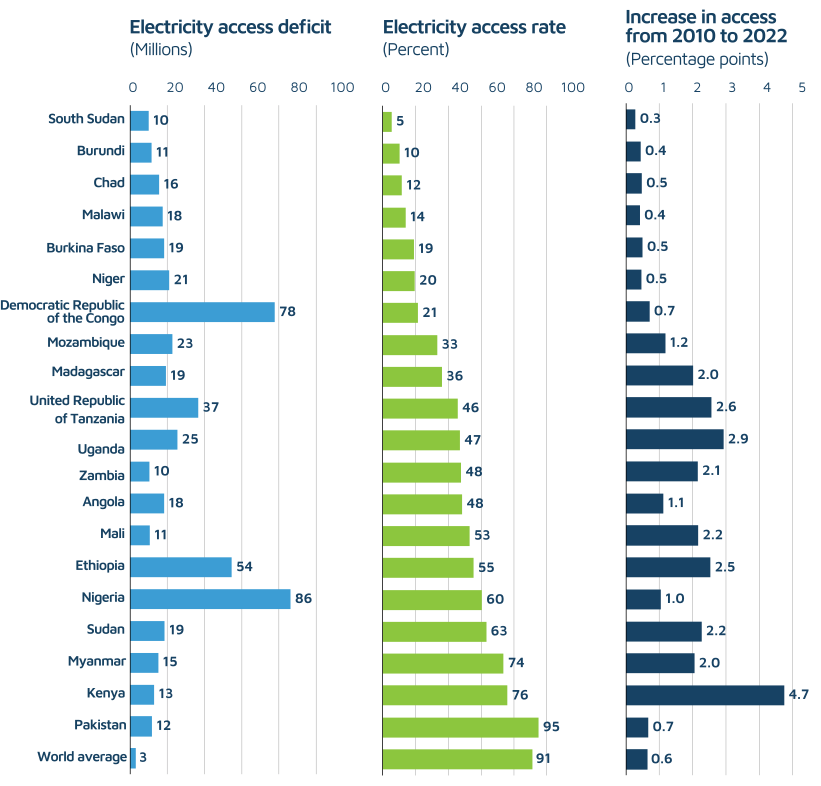
In 2022, 18 of the 20 nations with the largest electrification deficits were in sub-Saharan Africa, representing 75% of the global deficit.
Level of electricity access in nations with the lowest electrification rates, 2022
Source: Energy Progress Report 2024
When it comes to the total population living without electricity, the top three nations are:
- Nigeria (86.2 million people)
- The Democratic Republic of Congo (77.7 million people)
- Ethiopia (55 million people)
In these nations, electrification remains with modest annual access improvement rates:
- Nigeria – 1% per year
- The Democratic Republic of Congo – 0.7% per year
- Ethiopia- 2.5% per year
Among the nations making slow progress, there are also Burundi (0.4%) and South Sudan (0.3%).
Final word
Despite the progress achieved over the last 15 years, we are still far from providing electricity to every human on the planet. Progress continues, although rather slowly, particularly in remote regions. To improve the situation the least developed countries require investments, successful collaborations, and appropriate reforms.