

Add us as your preferred source on Google to see more of our content in Search.
 Add to Preferred Sources
Dairy products (or milk products) are nutrient-dense foods that provide a variety of vital micronutrients, along with energy and high-quality protein.
Millions of people worldwide, who are part of the dairy industry’s value chains, rely on it for their livelihoods.
Global milk production statistics
- According to the biannual report on global food markets from the United Nations Food and Agriculture Organization (FAO, November 2025), global milk production for 2025 is anticipated to reach 992.3 million tons (MMT), a 1.4% increase compared to 2024.
- In 2024, 979 MMT of milk were produced worldwide, while the year before, this figure was at 968.2 MMT.
- The Organization for Economic Co-operation and Development projects that global milk production – 81% from cows, 15% from buffaloes, and 4% from goats, sheep, and camels – will increase at a rate of 1.8% per year by 2034 and reach 1,146 million tons.
The OECD‑FAO Agricultural Outlook 2025‑2034 also mentions that future growth will be primarily driven by boosting dairy yields through improved animal health, feed efficiency, genetics, and improved production systems.
Global yields are predicted to increase gradually, with Southeast Asia and several African nations likely to see the highest growth.
Thus, Asia’s milk production increased 2.4% from 2023 onwards and reached 460 million tons.
Milk production volume in India – the largest milk producer – in 2024 registered a 3.5% growth compared to 2023, while in Pakistan, there was a 3% increase in the same period.
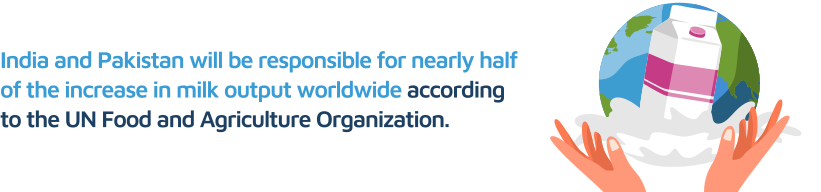
The OECD‑FAO report says that India will remain the largest milk producer in the world, showing strong growth. The reasons include expanding herds and improved productivity (mostly via small-scale farms connected to cooperative supply chains).
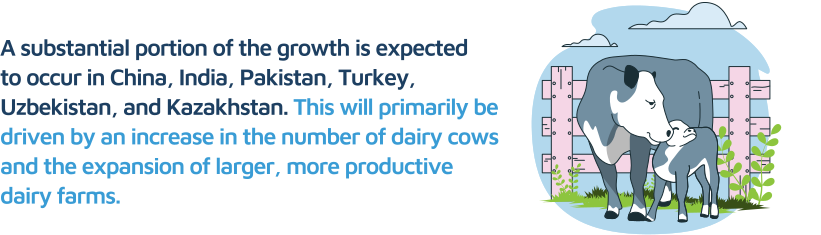
- Growth in the Asian region contributed to a further global increase in milk production levels. Experts register an ongoing herd expansion and steady productivity increases in Bangladesh, India and Pakistan.
- As for China, milk production, which fell by 2.8% in 2024, is expected to normalize steadily. The impact of continuous herd reductions is being mitigated by productivity gains resulting from consolidation among larger producers.
- In the EU, according to Eurostat, the milk production volume reached 161.8 MMT of raw milk in 2024, a 0.9 MMT increase compared to 2023. At the same time, in the European region, milk production reached 236 million tons in 2024, according to FAO, a 0.8% increase from the previous year. For the most part, the increase was registered in the European Union countries, Belarus, and Türkiye.
- The U.S. and Canada will carry on showing high yields per cow, with future production growth being reached mostly from efficiency gains.
- Sub-Saharan Africa is also anticipated to experience robust growth, primarily due to larger dairy herds.
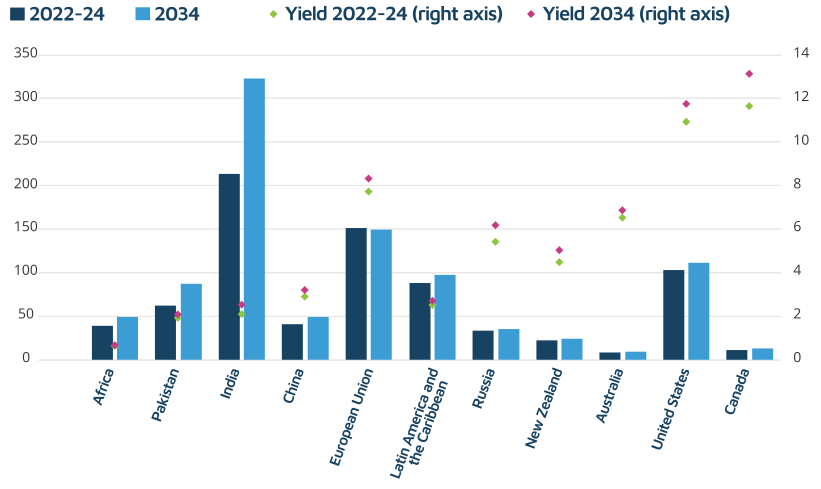
Source: OECD
Milk and milk products data (in thousand tons – milk equivalent)
Source: FAO. 2025. Dairy Market Review: Overview of global market developments in 2024
The role of dairy products in international development
The dairy industry boosts rural economies in both developed and developing nations. It gives smallholder farmers a stable source of income that can be invested in their children’s education, family support, healthcare, and their farms.
International organizations such as FAO, World Bank, and IFAD see dairy as a powerful instrument for ensuring food security, which assists the most vulnerable around the world.
Without a doubt, dairy products are crucial for international development, having an important role particularly in low- and middle-income countries, where they support nutrition, poverty reduction, and economic growth.
1. Nutrition and Health (SDG 2 and 3)
Dairy products (including milk) are rich in nutrients, containing important minerals, calcium, and high-quality protein. They are essential for maternal health, child development, and addressing hunger in underdeveloped regions.
2. Poverty Reduction and Livelihoods (SDG 1)
Globally, one billion people depend on the dairy industry for both their livelihoods and the upkeep of communities.
3. Economic Growth and Employment (SDG 8)
The dairy sector creates jobs across the value chain and assists rural economies. A long-standing practice of producing milk for processing and marketing it directly to customers is supported by 600 million people who live on 133 million dairy farms.
Leading milk-producing countries
Milk production is a vital component of global agriculture, as it is a key source of nutrition for people worldwide and the foundation of the dairy industry.
The largest producers of milk and milk products have a massive impact on supply chains and can influence dietary changes within the dairy industry.
The top 10 largest producers of milk and milk products accounted for over 76% of the global production in 2024.
Milk and milk products statistics (in thousand tons – milk equivalent)
*If counted as a single country
Source: FAO. 2025. Dairy Market Review: Overview of global market developments in 2024
Let’s dive deeper into the ten major milk-producing nations.
 India
India
India tops the list of nations with the most milk produced within one marketing year. The country accounted for 22% of global milk production with an output of 220 MMT in 2021/22. The following year, output increased to 239 MMT.
According to the latest data from FAO, in 2023/24 the country’s milk production reached 245 MMT, a rise of around 2.5% from 2021/2022, mostly due to an increase in dairy herd numbers.
The Indian states that boast the largest milk production are Uttar Pradesh, Rajasthan, and Gujarat.
India’s commitment to traditional and modern dairy farming practices is driving the sector’s ongoing growth.
Why doesn’t India import dairy despite being the world’s largest producer?
Though India accounts for 25% of world dairy production, the imports are very insignificant, mostly due to a high level of domestic production.
Considering that there are almost 80 million small and marginal dairy farmers in the country, a majority of whom sustain their families by raising a handful of animals, imports of dairy products would mean direct competition from the US and the EU.
India-USA dairy trade, or why is India not allowing USA dairy products?
Being one of the largest exporters of dairy products, the U.S. was looking for ways to enter India’s dairy market, a market that registers huge consumption levels of milk.
There are two main reasons why India does not import milk – one was stated above, i.e., cheaper products could lead to competition, and lower prices, affecting India’s dairy farmers.
The other reason is that the U.S. milk is considered “non-veg milk” in India, meaning that it originates from cows fed nutrients produced from animals (meat meal, blood meal). Even though these are allowed under U.S. regulations, such milk is considered incompatible with the people’s dietary beliefs in India.
India has mandated that any dairy products it imports from the U.S. must be coupled with certifications proving the animals were never given animal-based foods.
 European Union
All EU nations produce milk, which contributes significantly to the value of the union’s agricultural output.
The total annual EU milk production exceeded 161 MMT in 2024. The major milk producers are Germany, France, Poland, the Netherlands, Italy, and Ireland. In total, these nations account for over 70% of the region’s milk output, according to the agricultural data of the European Commission.
In the past few years, the EU dairy herd has reduced, while the milk yield per cow has increased. On average, approximately 20 million cows produced 7,800 kg of milk in the EU in 2023.
 The United States
In 2022/2023, the country registered an output of over 102 MMT, making it the second-largest individual country milk producer after India. (Since in this article we consider the European Union as an individual milk producer, although it is not a single country, the region showed a higher output than the United States.)
Although there are large-scale dairy farms in several states, these are primarily located in just three – California, Wisconsin, and New York.
The versatility of the American dairy industry is demonstrated by the production of a broad range of dairy products, including fluid and powdered milk, cheese, and butter.
 Pakistan
In 2024, Pakistan produced 66.3 MMT of milk, an increase of around 3% from the previous year (64.4MMT), with growing dairy herd numbers contributing to this.
Pakistan’s dairy industry is a major player in the global market, contributing significantly to domestic and worldwide milk supply.
Although the nation’s industry involves a variety of dairy animals, cows and buffaloes account for a significant amount of the total output.

The prosperity of the dairy business can be seen through the production of a wide range of dairy products, including liquid milk and ghee (clarified butter).
 China
China
China is the world’s fifth-largest milk producer with over 43 MMT registered in 2024/2025, yet its dairy sector is defined by a notable gap between milk output capacity and per-capita consumption. There’s a considerable difference between urban and rural areas, with people from rural regions registering a consumption that’s less than 10% of urban levels, says IBISWorld.
The demand is increasing due to rising household incomes, greater health awareness, high levels of urbanization, and expanding rural markets.
Data from IBISWorld’s report evaluated the 2025 market size at US$76.5 billion. Some experts anticipate the market to hit around US$91 billion by 2030, showing a CAGR of around 4.2%.
Cloning high-yield milk donors
In May 2026, it was announced that Chinese scientists from the Northwest A&F University had successfully cloned six super-high-yield dairy goats (four males and two females). This is an important advancement in dairy goat breeding technology.
According to the researchers, the cloned goats were developed from high-yield Saanen donors that boast an average yearly milk yield of more than 2,800 kg. Moreover, these donor goats have higher milk fat and protein levels compared to regular goats.
 Brazil
Brazil recorded an output of just over 38 MMT of milk and milk products in 2024/2025. Overall, the Latin American region continues to register an increase in milk output year-over-year, according to the U.S. Department of Agriculture. The increase is the result of favorable weather conditions.
At the same time, profitability is seriously affected by the rising energy costs and higher fertilizer prices.
According to Brazil’s latest production data for December 2025, milk output increased by 5.6%. In 2026, milk production in the country is anticipated to hit 26.16 MMT, which is 2.6% more compared to the 2025 estimates of 25.5 MMT.
 Russia
With slightly over 34 MMT of dairy products in milk equivalent registered in 2024/2025 (up from 33.8 in 2023), the Russian Federation continues to be among the largest milk producers.
The value of dairy products that the country exported in 2025, based on preliminary data, was US$500 million. Experts estimated that dairy product exports may exceed US$730 million by 2030.
Between January and November of 2025, Russia’s commercial milk output rose by 3.9%.
 Türkiye
The volume of dairy products in milk equivalent in 2024 was 21,9 MMT, making Türkiye one of the leading dairy producers in the world.
In terms of milk production, the country registered a 2.3% increase in 2024 compared to the previous year, thus showing a growth after three years of consecutive decline. The positive outcome is the result of herd replenishment via an increase in live cattle imports, as well as increased demand and policy interventions.
 New Zealand
Even though New Zealand is one of the largest top-10 producers of dairy products, 95% of its dairy is exported, with China being its number one buyer.
The country showed a production level of 21,5 MMT in 2024, which is slightly over the previous period, when it registered 21,2 MMT.
Overall, Oceania (the region composed of New Zealand, Australia, Papua New Guinea and thousands of the Pacific islands) had a milk production level of 30 MMT in 2024, which is 1.6% over the results it showed in 2023, and mostly this is the result of high output in New Zealand and Australia.
The high level of milk output in New Zealand in 2024 was the result of favorable weather conditions throughout September – November, which is the peak season for milk production. Moreover, the result was achieved despite a difficult start to the year, when the country was impacted by El Niño, which affected grassland and fodder (used specifically for feeding domesticated livestock).
Why does New Zealand dominate global dairy exports?
There are several reasons: First is ongoing investments in productivity improvements, Agtech innovations, and on-farm infrastructure, and second is the country’s small population – around 5.3 million. Whole milk powder (WMP) is the number one export category by volume.
 United Kingdom
The nation’s milk production stayed nearly at the same level as the previous year, with 15,54 MMT registered in 2023 and 15,59 MMT in 2024.
Despite lower yields caused by higher input costs and heavy rainfall in April and September, the country managed to increase its cattle population, thus counterbalancing the decline.
A February 2026 article by The Guardian outlined that British farm products had shown a nearly 40% drop over the last five years since Brexit.
Frequently asked questions (FAQ) about the world milk industry
What country produces the most milk in the world?
India is the world’s largest milk producer, accounting for approximately 25% of global output. In 2024/2025, India produced 245.9 million metric tons (MMT), having a sizable dairy herd of buffaloes and cows, and benefitting from government backing for cooperative farming.
What are the top 5 milk-producing countries?
According to the FAO Dairy Market Review, the top 5 milk producers globally in 2025 were:
- India with 245.9 million metric tons,
- European Union with 161.1 MMT,
- United States with 102.5 MMT,
- Pakistan with 66.3 MMT,
- China, with 43.1 MMT.
Which country is the largest exporter of milk?
New Zealand is the number one dairy exporter, even though it ranks 9th in raw production. The country exports 95% of all its dairy, generating NZ$22.4 billion (US$14.1B) in export revenue, according to the U.S. Department of Agriculture. New Zealand is followed by the European Union and the United States in terms of export of milk, according to an OECD report.
How much milk is produced in the world each year?
Global milk production was 982 million tons (2024), which is a 1.4% increase from the previous year. Projections show that milk production will show an annual growth of 1.8% and reach 1,146 million metric tons (MMT) by 2034, with the largest producers being India, Pakistan, and sub-Saharan Africa, according to OECD‑FAO Agricultural Outlook 2025‑2034.
Final word
The earliest evidence of dairy product consumption goes back more than 6,000 years. Nowadays, dairy products are widely consumed around the globe and play a crucial role in international development, especially in view of the increasing population and urbanization.