
Add us as your preferred source on Google to see more of our content in Search.
 Add to Preferred Sources
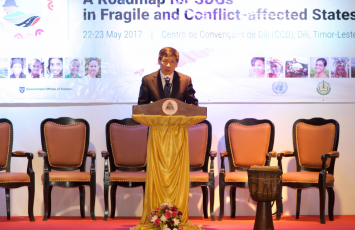
The Global Conference on the 2030 Agenda: A Roadmap for SDGs in Fragile and Conflict-affected States” was officially opened on Monday by the President of the Democratic Republic of Timor-Leste H.E. Mr. Francisco Guterres “Lu Olo”.
“Timor-Leste was one of the few countries to ratify the 2030 Agenda at the parliamentary level. This clearly shows our commitment to both the global development agenda and the implementation of the Sustainable Development Goals,” H.E Mr Francisco Guterres
At the opening, the United Nations Secretary-General delivered a video message and was represented by Assistant Secretary General and UNDP Regional Director for Asia and the Pacific, Mr. Haoliang Xu to deliver introductory remarks.
“This conference is an excellent forum for learning about how countries such as Timor-Leste, have transitioned from conflict to peace and development, and how peace has been sustained. It also presents lessons and opportunities for cooperation between fragile states on SDGs,” UNDP Regional Director for Asia and the Pacific Mr. Haoliang Xu.
Timor-Leste has experienced decades of challenges arising from occupation and internal strife. However, it is one of the few countries where peace has been achieved and sustained. Its experience offers important lessons of how a country-owned and country-led approach can ensure sustained peace and development, and take key steps to graduate from Least Developed Country (LDC) status to Low Middle Income Country (LMIC) status.
The Global Conference on 2030 Agenda brings together High Level policy makers from Government, Development Partners, and Civil Society Organizations to discuss challenges and share lessons and best practices on the implementations of the 2030 Agenda in Fragile and conflict-affected states.
Timor-Leste’s SDG Road Map was also presented as an example of how these challenges can be overcome. It will spur discussions on how to design a framework to achieve the SDGs, in such states.
Source: UNDP. Read full information here.
23 May, 2017