

Add us as your preferred source on Google to see more of our content in Search.
 Add to Preferred Sources
Over the last decade, humanity witnessed a massive decline in HIV infections, with 1.3 million or 40% fewer people acquiring HIV in 2024 than in 2010. However, the health sector aid cuts announced by the largest donors in 2025 is likely to affect progress by putting HIV prevention at risk in most developing nations since the funding for this comes from external donors.
According to the Joint United Nations Programme on HIV/AIDS (UNAIDS) 2025 report, nearly 80% of HIV prevention measures in sub-Saharan Africa and 60% in North Africa and the Middle East were supported by external funding. The organization estimates that by 2029, the aid cuts could lead to an additional 6.6 million new HIV infections and almost 4.2 million AIDS-related deaths with the funding cuts straining HIV response programs in low- and middle-income countries.
This article presents the current data and trends of new HIV infections in sub-Saharan Africa amidst the health aid cuts.
Why focus on sub-Saharan Africa?
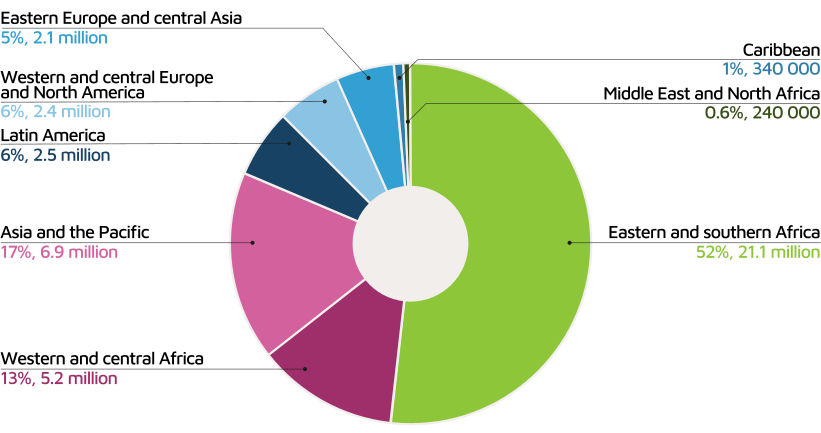
According to UNAIDS, in 2024, two-thirds of HIV positive people around the globe were from sub-Saharan Africa which means the region is at the epicenter of HIV/AIDS infections. Among those two-thirds, more than 21 million were from Eastern and Southern Africa, and at least 5 million were from Western and Central Africa (Figure 1). Globally, almost 41 million were living with HIV as of 2024, and therefore, people living in Eastern and Southern Africa make up 52% of this number, while Western and Central Africa residents represent 13%.
Figure 1: Distribution of people living with HIV (PLHIV) in 2024, by region
Source: Epidemiological Projections of UNAIDS, 2025
The decline in donor funding is disrupting testing and treatment, which is one of the reasons for the high number of people living with HIV in sub-Saharan Africa. In Western and Central Africa, access to treatment has been disrupted because donors funded 90% of the costs.
Diminishing international aid to fight HIV/AIDS in Africa
Despite accounting for at least 77% of weekly global new HIV infections among young women and girls, only 1% of annual global health expenditure is available to sub-Saharan Africa. The reduction in Official Development Assistance (ODA) of almost 70% is among the reasons for the high infections in the region, as external donors supported 80% of HIV initiatives in 2024 alone. Moreover, according to OECD data, foreign aid from major donors dropped in 2024 by almost 7.1% compared to 2023. The OECD predicted a 9-17% decline in net ODA in 2025 due to aid cuts by primary donors, putting progress in HIV treatment at risk.
Diminishing foreign aid for health has been fueled by recent funding cuts to the U.S. President’s Emergency Plan for AIDS Relief (PEPFAR). The program’s funding for AIDS was reduced from approximately US$6.9 billion in FY2023 to almost US$6.5 billion in 2025 (Figure 2). Despite the waiver that allows PEPFAR implementing partners to provide critical services such as HIV treatment, service gaps still exist. These health financing gaps are causing stockouts of HIV/AIDS drugs like pre-exposure prophylaxis and test kits while also weakening the ability of laboratory services to function effectively.
Figure 2: PEPFAR’s U.S. funding trends, FY2004-FY2025
Source: Kaiser Family Foundation of Health Policy
HIV data by country in sub-Saharan Africa
In 2024, South Africa had over 7.8 million people living with HIV (PLHIV), ranking first in this sad top 10 list (Figure 3). Mozambique ranked second with approximately 2.5 million PLHIV.
In terms of prevalence, Eswatini had a 26% prevalence rate – the highest level both around the globe and in the sub-Saharan region. Despite South Africa leading in the number of PLHIV, it had an 18% prevalence rate, putting it in third place in the region. Eswatini also leads the globe in new HIV infections per 1,000 people, followed closely by South Africa and Mozambique.
Furthermore, HIV/AIDS accounts for about 4.6% of deaths in Africa and is the eighth leading cause of death. South Africa (53,000) and Mozambique (44,000) had the highest number of AIDS-related deaths worldwide in 2024. Among the Top 25 countries with the highest AIDS- related deaths, the majority were in sub-Saharan Africa, as shown in Figure 3.
Figure 3: Top-10 nations by number of PLHIV in sub-Saharan Africa as of 2024
Source: Statista Survey Data of 2024
Emerging HIV/AIDS global annual statistics
Globally, almost 41 million people lived with HIV in 2024 compared to close to 40 million in 2023 (Figure 4). In 2024, at least 26.3 million people living with HIV came from sub-Saharan Africa, making it an epicenter of the infection.
Considerable efforts by donors, implementers, and governments resulted in new HIV infections decreasing from nearly 2.2 million in 2010 to 1.3 million in 2024 – a 40% decrease. The same level of 1.3 million new infections had been witnessed in 2023.
Meanwhile, the accessibility of antiretroviral therapy increased from about 7.7 million in 2010 to roughly 31.6 million in December 2024.
Figure 4: 2024 regional data of HIV
Source: UNAIDS Epidemiological Estimates, 2025
However, new HIV infections are predicted to rise from 2025 through 2030 due to aid cuts that may put previous progress at risk. According to a UNAIDS 2025 report, the U.S. funded almost 45% of total HIV prevention programs in 15 sub-Saharan nations, with high-burden countries depending entirely on PEPFAR for HIV prevention. Any subsequent cuts by the U.S. for these programs in the region may reverse progress.
Increasing burden of HIV/AIDs on pregnant women & girls
Expectant women and girls in developing nations are paying the highest price for service disruptions to donor-supported HIV programs and experience higher infection rates resulting from social and gender inequalities. Globally, 45% of all new HIV infections in 2024 were among women and girls, but in sub-Saharan Africa, this figure is 63%. In 2024, more than 4,000 adolescent girls and young women became infected with HIV on a weekly basis, with at least 3,300 of these living in sub-Saharan Africa.
Wrap Up
Recent statistics indicate that sub-Saharan Africa leads in new HIV infections globally, and the number is expected to increase as a result of aid cuts in 2025 and 2026. Despite significant progress in reducing HIV infections over the last decade, the new trend of health aid cuts is leading to the need for increased budgetary allocation by local governments and renewed international support to achieve sustainable progress. Sub-Saharan Africa should therefore redevelop its sustainable HIV/AIDS support mechanisms to address the service disruptions and transform the AIDS response.