
Add us as your preferred source on Google to see more of our content in Search.
 Add to Preferred Sources
Key reasons to read this article
- Money, not the law, often determines women’s safety in Africa.
- Even where abortion is legal, thousands still risk their lives because rights on paper do not translate into access in reality.
- Millions of abortions occur annually in Africa, most of them unsafe, with the death toll increasing to tens of thousands.
- The daily wage of US$4 often turns abortion into a life-threatening gamble.
- Decisions made on other continents can determine whether a rural clinic survives or whether women are forced to face danger.
On a night she will never forget, Magdaline Murage, a 25-year-old casual worker in Kenya’s Kirinyaga county, drank a mixture of tea leaves and detergent to end an unwanted pregnancy. She already had two children, and her wages from a rice farm barely fed them.
At a local hospital, Magdaline was denied care. Instead, she was left on a cold concrete veranda as punishment. “Because you wanted to die, you should suffer,” health workers told her, as passers-by stopped to stare. By the time treatment was offered, the damage to her reputation had been done. She fled her village soon after to escape the stigma.
Two hundred kilometres away in Nairobi, Stacy Adhiambo, a 43-year-old businesswoman, faced the same decision with a very different outcome. She was driven to a private clinic, underwent the procedure discreetly, rested for two days, and then returned to work. “It was like going to the dentist,” she said. “Uncomfortable but professional.”
The two women live under the same constitution. Yet their experiences expose a defining reality of abortion access across much of Africa – safe care for those who can pay, and dangerous, stigmatising outcomes for those who cannot. It is not legality, it is class, geography, and information that determine who survives.
A continent still bound by restrictive laws
The legal landscape across Africa’s 54 countries remains a patchwork of prohibition and permission. About 92% of women in sub-Saharan Africa live in 43 countries with highly or moderately restrictive laws, according to the Guttmacher Institute. Data from the MSI Reproductive Choices indicates that six countries, including Egypt, Madagascar, and Senegal, still prohibit abortion entirely, down from 10 in 2019.
From a progressive aspect, eight countries now allow abortion on request up to a certain stage of pregnancy, typically 12 weeks. These include South Africa, Zambia, Rwanda, Tunisia, Cape Verde, Mozambique, São Tomé and Príncipe, and Benin.
Most remaining countries permit abortion only in limited circumstances, such as to save a woman’s life, protect her health, or in cases of rape, incest, or foetal deformities.
Between 1994 and 2022, 19 African countries improved their abortion laws to some extent. Women who undergo illegal procedures face up to seven years imprisonment, while providers risk up to 14 years, depending on the country.
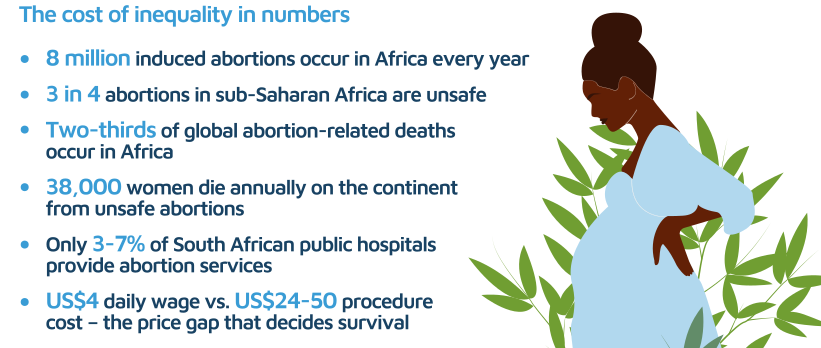
Yet abortions continue at almost the same rate. Africa records an estimated 8 million induced abortions annually, accounting for almost two-thirds of global abortion-related deaths, according to the World Health Organization.
When progressive laws meet regressive reality
There was no need for Magdaline to drink detergent. Kenya’s 2010 constitution allows abortion when a trained health professional determines that a woman’s life or health is at risk.
But she did not know her rights. She could not afford private care. And she feared arrest. “I thought it was completely illegal,” she told DevelopmentAid. “I only went to the hospital when I thought I would die.”
Even in South Africa, which legalized abortion nearly three decades ago, the gap between the legal right and the lived reality remains vast. Dr. Lethukwenama Letsoalo, a medical doctor and sexual and reproductive health advocate, confronts this paradox daily.
“Having a right on paper does not equate to a right in practice,” she says. Unsafe abortion remains rampant in South Africa because “most people don’t know it’s legal and free and comprehensive sexual education is lacking”.
This ignorance is compounded by unawareness of the 12-week limit. Only 3% to 7% of South African public hospitals provide abortion services, she added.
Healthcare providers, driven by religious beliefs, refuse to perform procedures and sometimes harass girls seeking services, even though the law allows it Dr. Lethukwenama commented.
This pattern is repeated across the continent. Didmus Ochieng, a health worker at a public facility in Kenya, describes the paralysis. “The law says the mother’s life must be in danger, but if a woman says the pregnancy is causing mental health issues, how do I prove it?” He explained that even in the case of rape, verification becomes complicated and many providers avoid the risk. He added that religious beliefs heavily influence whether doctors will provide the service.
In October 2025, Malawi’s High Court delivered a landmark ruling in the case of AC, a 13-year-old girl who became pregnant after being raped, who was initially denied an abortion at a public facility. The court ruled that forcing a child survivor of sexual violence to continue a pregnancy was “harsh and inhumane.”
But this decision was dependent on age. “It only applies to child survivors,” says Ireen Kayira, a program lawyer at the Nyale Institute in Malawi. “It does not cover other women.”
Efforts to domesticate the African Union’s Maputo Protocol, which mandates abortion access in cases of rape, incest, and threats to maternal health, have repeatedly stalled. Although 46 AU member states have ratified the protocol, abortion provisions are routinely stripped from national legislation due to political fear of backlash, she noted.
Inequality by the numbers
Research in Zambia in 2025 found that socioeconomic status drives roughly 67% of inequality in unsafe abortion outcomes.
Magdaline earned 500 Kenyan shillings a day, about US$4, from casual work on the rice farm. A safe abortion in a public facility would cost her about US$24, while in a private facility, this would be about US$50.
Dr. Jessica Oga, a legal expert and sexual and reproductive health advocate, has witnessed this divide across Nigeria and Uganda. “A wealthy woman has information, can go abroad to have the procedure done, or attend a private hospital with skilled professionals,” she explained. “It affords her discretion.”
With regard to rural women and those living in slums, she explained that, “there are not so many skilled workers in rural areas, so often women turn to traditional healers or self-abortion.”
Kayira disclosed that a survey supported by the Nyale Institute found that only 50% of public hospitals provided abortion services, despite having trained staff. Meanwhile, 100% of private hospitals in the survey offered them.
Contemporary interference
Now, a new form of external pressure is looming. In January 2026, U.S. President Donald Trump reinstated the Global Gag Rule, a policy that bars foreign organizations from receiving American health funding for providing or even discussing abortion services.
For Dr. Oga’s organization and countless others across Africa, the implications are serious. “Organizations involved in sexual, reproductive, and health rights in Uganda risk dropping the initiative, and this will not stop abortion but make it more unsafe,” she warned.
The ripple effects will extend beyond abortion to family planning, HIV services, and other health programs that serve vulnerable populations with no alternatives, she added.
Pragmatic path forward
Dr. Lethukwenama advocates for solutions that acknowledge both the legal barriers and implementation failures. She calls for government-regulated telemedicine platforms to provide safe abortion medication following a verified doctor consultation, and the integration of self-managed abortion into mainstream healthcare.
“Women currently buy abortion pills online from anyone,” she explained. “The government should have a website listing verified companies and doctors.” This would eliminate the need for women to face stigma and barriers at health facilities while also ensuring their safety.
For now, the gap persists, and 38,000 African women continue to die every year from unsafe abortions, as a study published in the PLOS journal revealed.