

Add us as your preferred source on Google to see more of our content in Search.
 Add to Preferred Sources
Key reasons to read this article:
- The Middle East war may trigger a crisis far bigger than any battlefield.
- Missiles dominate headlines, but the real danger may come from a covert water war.
- The destruction of the water systems that keep entire societies alive may unleash a slow-moving catastrophe that could outlive the war itself.
- When water disappears and farms fail, millions may have no choice but to move.
- The most devastating weapon in this war may be something no one intended to use.
Missile strikes on fuel depots, drone attacks on coastal infrastructure, and explosions near ports across the Persian Gulf have dominated global headlines since the United States and Israel launched strikes on Iranian targets in late February, dramatically escalating tensions across the Middle East.
But analysts say the most profound consequences lie not on the battlefield but in the destruction of the systems that allow societies to function, triggering a chain reaction in which environmental degradation and economic collapse reinforce one another, generating a cascading crisis.
The sequence has a recognizable pattern. Strikes destroy energy infrastructure and cripple water systems. Failing water supplies undermine agriculture. Collapsing agriculture drives migration. And throughout, governments consumed by war lose the capacity to confront climate change.
Each link weakens the next, and in a region already at the edge of its environmental limits, there is very little slack in the chain.
First domino: Water systems at breaking point
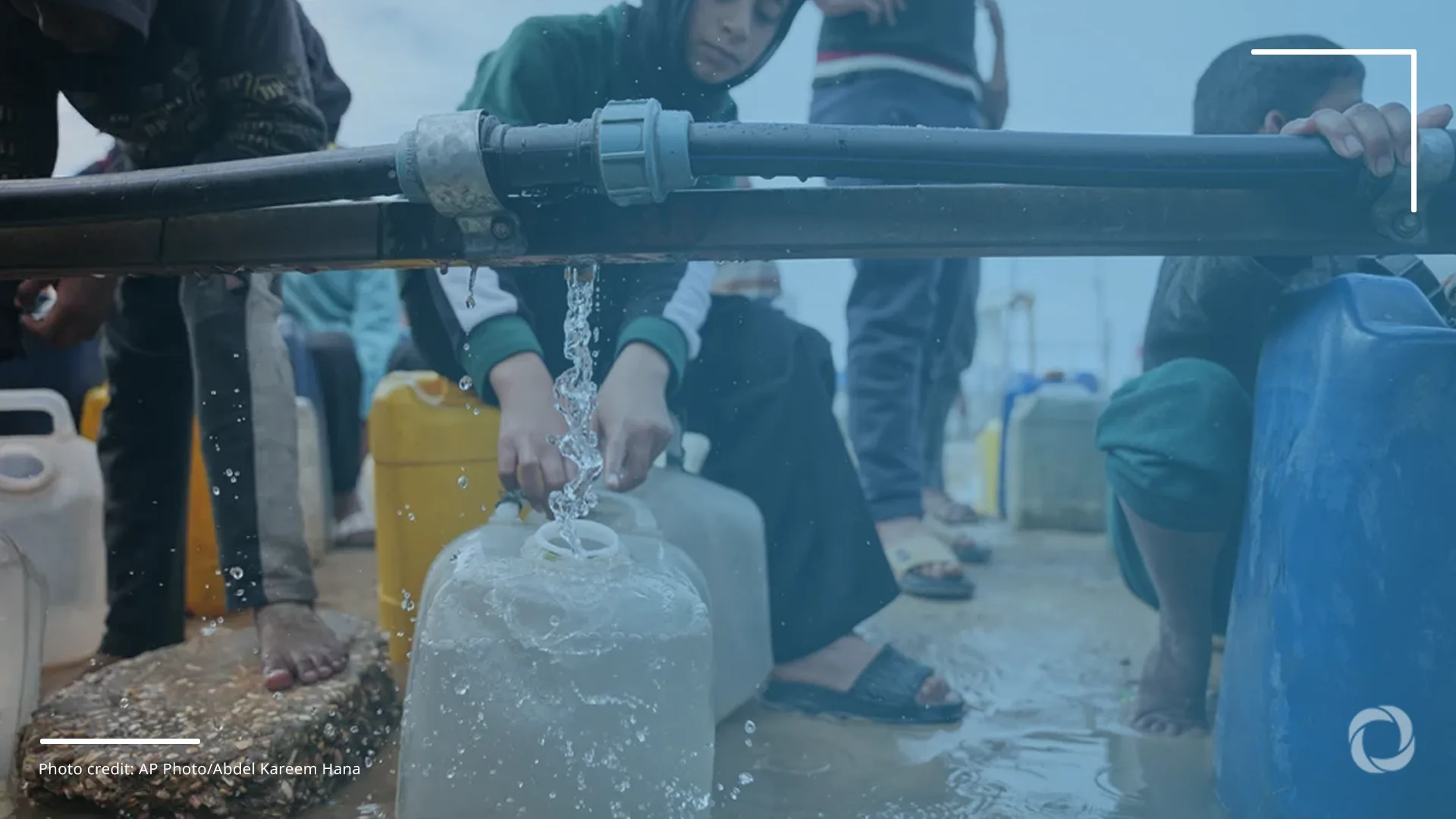
In the Middle East, water has always been more valuable than oil. The region holds just 2% of the world’s renewable freshwater with the World Resources Institute estimating that 83% of its population faces severe water scarcity. To survive, Gulf states have invested heavily in desalination plants. The region accounts for 46.9% of global contracted desalination capacity, supplying 86% of Oman’s, 70% of Saudi Arabia’s, and 90% of Kuwait’s drinking water.
Those lifelines are now under direct attack. Iran’s Foreign Minister Abbas Araghchi accused the US of striking a plant on Qeshm Island, disrupting the water supply to 30 villages. Bahrain reported a facility being hit by debris from Iran. Plants in the UAE and Kuwait have also been caught in the crossfire. This vulnerability has long been anticipated. A 2008 U.S. diplomatic message warned Riyadh might need “evacuation within a week” if key plants were destroyed, while a 2010 CIA analysis cautioned that outages could last months.
The problem runs deeper than the strikes themselves. Most desalination plants are cogeneration facilities that produce both water and electricity. Attack the power grid, and water production halts immediately. A 2025 World Bank report noted that energy accounts for up to 75% of desalination operating costs, meaning fuel supply disruptions become water supply disruptions.
Aziz Alghashian of the Gulf International Forum argues that targeting water infrastructure has become a calculated pressure tactic that is designed to “pressure governments without forcing full-scale war”, an allegation that U.S. and Israeli officials have repeatedly denied.
Iran was already reeling from five years of severe drought before the first strike and now the conflict has turned a chronic vulnerability into an acute crisis.
Second domino: Agriculture and food supply under pressure
When water systems fail, agriculture follows. In a region where countries such as Bahrain and Saudi Arabia have over 90% of cultivated land dependent on irrigation infrastructure, according to the Food and Agriculture Organization, any disruption to power or water supplies translates directly into failed crops, declining livestock production, and broken supply chains.
But the conflict’s impact on food extends far beyond the region’s own farms. The Persian Gulf supplies at least a quarter of the world’s traded nitrogen fertilizers which are essential for global crop production.
With the Strait of Hormuz effectively closed, that supply has stalled. “If the Strait of Hormuz remains strangled, prices for fertilizer will rise,” Peter Goodman, global economics correspondent for the New York Times, warned. “Farmers may use less on their crops. The world will get less food, and it will cost more.”
The United Nations has confirmed that rerouting shipping around the strait is already driving up logistics costs, compounding food inflation in countries, many of them in this region which imports 80-90% of what its population consumes.
Third domino: Displacement and urbanization
When farming becomes unviable, people move. The escalating war has already displaced more than 4 million people, including 3.2 million in Iran and roughly 820,000 in Lebanon.
According to the International Organization for Migration’s Displacement Tracking Matrix, over 19 million people across the region have been internally displaced by the current conflict, violence, and disasters.
The populated areas absorbing these are themselves under strain, with power grids disrupted and supply chains severed. The International Monetary Fund has documented that refugee influxes could be equivalent to 20 years of projected population growth landing on the existing infrastructure overnight, overwhelming schools, hospitals, and water networks that were built to service just a fraction of the population now depending on them.
Before the war began, the Middle East Forum predicted there would be 3.5 million Iranian cross-border refugees by 2035 as a result of water scarcity and potential government failure. Analysts estimate that the war may compound this threat drastically, compressing the timeline.
Fourth domino: Climate resilience collapses
The conflict has struck a region that is already losing the race against climate change. The Middle East and North Africa are warming at up to 3.5 times the global average, according to the Journal of Geophysical Research, with heatwaves anticipated to last 118 days a year by 2100.
The war is accelerating that trajectory. Burning oil infrastructures produce black carbon particulates that absorb heat and alter cloud structure. Sulphur dioxide and nitrogen dioxide settle into the soil and seep into water tables, contaminating ecosystems long after the fires have been extinguished. “If the number of oil fires increases,” the Conflict and Environment Observatory warns, “their cumulative climate effects may become appreciable.”
Governance is the second casualty. Governments at war redirect budgets from environmental and infrastructure programs to defense, a pattern Europe demonstrated after the outbreak of the Ukraine war, when military spending surged while international climate finance came under pressure.
Before Russia’s full-scale invasion in 2022, Ukraine spent about 7–8% of its government budget on defense. By 2024, that share had risen to 54%, according to the Stockholm International Peace Research Institute, leaving social programs largely financed through foreign aid.
The IMF has found that conflict-affected states suffer four times more higher economic losses from climate shocks than stable nations.
The war could also sever the funding pipeline that is driving the region’s clean energy transition. Both the United Arab Emirates, which pledged US$30 billion in oil-funded climate investment at COP28, and Oman, whose government confirmed in January 2026 that hydrocarbon revenues were financing its renewables program, now face collapsing export revenues, and with them, the capital for their clean energy futures.
The full cost
The missiles make the headlines but the consequences will outlast them in cracked irrigation pipes, abandoned farms, overcrowded cities, and gutted climate budgets. Nor does this conflict confine its destruction to the region alone. It exports it, through food inflation, severed supply chains, and collapsed climate ambition, to every country connected to those few kilometers of water at the Strait of Hormuz.