


Add us as your preferred source on Google to see more of our content in Search.
 Add to Preferred Sources
Philanthropic organizations, bilateral donors and development agencies are providing funding to support Artificial Intelligence (AI) policies in Africa to ensure the ethical and sustainable use of this technology on the continent. These donor-aided initiatives mainly support AI governance and data protection frameworks, and the implementation of the AU Continental AI Strategy that was approved in 2024.
The funding available for AI governance support has increased between 2024 and 2026, aligning with Africa’s digital transformation strategy with its digital economy estimated to be US$180 billion in 2025. The financing spans across policy entities and regional economic groups in Africa, reinforcing coordinated ethical and environmental sustainability strategies.
This DevelopmentAid article explores the key donor-aided AI governance initiatives in Africa, highlighting the major financiers and their role in strengthening ethical regulation and environmentally sustainable AI deployment.
What is AI governance?
AI governance is a framework of procedures, policies, and ethical standards that are required to oversee the research, development, use, and maintenance of AI systems, thereby helping to ensure both safety and respect for human rights. AI governance also helps to align AI innovation with sustainable growth and environmental sustainability objectives.
Why is AI governance needed and why is it important?
AI governance is vital to ensure the fair, ethical, and secure deployment of AI technologies. The policies and ethical frameworks established for AI deployment on digital platforms create safety and trust among users. Effective AI governance also creates standards for data quality and fairness, ensuring algorithms are trained on diverse datasets that reduce bias and protect privacy rights and data security in digital systems across sectors such as finance and health.
Conversely, a lack of effective legal and ethical guidelines means that AI technologies could expose sensitive data and fail to comply with data protection laws. The case of 2025 DeepSeek AI, a Chinese-based competitor in the AI marketplace, illustrates the importance of AI governance. DeepSeek faced global scrutiny when its unsecured ClickHouse databases leaked at least a million sensitive data points, such as chat histories and user passwords. The breach provided access to confidential information, demonstrating the need for effective AI governance to ensure secure data handling and trust in AI innovations.
The state of AI and AI governance in Africa
AI is rapidly evolving in Africa, with countries implementing proactive strategies to enable research, innovation, and deployment. Sectors such as education, health, and agriculture are integrating AI innovations to transform economies and business models. According to the McKinsey 2025 report, AI is capable of growing Africa’s economy by approximately US$4.8 billion by 2030, and most African nations are therefore adopting AI technology to reap its benefits. In terms of adoption rates, South Africa leads with 21.1%, followed by Egypt (13.4%) and Senegal (12.9%), according to Microsoft’s 2025 AI report.
Top-10 African nations by AI adoption rates and innovation
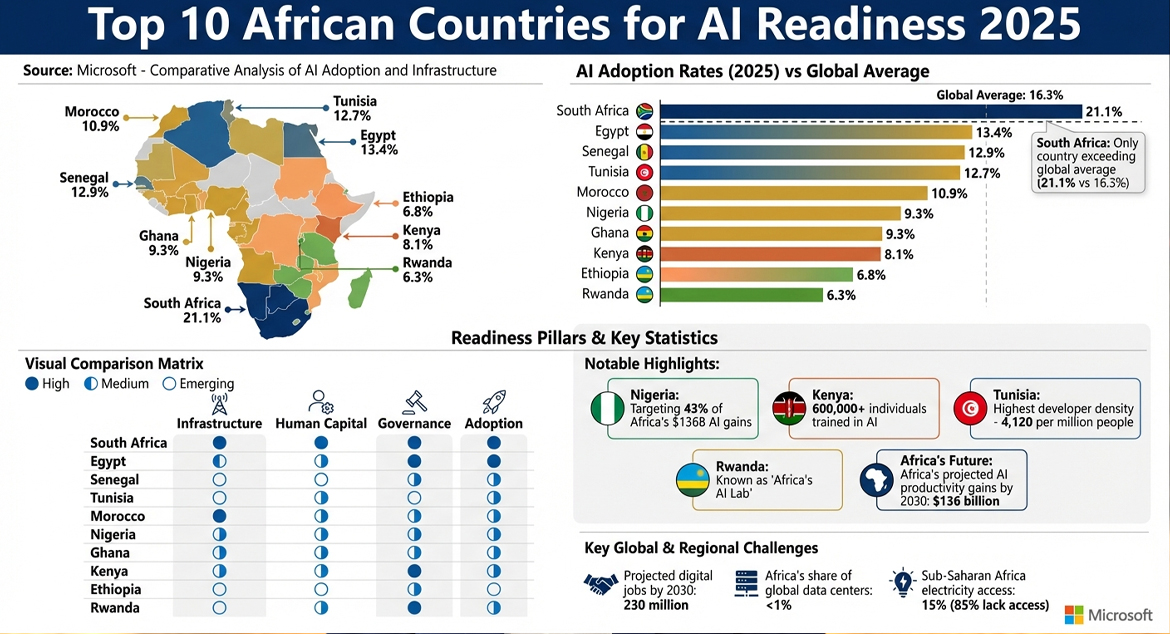
Source: Microsoft’s 2025 AI Africa’s AI Readiness Report
Key donor-aided AI governance initiatives in sub-Saharan Africa
🔹 AI for Development Africa (AI4D Africa): This is a five-year program financed by the International Development Research Centre (IDRC), Sweden’s Sida, and the UK Foreign, Commonwealth & Development Office (FCDO). This multi-million program is strengthening AI policy research, scaling AI innovations and infrastructure in sub-Saharan Africa. Its ultimate goal is to develop a responsible AI framework that can accelerate sustainable development.
🔹 African Observatory on Responsible Artificial Intelligence (AORAI): Aided by the IDRC and the FCDO with at least US$1.4 million in funding, this program promotes evidence-based AI governance research and policy advisory support for African nations. In its three years of operation, the AORAI has strengthened African agendas on responsible AI use and supported the inclusion of African experiences on the world’s stage of AI decision-making.
🔹 Smart Africa Alliance: Funded by multilateral donors and member nations, the alliance improves harmonized digital laws such as AI regulatory coordination. This promotes AI regional governance, data privacy, and policy adherence among the African member states. Through its Smart Africa Digital Academy, the alliance received a US$20 million grant from the World Bank to expand digital innovation and AI use across the region.
🔹 Digital Transformation Strategy for Africa: Funded by development partners such as the African Development Bank and the World Bank, this strategy incorporates AI governance into digital policy reforms to ensure inclusive and sustainable digital economies. It focuses on capitalizing on AI to generate an approximate US$1 trillion contribution to GDP by 2035. Such a strategy positions AI governance as a primary pillar for sustainable growth.
🔹 Data Governance in Africa Initiative: Aided by over €60 million from the European Union and other EU member states in the Global Gateway Strategy, this donor-backed initiative is strengthening the African Union by creating and establishing data policies and cross-border data sharing across the continent. The initiative also helps to develop a secure, human-centered digital environment that is based on ethical AI governance and privacy protection.
🔹 AI Evidence Alliance for Social Impact (AEASI) African Initiative: This is a £2.75 million program financed by the UK’s FCDO, Canada’s IDRS, and Community Jameel. The initiative develops evidence-based research on the societal effects of AI and guides policymakers on responsible AI deployment.
🔹 Championing Responsible Artificial Intelligence Policy-East African AI Policy Centre Initiative: With a US$1 million budget provided by the IDRC and implemented by Strathmore University, this initiative promotes evidence-based AI governance and policy dialogue to help African governments to address AI risks while promoting innovation.
🔹 The Africa Centre of Competence for Digital and AI Skilling: This project is worth over US$2.6 million, financed through a partnership with UNDP, contributing at least US$800,000 to fund digital and AI competencies for public servants. The program strengthens institutional capacity for AI risk assessment, ethical evaluation, and sustainable digital deployment across sub-Saharan Africa.
Wrap up
Donor-financed AI governance programs in Africa are strengthening ethical AI deployment and integrating environmental sustainability standards. The regulations promote energy-efficient AI algorithms, green data-center structures, and the use of renewable energy sources. By aligning responsible AI regulation in Africa with economic development, AI governance will reduce data-center energy consumption by enhancing green infrastructure and utilizing renewable energy.