
Add us as your preferred source on Google to see more of our content in Search.
 Add to Preferred Sources
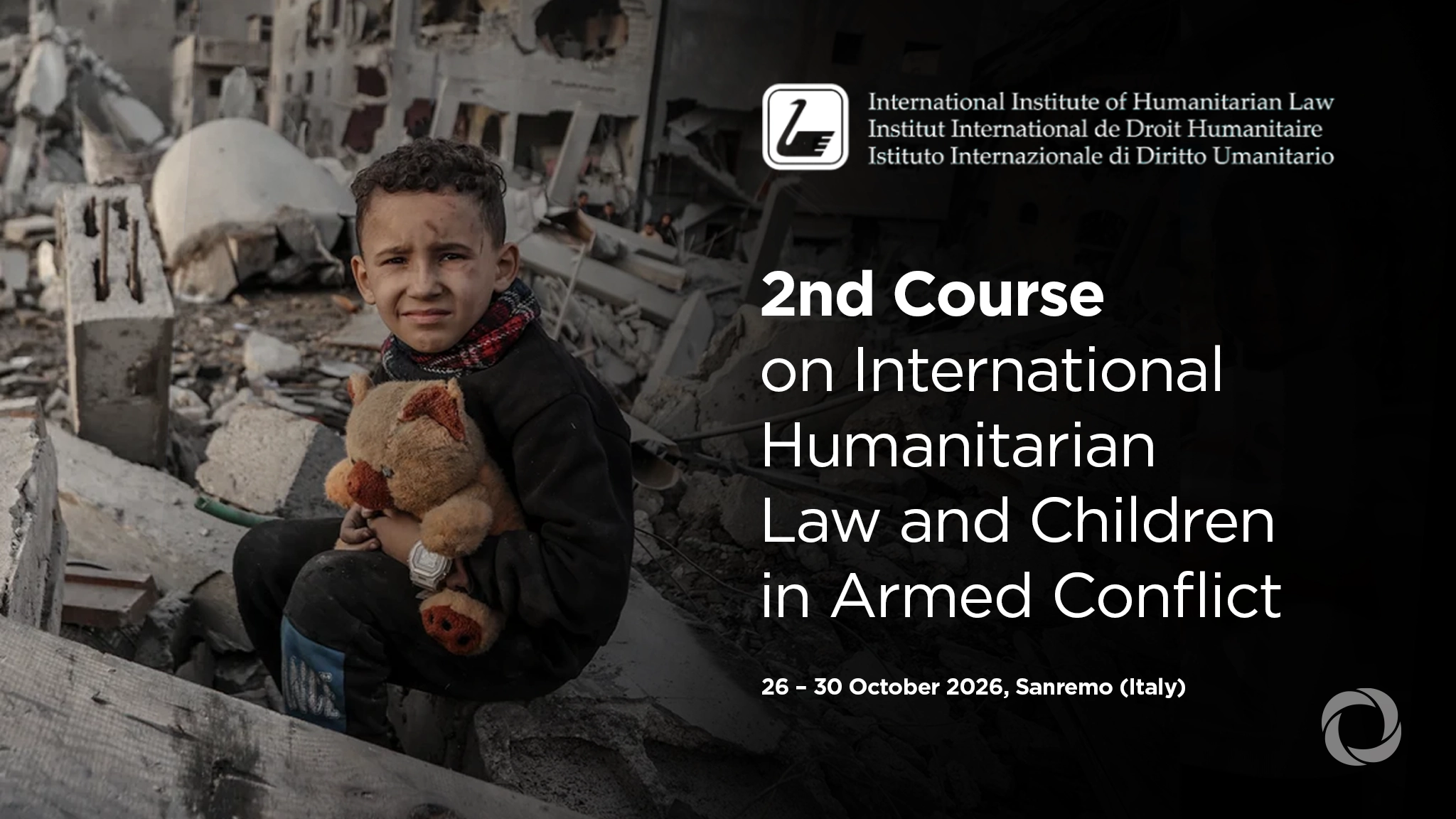
📅 26 – 30 October 2026
Sanremo (Italy)
Protecting children not only constitutes an obligation in international law but, even more importantly, a concrete investment in the future of mankind.
The legal protection of children, as part of the specific protection accorded to civilians during armed conflict, was first introduced into International Humanitarian Law by the 1949 Geneva Conventions as “persons taking no active part in the hostilities”. While the codification of special international provisions related to children was eventually integrated into IHL by the Additional Protocols to the Geneva Conventions of 1977, the following decade was characterized by an active legal debate on further regulation, leading to the adoption of the Convention on the Rights of the Child and other multilateral human rights agreements at the regional and international levels.
Currently, the continuous violations of these hard-fought IHL and IHRL provisions in international and non-international armed conflict, highlight the necessity of increased efforts in the training military and civilian practitioners whose work impacts children’s lives. In its most recent report, published at the end of 2025, the Special Representative of the Secretary-General for Children and Armed Conflict reported that, in 2024 only, the United Nations verified 41,370 grave violations against 22,495 children. This, with a 17% increase in the number of children subjected to multiple violations both perpetrated by non-State armed groups and regular armed forces/governmental forces.
Based on the aforementioned considerations, the Special Projects Department of the Sanremo Institute and the Universities Network for Children in Armed Conflict (UNETCHAC) have developed an international training programme on the protection of children in armed conflict.
Overall objectives
The 2nd Course on International Humanitarian Law and Children in Armed Conflict will focus on the issues of the application of the existing international provisions protecting children, as well as on the complex interplay of different bodies of law (IHL, IHRL, Refugee Law, etc.) on the field, the prevention strategies of crimes against children, the monitoring and reporting duties of governments and other actors, the issue of accountability against impunity and many other key aspects of the special protection granted to children in conflict scenarios.
Specific learning objectives
- Promote the participants’ overall awareness of the different bodies of law governing child protection at different levels (international, regional, national).
- Promote a deep understanding of the specific international provisions and principles applicable to children in armed conflicts.
- Develop a better understanding of the mechanisms governing the application of international provisions, strengthening compliance and accountability.
- Enhance the participants’ capacity of applying rules, assess risks of possible violations on the field, and develop policies and procedures accordingly.
- Highlight and increase awareness of the operational relevance of integrating age sensitive perspectives into the action implemented on the field, as well as of operating on the basis of a child-centred approach.
- Promote the integration of child protection considerations into strategic planning, operational design, and post-conflict recovery processes, ensuring a thorough understanding of its value for long-term sustainability and social resilience.
- Foster cooperation among the staff of institutions operating at different institutional levels and in different sectors (e.g. civilian and military, public and private, national and international).
Target audience
The course is addressed to governments officials, military officers, staff of international intergovernmental and non-governmental organisations, civil society organisations, law enforcement officers, humanitarians, academics, and any other category of practitioners professionally interested in the topic.
Considering the specialised focus of the course, a certain preliminary overall knowledge of the basics of international public law are preferrable to fully benefit from the training sessions.
Methodology
Within the course, expert practitioners and academics will work together with participants to foster a deep understanding and proper implementation of International Humanitarian Law, International Human Rights Law, Refugee and Migration Law, and many other related international rules protecting children in armed conflicts. The Course strikes a balance between theory and practice and is delivered through a participatory and creative teaching methodology, aimed at facilitating the learning process and implementing the knowledge gained throughout the training. Sessions include lectures, presentations, case studies, group work, and other activities such as role play.