
Add us as your preferred source on Google to see more of our content in Search.
 Add to Preferred Sources
Key reasons to read this article:
- A new EU-Bangladesh partnership promises stronger human rights protection, but press freedom remains under constraint.
- Journalists now face some of the most serious legal charges ever brought against media professionals in Bangladesh.
- The country’s global press freedom ranking continues to slide.
- International organizations are demanding accountability for attacks on journalists.
- The government insists reform is coming. But will it be sufficient?
Bangladesh has recently signed a new Partnership and Cooperation Agreement with the European Union, committing the country to uphold democratic freedom, human rights, and the rule of law. Yet despite this agreement, concluded within a bilateral relationship worth more than €22 billion in trade, concerns over press freedom continue to mount. Journalists are facing arrest, legal prosecution and street-level violence.
Since the political transition following the fall of Sheikh Hasina’s regime, any expectations of improvement have largely failed to materialize.
Deteriorating media landscape
The press freedom situation in this 169-million-people country appears to be deteriorating further as what critics describe as revenge-driven politics continues, following the political transition that ended Sheikh Hasina’s rule. This scenario is unfolding across a massive media landscape that features over 3,000 print media, 35 commercial radio stations, 32 licensed community radio stations, 30 television channels, and hundreds of online news portals. Reporters Without Borders (RSF) has ranked Bangladesh 152nd out of 180 countries in the 2026 World Press Freedom Index, classifying it as highly restrictive in terms of press freedom. This represents a drop from 149th position in 2025, placing the country in the RSF’s ‘very serious’ violation category.
To determine the 180-country ranking, the RSF assesses journalism conditions across five indicators: political, legal, economic, sociocultural environment, and safety. In Bangladesh’s case, a sharp decline in the political context score has been the primary driver behind the country’s drop in the ranking.
South Asian press freedom rankings
Source: Reporters Without Borders
The weaponization of justice
The legal assault on independent media has shifted from routine criminal charges to an unprecedented use of criminal law being used against reporters. Thus, prominent journalists Farzana Rupa, the former principal correspondent of Ekattor TV, and Mozammel Babu, the outlet’s former Editor-in-Chief, were arrested in a crimes-against-humanity case filed at the country’s International Crimes Tribunal.
The state prosecution has leveled charges of “crimes against humanity” against the two journalists, relying on editorial decisions made over a decade ago. Prosecutors allege that the journalists aired a “misleading” broadcast to obscure the death toll during a brutal government crackdown on a Hefajat-e-Islam rally back in 2013.
The move has drawn fierce criticism from international watchdogs. The U.S.-based non-profit Committee to Protect Journalists has noted that editorial decisions covering contested political events are not crimes against humanity. It highlighted that these charges violate both the country’s constitution and international human rights conventions. It has called on the Bangladeshi authorities to “stop weaponizing the international criminal tribunal to target journalists and immediately release Farzana Rupa and Mozammel Babu.”
Fractured institutions
The dramatic escalation reflects a deeper, structural decay across Bangladesh’s democratic framework. Commenting on the country’s overall press freedom records over the last 15 years, Kamal Ahmed, Consulting Editor of the Daily Star, observed that the vulnerability of the press is directly tied to the collapse of state accountability.
“While all three core organs of the state, i.e., judiciary, executive and legislature have been destabilized, the political parties failed to practice democratic and pluralistic culture that exacerbated press freedom situation in the country,” he explained to DevelopmentAid.
International call for accountability
International pressure has mounted rapidly on Dhaka to address past and present systemic abuse. Nicolas Weeks, the Ambassador of Sweden to Bangladesh, emphasized that institutional safeguarding is non-negotiable for a working democracy.
“Governments’ protection of press freedom is key to upholding trust in the media which enhances democratic participation,” Weeks commented.
Similarly, Susan Vize, Representative of UNESCO in Bangladesh, pointed to a legacy of unaddressed crimes. Noting that her office has engaged in extensive discussions with stakeholders in Bangladesh over the last few years, Vize observed:
“It is high time for Bangladesh to address past violations, identify the current problems and move towards ending impunity for crimes against journalists.”
This diplomatic push echoes a United Nations report that urged the state to launch urgent criminal investigations into serious human rights violations, including alleged extrajudicial killings committed under the Hasina government.
A legacy of impunity and self-censorship
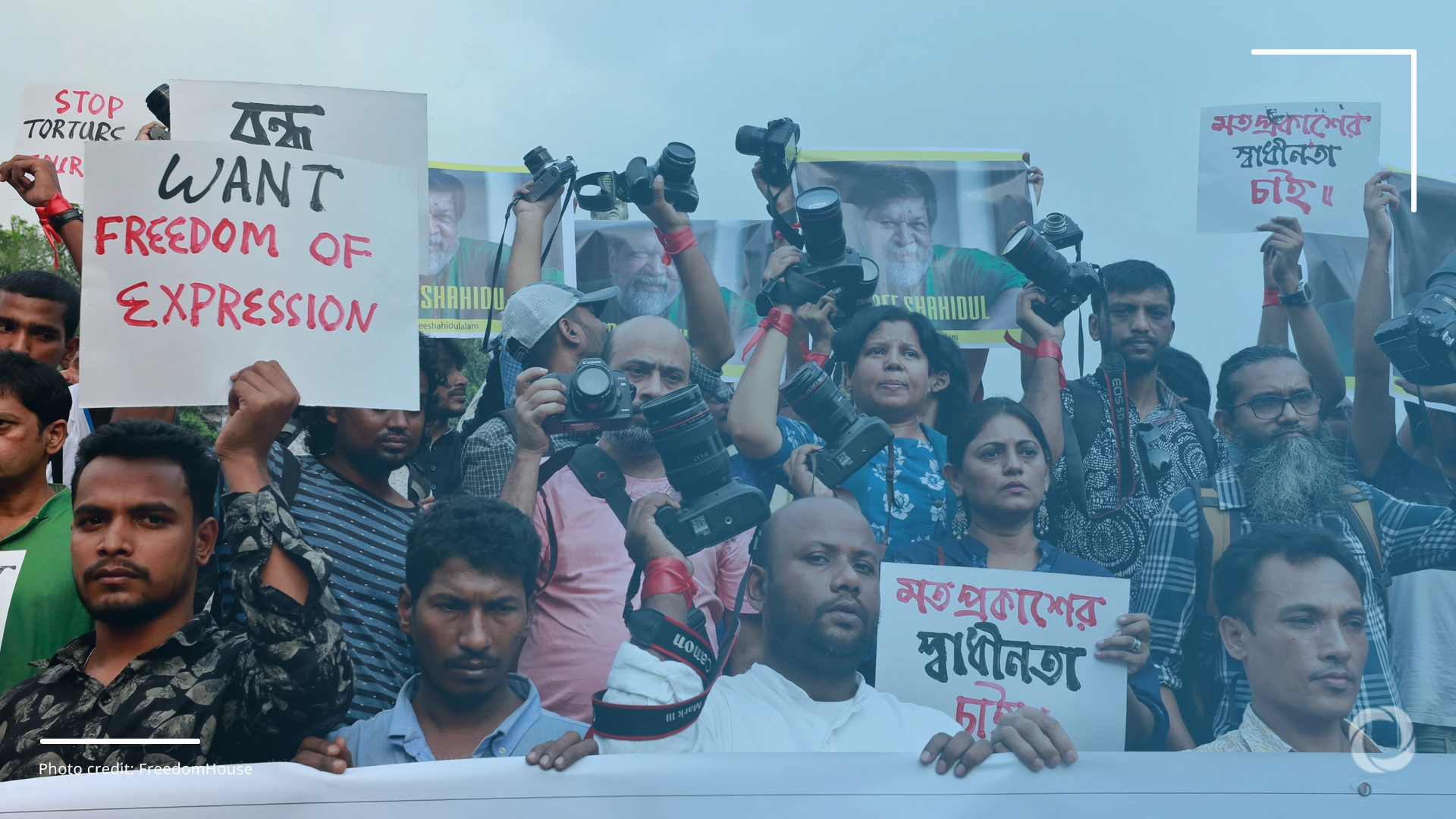
The scale of the danger facing Bangladeshi journalists is underscored by devastating historical and recent data. Since 2009, 45 Bangladeshi journalists have reportedly been killed, and over another 1,300 injured. Rather than becoming more stable following the 2024 political transition, the legal targeting of the press has mutated, with nearly 135 journalists having faced legal charges, including murder and crimes against humanity.
Civil society groups warn that a toxic combination of street violence and legal weaponization is paralyzing newsrooms. Iftekhar Zaman, Executive Director of Transparency International Bangladesh (TIB), has criticised the government’s failure to protect reporters following a mob attack in December 2025 against two leading media outlets, Prothom Alo and The Daily Star.
“The government’s irresponsibility by remaining silent on the matter has done nothing but fuel impunity for crimes against journalists and the media,” he stated.
According to TIB, genuine safety is impossible without completely dismantling the restrictive legal framework that has been inherited from the past. Zaman has called for the repeal of disputed laws, including the ICT Act and the Digital Security Act (DSA), to ensure the safety of journalists. Nearly 250 journalists have faced prosecution under the DSA and several other laws.
“These incidents have forced journalists and media outlets to practice self-censorship,” Zaman lamented.
The state’s proposed remedy
In response to the compounding domestic and international crises, the recently elected government has proposed a structural overhaul. Speaking to DevelopmentAid, Zahir Uddin Swapan, Information and Broadcasting Minister, revealed that the state is considering forming an independent media commission.
“This commission would help to combat impunity for crimes against journalists and create an enabling environment for media across the country,” Swapan stated.
Media watchdogs have cautiously welcomed this initiative. Talking to DevelopmentAid, Hasibur Rahman Mukur, Executive Director of the Media Resources Development Initiative, agreed that while ensuring accountability is the ultimate goal, “establishing an independent media commission would help to investigate past cases of press freedom violations” and break the decades-long cycle of violence.