

Add us as your preferred source on Google to see more of our content in Search.
 Add to Preferred Sources
South Africa is home to millions of immigrants from its poorer neighboring countries. In some regions of the country, where the local population confronts economic challenges, social tensions between population groups are on the rise. Notably, both legal and illegal migrants are often victims of xenophobic attacks in South Africa.
In early 2026, the country’s national statistical agency, Stats SA, estimated 3.3 million immigrants, or roughly 5.2% of the country’s 62 million population. However, the number of undocumented migrants may be significantly higher.
Historically, the nation has experienced xenophobic attacks against immigrants since 1994, but the situation worsened since 2008, when a massive wave of violent attacks resulted in at least 62 deaths.
The xenophobic profiling and attitudes are targeting migrants’ households and businesses. According to a survey conducted by Xenowatch (a project of the African Center for Migration & Society (ACMS) at the University of Witwatersrand), from 1994 to 2026, over 1,300 incidents of xenophobic attacks have occurred with at least 690 deaths and approximately 128,000 displacements (see figure 1).
The xenophobic tensions are rising in urban areas like Johannesburg, Durban, and Soweto, where youth unemployment is rampant.
Residents are encountering socio-economic challenges, such as unemployment, which stands at almost 33%, overpopulation, organized crime, and strained public services. These factors are among the main causes of anti-immigrant sentiments and negative attitudes against outsiders.
The attacks and illegal immigration are weakening sustainable economic growth by disrupting the flow of labor mobility and trade.
Figure 1: Xenophobia-related incidents and deaths in South Africa from 1994 to 2026
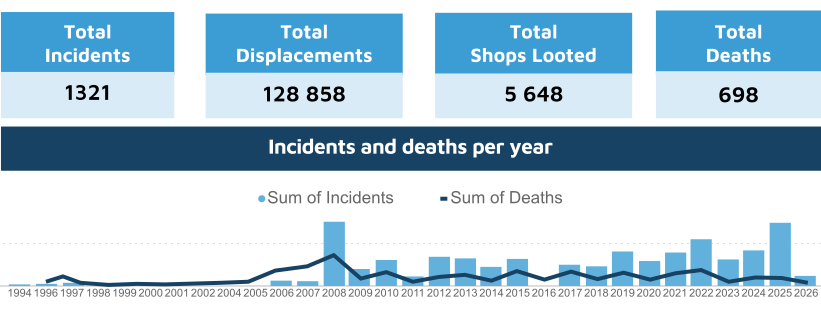
Source: Xenowatch statistics dashboard
Stories of xenophobia attacks victims
The killing of five Ethiopians from March to May 2026
Five Ethiopians were killed in South Africa in three months of 2026. As of the end of April 2026, at least five Ethiopians were gunned down in Johannesburg amidst the recurring xenophobic attacks on immigrants. But there are no official reports associating the killings with xenophobia or usual gun crimes. As a result, local police are investigating the violent attacks to determine motives.
However, amidst the wave of xenophobic attacks against foreigners in South Africa, Ethiopian citizens are perceiving it as a possible case of xenophobia. Gezahegn Sumamo, the head of the Generation to Generation initiative, says that there are increasing concerns among Ethiopian immigrants due to intimidation, exclusion, and threats of violence.
The case of Abdikadir Ibrahim Danicha
Abdikadir Ibrahim Danicha is among Somali refugees who came to South Africa to look for greener pastures after the 1991 civil war broke out in Somalia. Despite doing well in operating small stores in South African townships, he is among immigrants facing persecution. In June 2014, his small venture selling groceries and cosmetics in Johannesburg was looted and later set ablaze using a petrol bomb. He sustained severe injuries during the attack.
The story of Emmanuel Asamoah
Emmanuel Asamoah, a Ghanaian entrepreneur, ran a hairdressing business in South Africa. Despite possessing legal operating documents, he fell victim to a xenophobic attack by a vigilante group, who demanded him to leave the country. The occurrence that ended without a violent clash was captured on video and went viral. In the video, the groups demanded immigration documents from the man, and after validating their authenticity, they told him to go and “fix your nation”.
Anyway Hlungwani
Hlungwani, an immigrant from Zimbabwe residing in South Africa, is one of the victims of a wave of xenophobic violence that took place in May 2025. The attacks that took place in the Eastern Cape were a result of the killing of a South African, reportedly by an immigrant. In the seemingly revenge attacks, immigrants were the main targets. The violence by the locals against the immigrants left at least three dead and 10 injured.
Primary causes of xenophobic attacks in South Africa
Historical patterns of group conflicts and violence
According to a Xenowatch report, most of the groups and communities involved in the attacks have a history of using conflict and violence as a mechanism for solving conflicts. Studies document that mob justice and the normalization of violence as the only strategy for solving conflicts are fuelling the xenophobic attacks. According to Pierre Misago, a researcher at the University of Witwatersrand, the attacks happened before 2008, but they worsened in 2008, when there were many deaths and displacements. As a result, it’s happening since many view violence as a normal way of resolving conflicts.
“What’s happening now is not new, as it happened prior to 2008, but it escalated in the same year, since many people died and mass displacement happened. It never ceased since then”, said Pierre Misago, researcher at the African Center for Migration and Society at the University of Witwatersrand.
Real and perceived socio-economic deprivation
Most of the xenophobic attacks are happening in South Africa in informal settlements and marginalized towns. Some residents in such settlements encounter socio-economic difficulties like of work, extreme poverty, overcrowded housing, and straining public services. The stiff competition for the limited job opportunities, public services, and resources between the foreigners and indigenous groups is perceived to cause tensions and conflicts. The socio-economic, whether real or perceived by citizens in informal settlements, provides a background and justification for xenophobic attacks.
Negative attitude and xenophobia towards foreigners
Local residents and institutions have negative perceptions of foreign nationals. They blame foreign residents for most of their socioeconomic problems and view the foreigners as threatening their lives and income sources. Researchers say that xenophobic attitudes and hostility against immigrants are common amongst the general public and government officials. The xenophobic attitudes are based on economic class, gender, ethnicity, religion, and race. A 2020 study shows that approximately 57% of South Africa’s population have negative perceptions towards immigrants, mostly those from other African nations.
Hatred
In a research involving 10 migrant entrepreneurs from South Africa, the participants opined that despite them resembling black South Africans, the locals hated them since they ran successful enterprises. One of the interviewees stated that
“What I mean by hatred is that they can come and say Why, you foreigner, you come here and do nice and start the business for two years, and you started buying cars? They hate that because we know how to do business, they can’t do business. We know something that can bring money.”
Wrap up
Xenophobia attacks in South Africa are impeding social cohesion, trade, migrants’ security, and sustainable growth. The increasing anti-immigrant protests, xenophobic attacks, and looting of businesses belonging to foreigners necessitate government intervention. Enhancing protection of human rights, peaceful coexistence, and economic inclusion for all are important strategies for solving the main causes of xenophobia in South Africa and the whole of Africa.