

Add us as your preferred source on Google to see more of our content in Search.
 Add to Preferred Sources
Key reasons to read this article:
- Find out why countries are investing millions in airborne healthcare.
- Discover how drones are delivering life-saving care where roads cannot reach.
- Learn how flying technology is transforming farming and disaster response.
- Understand what is stopping drones from becoming part of everyday public services.
- Unpack why the next infrastructure revolution may not be built on the ground, but in the sky.
When a bridge collapses after heavy rain or floodwaters cut off the only road to a remote village, the consequences are immediate. A clinic runs out of blood. Vaccines fail to arrive. A patient waits for hours or days for medicines that should have taken minutes to deliver.
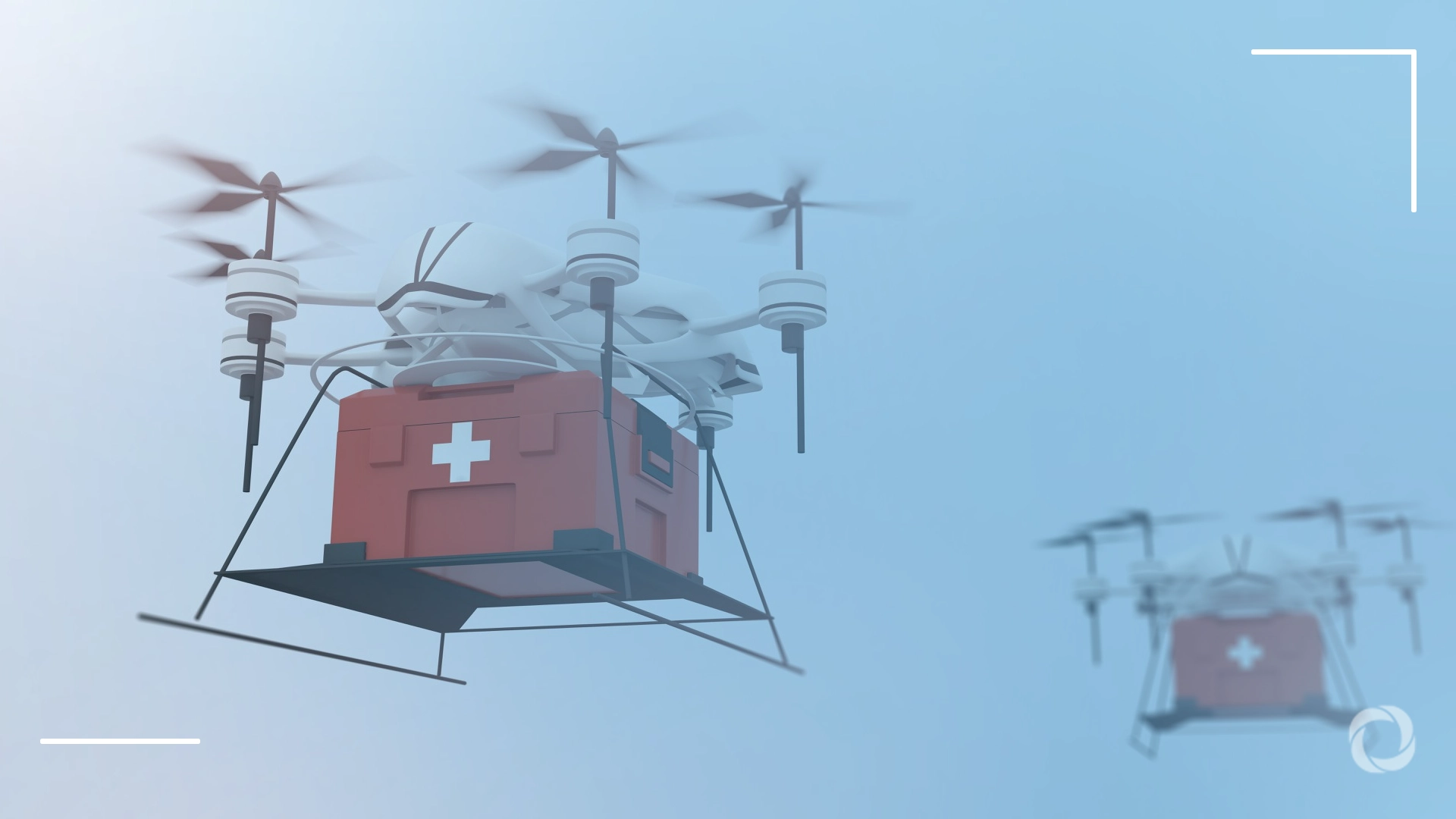
For billions of people, access to healthcare and other essential services is still shaped by geography. But a growing number of governments, aid agencies, and technology companies are betting that the answer lies not on the ground, but in the sky. They have started building ‘invisible’ air corridors of drones to deal with those delays.
The need is enormous. The World Health Organization estimates that about 4.6 billion people worldwide still lack reliable access to essential medicines and healthcare. For many, the barrier is simply distance. Research has found that millions of people in Africa can reach a clinic within an hour on foot, making access to routine medical services slow and unreliable. Yet, in places where geography has long dictated opportunity, drones are beginning to redraw the map.
From pilot projects to healthcare networks
Healthcare was among the first sectors to clearly demonstrate what drone logistics could achieve. When lives depend on speed, reducing delivery times from hours to minutes can make an immeasurable difference.
In Africa, Rwanda led the way in 2016, partnering with the U.S. drone company Zipline to create the world’s first national drone delivery service for blood products. What began as an ambitious pilot project has evolved into an integral part of the country’s healthcare system. By 2021, Zipline was completing more than 13,000 deliveries annually, and handling about 75% of blood deliveries outside the capital city.
The success of Rwanda’s model attracted the attention of other countries.
In 2019, Ghana’s government partnered with Zipline and Gavi, the Vaccine Alliance, to build a national vaccine drone network. It consists of four distribution hubs, each operating 30 drones and serving roughly 2,000 clinics and 12 million people.
Nigeria has followed a similar path. Since 2023, it has been expanding its fleet. In just a couple of months in the same year, more than 100,000 vaccines had been delivered to 18 of Nigeria’s states. According to the Director of the Mfuma PHC, Mr. Raphael Ochim, “People cheered when drones appeared overhead” because, while clinics once waited days for supplies, they now receive these in under 30 minutes.
How drones are saving lives
Expanding access beyond healthcare
While medicine remains an important use case, drone networks are branching out into other essential services, proving their value in agriculture, disaster response and climate resilience.
Helping farmers make better decisions
In agriculture, drones rarely carry seeds or fertilizer. Instead, they provide something just as valuable: information. Equipped with high-resolution cameras and sensors, drones can identify pest outbreaks, water stress, and nutrient deficiencies long before those problems are visible on the ground. Farmers can then intervene, reducing costs while improving yields.
In Uganda, a drone-imaging program enabled a seed company to monitor 270 small farms, resulting in farmers reducing pesticide use by 60% and redirecting fertilizer to underperforming fields, boosting yields and farm income. The project estimated a US$2,150 annual profit increase per farm from data-driven management.
As climate change makes weather patterns more unpredictable, such precision farming tools are becoming increasingly important for improving food security while reducing the environmental impact on agriculture.
Responding when disasters strike
Drones are also transforming the way humanitarian organizations respond to natural disasters. Floods, landslides, and cyclones often destroy roads just when people need emergency assistance the most. In these situations, drones can quickly provide information that would otherwise take days to collect.
Following devastating floods in Nepal’s Melamchi River Valley in 2021, the authorities deployed drones to map which villages had been flooded, which homes had been destroyed, and where landslide risks remained. The resulting aerial imagery helped emergency teams to prioritize rescue operations and allocate resources more efficiently.
Humanitarian agencies increasingly consider drones to be an essential part of disaster response. The UN World Food Programme (WFP) has pre-positioned drone kits in 15 countries to support rapid assessment after floods, storms, and other disasters, as well as to restore emergency communications.
What’s holding them back?
Praised by many, including WFP, for their capability to “help countries meet Sustainable Development Goals”, drones, however, are not a cure-all for weak infrastructure. They cannot replace roads and trucks, nor solve deep infrastructure gaps overnight. Moreover, several significant challenges still stand in the way of their wider adoption.
Costs and long-term sustainability
Building and maintaining drone delivery networks continues to be expensive. Many programs rely on government contracts or subsidies to remain operational. Zipline, for example, has received a US$150 million grant from the U.S. government, while several African countries have committed up to US$400 million over several years. This raises important questions: What happens when donor funding runs out? Will governments keep paying those bills?
A World Bank analysis in Tanzania found that drones still cost more than trucks for most medical shipments, meaning drones are most effective when speed, not volume, is the priority.
Limited payload and range
Delivery drones can currently carry a few kilograms at a time. This makes them ideal for blood units, vaccines, or small medicine packs, but unsuitable for shipping large quantities of supplies. Heavy supplies will continue to depend on trucks or planes. Battery capacity also limits range and requires a recharging infrastructure that is not always available in remote regions.
Regulation
In most countries, aviation rules still lag behind the tech. Many regulators require drones to fly within visual line-of-sight, below certain altitudes, and away from airports. Each new flight path often needs approval. USAID and International and Communications Technology have warned that “restrictive” regulations for drones remain among the principal barriers to scaling such delivery programs.
Public trust
In communities affected by conflicts, drones could evoke memories of military operations rather than being seen as help. Questions also remain about privacy as well as safety concerns. Who owns the images and information collected during drone flights? How should that data be stored and protected?
Development organizations argue that transparent protocols for data use, security, and sustained community engagement are essential if public trust is to keep pace with technological innovation.
Looking beyond the horizon
Drone networks will not eradicate the need for hospitals, roads and transport systems. Neither will they fix deep-rooted inequalities overnight. Healthcare will still depend on trained professionals, functioning clinics, cold-chain storage and resilient infrastructure, just as agriculture will continue to rely on skilled farmers, innovation, good roads and reliable transport systems,
But drones are beginning to solve one challenge: overcoming distance and reducing time. When roads disappear under floodwater or mountain villages become inaccessible, blood, vaccines, medicines and diagnostic samples can continue to move, even when conventional transport cannot.
Now, the question for policymakers is not whether drones can deliver. That has already been proved. The question is how to integrate them responsibly, sustainably and at scale.