


Add us as your preferred source on Google to see more of our content in Search.
 Add to Preferred Sources
Artificial Intelligence (AI) is reshaping some roles in the labor market by automating routine tasks in youth-dominated entry-level jobs. Automation itself does not entirely replace the repetitive tasks that are traditionally delegated to younger employees, but rather redefines them: instead of routine execution, these tasks now incorporate AI oversight, problem-solving, and critical-thinking roles.
The increasing use of AI in junior entry-level roles is compelling young job seekers to incorporate AI skills in their education to match the dynamic of the labor demand, and often, young people are more optimistic in relation to AI enhancing their job prospects in high-value tasks rather than replacing them.
As the world observes World Youth Skills Day, the roles of AI in expanding youth skills and the labor market are an emerging issue. In this article, we bring you insights on AI-related skills head-hunted by employers among the tech-savvy youth.
An overview of youth unemployment globally
According to the International Labour Organization (ILO) 2025 report, the global youth unemployment rate stood at 12.4%, with approximately 260 million young people not in employment, education, or training (NEET). Upper middle-income nations are leaders in this trend, with 16% of youth being unemployed, compared to low-income countries where this rate is at 8%. But don’t let this trend trick you – the apparently low rate of unemployment in poor countries depicts underemployment and informal work rather than massive youth engagement and quality jobs.
Global trends of youth unemployment in 2025
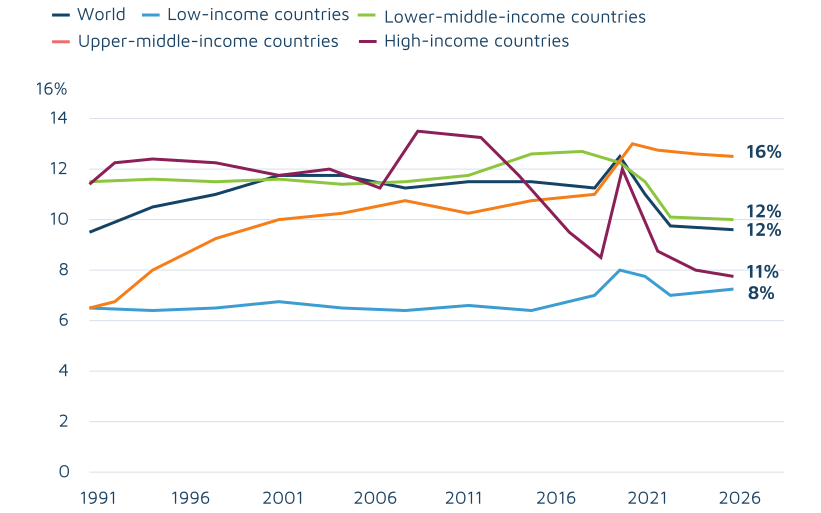
Source: ILO
ILO emphasizes the need for youth to learn AI skills for high-demand jobs and self-employment, as automation is currently contributing to reducing entry-level jobs. The African Development Bank raises concerns about the growing youth unemployment rate in Africa, as the number of young people on the continent is expected to grow to 830 million by 2050 from the current 200 million.
AI shrinking entry-level jobs among youth
AI is revolutionizing the nature of jobs and increasing the pace of transformation, with early career tasks facing automation. As a result, AI is changing some entry-level roles that conventionally served as entry points for young talent in various sectors. According to a January 2026 World Economic Forum Youth Pulse survey of 4,600 young people aged 18 to 30 from almost 144 nations, automation will significantly reduce the number of available entry-level jobs. Thus, 66% of the respondents stated that in the next 3 years, AI will cut the number of routine tasks mostly assigned to youth starting their professional journey.
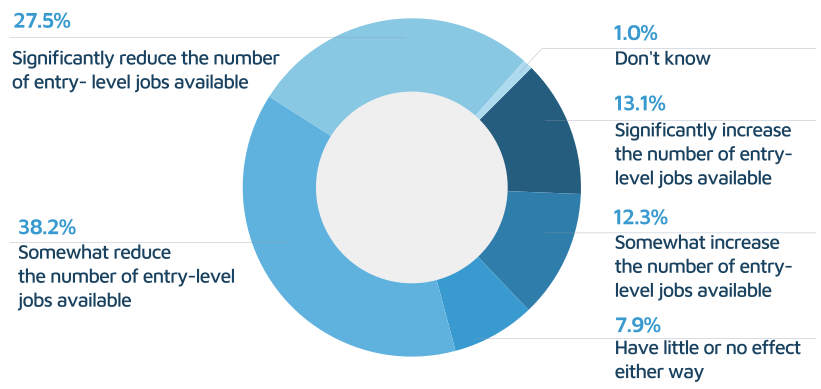
Source: WEF’S Youth Pulse January 2026 Insight Report
Another Insight Report by the World Economic Forum and PwC shows that more than one-third of young employees are working in jobs with high to medium exposure to automation, which increases the risk of becoming unemployed. The highly exposed originate from high-income countries due to many knowledge-intensive industries that mostly require routine roles.
Young workers’ distribution in occupations exposed to AI per region
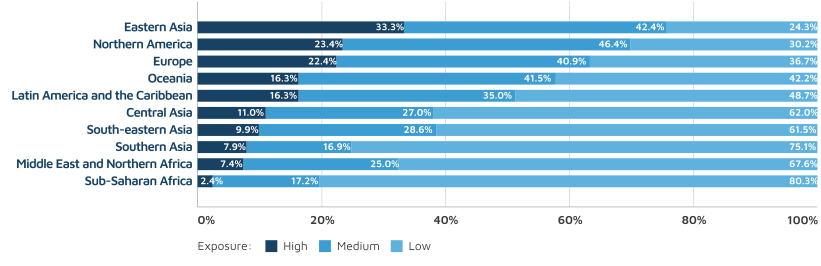
Source: WEF and PwC 2026 Insight Report
Another survey by Resume Builder indicates that 42% of U.S. Gen Zs (individuals born between 1997 and 2012) are working or determined to obtain jobs or skills in blue-collar fields, which are less exposed to AI replacement.
Youth-centered AI skills and jobs head-hunted by employers in 2026
🔸 Agriculture digitalization specialists
They provide technical knowledge encompassing integrating digital solutions into the agriculture and food processing sector. Their technical guidance helps farmers utilize tools like drones, AI, and high-resolution satellite imagery to assess crop development and growth. The average salary of agriculture digitalization specialists ranges between US$60,000- US$90,000 per year, plus other benefits.
🔸 Drone pilots
Drone or Unmanned aerial vehicle pilots obtain aerial images, collect data, and carry out inspections to support commercial, industrial, or public safety operations. The pilots obtain visual and geospatial data in various sectors, including construction, agriculture, and security. Their average salary ranges from US$50,000 to US$95,000 per year.
🔸 Digital content writers/creators
Content creators use digital tools to produce entertaining, motivating, and persuasive content for diverse audiences. Their scope is to emotionally resonate with users and raise awareness, promote, or sell a product or service. The salary of content creators varies based on location, views, and experience.
🔸 Data center electrical engineers
These specialists design, execute, and maintain the electrical infrastructure that powers servers, network, and cooling systems in data facilities. Their work is delicate, as a single interruption causes data loss worth millions of dollars. Thus, a licensed data center engineer pockets an average base wage of US$94,500 annually.
🔸 Smart HVAC technicians
HVAC technicians install, maintain, and replace heating, ventilation, and air conditioning (HVAC) systems. They use technologies such as predictive analytics, automation, and smart systems to increase efficiency, reduce costs, and enhance reliability. HVAC technicians’ average annual salary begins at US$59,000.
🔸 Virtual caregivers
Caregivers offer virtual support and companionship to clients through digital platforms, facilitating scheduling and medication reminders. Using AI tools, caregivers automate some of the administrative roles like documentation and scheduling. The automation enables them to focus on compassionate care and hands-on duties that are less likely to be automated. Caregivers’ yearly average salary in high-income nations ranges from US$30,000 to US$35,000.
🔸 Smart-home electricians
Smart-home electricians solve complex electrical work required for modern highly intelligent houses’ operation. They develop, install, and connect modern homes with advanced automation systems, enabling remote regulation of lighting, climate, entertainment devices, and appliances. They earn a median salary of US$56,000, which varies based on experience, skills, and geographical location.
🔸 Telehealth patient specialists
Telehealth specialists are not doctors and do not necessarily require a medical background. Their responsibilities vary around organizing and supporting remote healthcare services, ensuring smooth, quality, and efficient patient care. Still, they plan telehealth appointments, assist providers and patients with technology setup, and handle electronic health records (EHRs). By using digital platforms like remote monitoring devices and wearables, the specialists improve access to care.
🔸 Consultant AI engineers
These specialists help organizations in identifying, developing, executing, and operating AI models. According to an International Data Corporation (IDC) study, the demand for AI consulting increased by 40% in FY 2024/2025. Based on specialization and experience, senior AI consultants charge at least US$2,000 daily.
🔸 Remote humanitarian logistics officers
The logistics specialists manage all supply-chain activities in humanitarian organizations through ground visits or digital tools. Using digital predictive analysis of AI, these specialists manage the supply chain (procurement, transportation, warehousing, customs). The annual salary of logisticians depends on experience, location, and grade.
Final thoughts
AI automation is changing the labor market for youth by stealing some of the entry-level jobs that are mostly meant for youth entering the job market. In response, young people are turning to blue-collar jobs and are looking for ways to incorporate AI-related training into their education. The 2026 Youth Skills Day is a stark reminder for private and public organizations to integrate human-AI collaboration to sharpen youth skills and create sustainable jobs.