

Add us as your preferred source on Google to see more of our content in Search.
 Add to Preferred Sources
On 21 November 2026, the EU will impose on its member countries a full export ban on non-hazardous plastic waste to non-OECD nations, which will remain in effect for at least two and a half years, until May 2029. After that point, only those non-OECD nations that are certified by the European Commission can receive EU plastic waste exports.
Which countries currently import the most of EU plastic waste? What does the Union intend to do with its plastic waste after November 2026? How should individual consultants and development experts act in regard to the ban, and how are multilateral development banks and other donors changing their funding priorities in the waste and sustainability sectors?
Let’s explore the answers to these and other questions that arise from this initiative in the following article.
How much plastic waste does Europe export?
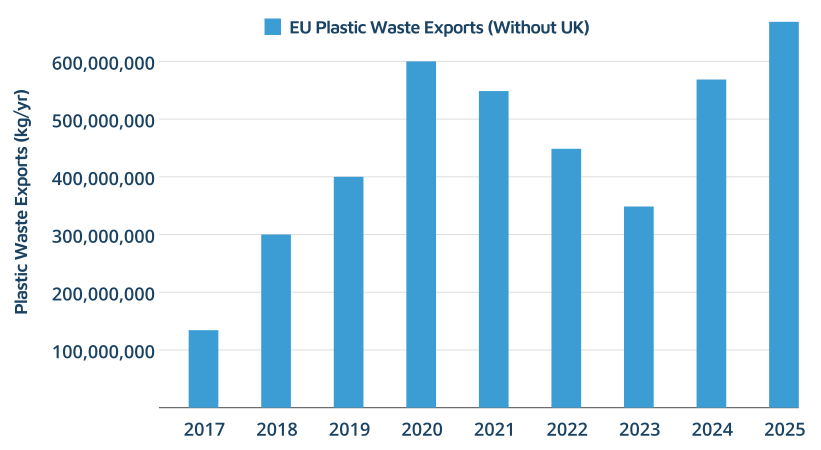
In 2025, the annual volume of plastic waste exports from Europe to other countries remained at nearly the same level as in 2024 – 1.5 million tons, with Germany and the United Kingdom leading the exporter list.
Germany’s plastic waste exports hit 810,000 tons, all of which were sent overseas (i.e. outside the EU). As for the UK, the country exported 675,000 tons, as shown in the report from the environmental NGO Basel Action Network (BAN).
The country that received the most plastic waste from the European Union was Türkiye, with the other three largest importers being Malaysia, Indonesia, and Vietnam – all three non-OECD nations. Today, some of these countries no longer import plastic waste.
Global circulation of plastic waste: general picture
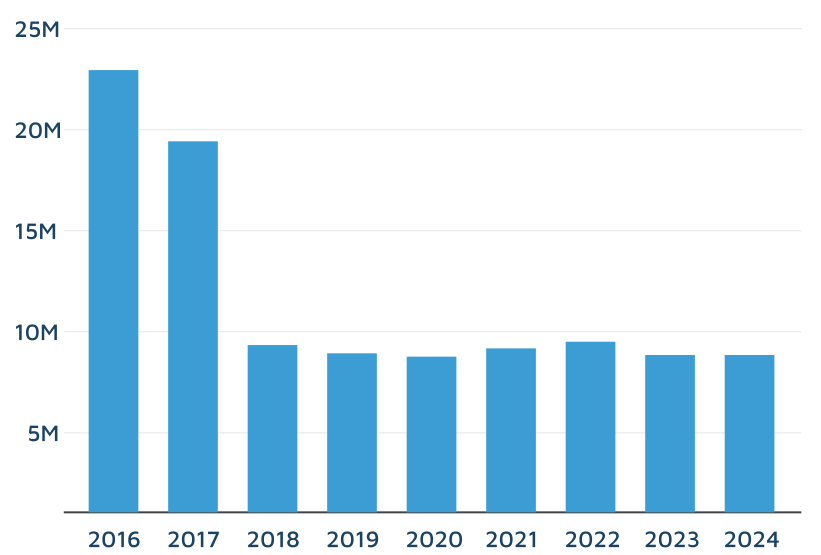
The history of plastic waste exports has changed over time. Between 1992 and 2016, China accounted for 45% of the world’s imports of plastic waste, according to Science Advances. This lasted till 2018, when the country banned imports of plastic waste—a measure that led to a significant reduction in the total volume of plastic waste circulating between countries.
Among other major importers, Indonesia prohibited the import of non-hazardous waste to 15 of its ports back in 2021. However, after four years, in 2025, it outright prohibited the import of plastic waste. Nonetheless, the 2025 data indicates that the imported amount continues to grow. One of the reasons is the pre-signed agreements that remained in effect in 2025. Secondly, authorities still have to evaluate the details of the new rules, since these appear to be incomplete, according to EHN and EarthJournalism, allowing for plastic waste to flow into the country.
Malaysia, another large importer of waste, in mid-2025 permitted the export of plastic waste to its territory only to those nations that managed to ratify the Basel Convention on the Control of Transboundary Movements of Hazardous Wastes and Their Disposal.
The graph below illustrates how the global plastic waste trade acted after China pulled out:
Source: The Invading Sea
What are the top destinations of the EU’s plastic waste?
As mentioned previously, around 1.5 million tons/yr of plastic waste was exported by the EU in 2025, with around 50% (737,000 tons/yr) going to non-OECD countries.
The table below shows the three major importers of the EU plastic waste in 2025, with the data being compared to 2024:
Which countries are most affected and by how much
The United States, China, and other larger nations register a lower volume of plastic exports due to the fact that most of it they handle within their borders, either recycling, incinerating, or gathering it in landfills.
Besides, compared to Europe and the UK, where exports can be included in official recycling rates, they are not under the same stress to meet recycling targets, says The Guardian.
In 2025, the United States exported 385,000 tons of plastic waste, ranking fifth in the world, while the data available for 2024 shows that China was the 18th largest exporter.
The EU plastic waste export ban in plain language
The European Union spent decades exporting a share of its plastic waste abroad. Now, the Union states that it will prohibit the export of plastic waste to non-OECD nations in November 2026, according to the European Commission.
As the prohibition draws near, there are worries that all exports would be diverted to developing OECD nations like Türkiye (which now receives the most plastic waste from Europe) and regions of Eastern Europe that are unable to handle larger volumes (countries like Romania and Bulgaria, which are EU and OECD members).
According to Sara Matthieu, a member of the Group of the Greens/European Free Alliance, the main issue affecting the plastic recycling industry is that newly created or virgin plastics are still far less expensive than recycled and reused materials. This makes recycled plastic less attractive for buyers.
Türkiye: the largest destination for EU plastic waste
Türkiye is an OECD member country. Considering that direct legal routes to Malaysia, Indonesia, and Vietnam are closing, Türkiye may receive an even larger flow of plastic waste, since the 2026 EU plastic waste export ban applies exclusively to non-OECD nations.
Türkiye’s own recycling infrastructure is already under pressure. According to the most recent data, the volumes of imported plastic waste in the country considerably exceed its processing capacity.
Source: Basel Action Network
Numbers from the Ministry of Environment, Urbanization and Climate Change show that the nation currently has 1,263 facilities altogether able to process around 1.1 million tons of plastic waste. At the same time, the volume of plastic waste imports is around 1.3 million tons, while domestically, Türkiye produces another 3.3 million tons.
Another reported issue is that over the past five years, around 200 fires at plastic recycling facilities were reported in the country, which local environmental organizations believe to be a systemic problem of Turkey’s plastic recycling industry.
Basel Convention’s plastic waste amendments
The Waste Shipments Regulation (WSR) 2024/1157, adopted by the EU on 11 April 2024, implements the Basel Convention’s plastic waste amendments into EU law.
The Basel Convention, the multilateral accord addressing environmental issues, added plastic waste controls that came into force in January 2021.
The EU’s new WSR goes further: it replaces the previous notification-and-consent model with an export ban to non-OECD countries. It applies to all plastic waste, including hazardous waste (designated as A3210 under the Basel Convention) and non-hazardous goods for recycling (coded as B3011).
The current move follows a similar one related to electronic and electric waste (e-waste) export prohibition to non-OECD countries from January 1, 2025. The next, bigger wave is the prohibition on plastic waste.
Key dates a development professional should know
How we got here: A brief history
During the 2000s, China was the nation that imported the largest volume of plastic waste globally, being the place where OECD countries sent the waste they could not recycle at home.
In 2018, China introduced its National Sword Policy, banning 24 categories of solid waste imports, which led to millions of tons of plastic waste having nowhere to go.
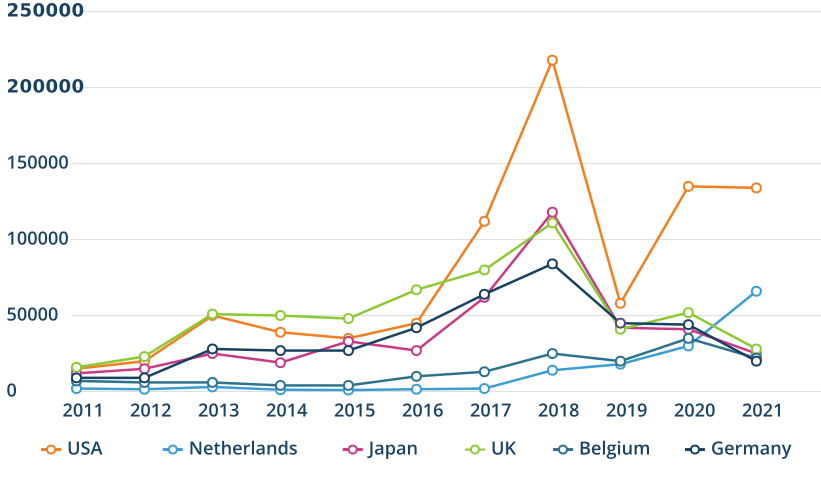
New destinations for waste became countries in Southeast Asia. EU plastic waste shipments to India, Indonesia, Malaysia, Thailand, and Vietnam, among others, have surged. Malaysia and Vietnam saw plastic waste imports increase by more than 100%.
Malaysia’s imports of plastic waste, selected nations, 2011–2021, tons
Source: ResearchGate
Ultimately, countries from Southeast Asia ended up in a situation where they absorbed enormous amounts of waste without having proper infrastructure to manage their own waste, which worsened the environmental issues (illegal dumpsites, open burning, contaminated waterways, etc.).
“Waste colonialism” – this term appeared shortly after, being coined by international NGOs and advocacy groups to describe the practice of wealthy nations shifting their environmental burden to less developed ones by exporting waste.
The Basel Convention was the international reaction to the growing problem. Its plastic waste regulations, adopted in 2019 and enacted in January 2021, stipulated prior informed consent for the shipping of non-hazardous plastic waste between nations. However, the system was essentially voluntary, and implementation varied greatly.
The EU’s Regulation (EU) 2024/1157 is the legislative answer. Instead of requiring consent, the EU regulation simply prohibits the practice and makes the ban enforceable by law.
Practical implications for NGOs, donors, and consultants
Waste management projects in Malaysia, Indonesia, and Vietnam that rely on imported plastic waste from the EU may face tighter supply and stricter compliance requirements. Donors and implementers should reassess project designs, keep an eye on the changing trade flows, and ensure they are aligned with EU and national waste import rules.
Where will 737,000 tons of EU plastic waste actually go after the ban?
The ban does not get rid of plastic waste; instead, it redirects it from non-OED countries that lack recycling and elimination infrastructure. For development professionals, knowing where the material flows is just as crucial as knowing what the regulations state.
We can witness several scenarios unfolding simultaneously.
🔹 Intra-EU processing pressure
The recycling industry within the European borders is under serious strain, and it’s mostly because of the following:
- Recycling plastic is often more expensive than making new plastic.
- Energy prices are high.
- Cheap imported plastic is flooding the market.
- There isn’t enough demand for recycled plastic, so many recycling companies are struggling to earn a profit.
According to Plastics Recyclers Europe, from 2023 to the end of 2025, the sector lost roughly one million tons of recycling capacity.
In 2024, the installed capacity for recycling plastics in the region was 13.5 million tons. Today, it continues to decline. The WSR is intended to keep more recyclable waste in Europe, but many countries still lack enough infrastructure to process these larger volumes domestically.
🔹 Illegal trafficking risk escalation
The UNODC’s February 2026 Global Analysis on Crimes that Affect the Environment classifies waste trafficking as a highly profitable, relatively low-risk illegal activity.
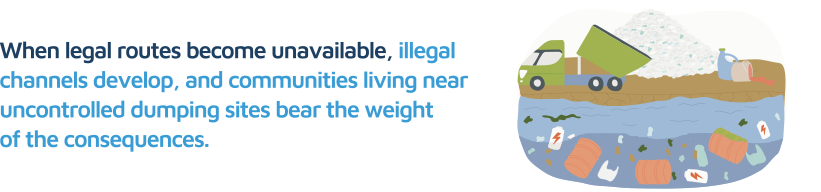
Ioana Cotutiu, Programme Coordinator for Illegal Trade in Waste at UNODC’s Regional Office for Southeast Asia and the Pacific, outlined that 15-30% of waste shipments are the result of illegal waste trafficking, which is usually carried out by criminal networks and jeopardizes attempts to create a circular economy.
The EU reacts by forming a specialized Waste Shipment Enforcement Group, which includes environmental, customs, and police officers. OLAF (the EU Anti-Fraud Office) is authorized to assist cross-border investigations into illicit waste shipments.
🔹 Tackling illegal waste: Real-life cases already happening
Between April 2025 and March 2026, an operation involving several organizations, including the Ecological Alert and Recovery – Thailand (EARTH) Foundation and the Basel Action Network (BAN), along with Thai authorities and the United Nations Office on Drugs and Crime (UNODC), was carried out at Laem Chabang port in Thailand. They impounded 714 suspicious waste containers, which implies that authorities are already tackling the issue in real life.
What to do before November 2026: A checklist for development practitioners
Before the ban takes effect (21 November 2026):
- Review all active waste management programs in Malaysia, Indonesia, Vietnam, and other regions and identify any that use plastic waste from the European Union in their supply model.
- Talk to government partners, recyclers, donors, and communities about the change. Build a plan for using local waste instead of imported waste, and update budgets, timelines, and risk plans. If a project depends a lot on EU plastic waste, prepare a transition plan now so operations do not stop suddenly.
- Review legal compliance, especially import rules and waste shipment rules in each country. Add clear monitoring so you can track where waste comes from and how the project is affected.
For future programs:
- Include WSR compliance rules in new environmental projects, but keep in mind that the ban is temporary (initially 2.5 years until 21 May 2029).
- Build environmentally sound management (ESM) standards into waste facility checks.
- Include informal waste worker formalization into new waste-sector program designs (many people work informally, collecting/recycling waste, and are in need of formal jobs).
Funding landscape: What the ban opens up for development organizations
The EU’s plastic waste export ban has high chances of increasing the demand for projects that help nations improve collection, treatment, traceability, and eco-friendly management systems.
We’re already seeing the EU SWITCH-Asia Policy Support Component carrying out active webinars and creating guidance materials for Asia-Pacific countries on WSR implications.
Bilateral and multilateral donors
The World Bank is already financing waste and plastic management in Southeast Asia, including SEA-MaP (2022-2027), a US$20 million regional grant for ASEAN member states that supports policy, capacity-building, and investment in marine plastic pollution prevention.
The Asian Development Bank is also active on plastic circularity, with financing and technical work that supports recycling capacity and broader waste-management systems across Asia and the Pacific.
GIZ’s SEA-MaP-related work likewise emphasizes innovation and investment in plastic waste management in the ASEAN region.
Finding active grants and tenders
DevelopmentAid tracks funding opportunities in the Pollution & Waste Management sector across all major bilateral and multilateral donors:
You can filter by geography to find active opportunities in Indonesia, Malaysia, Vietnam, or any other country and region.