


Add us as your preferred source on Google to see more of our content in Search.
 Add to Preferred Sources
The EU ETS enters a new political reality
The European Union Emissions Trading System (EU ETS) is the EU’s flagship climate policy instrument and the world’s first international carbon market. Since its introduction in 2005, emissions from sectors covered by the system — including electricity and heat generation, energy-intensive industries, aviation, and maritime transport — have fallen by around 50%, making the ETS one of the most advanced and effective carbon markets worldwide.
Despite these achievements, the system is entering a more contested political phase. Industry groups are increasingly questioning whether the rising effective cost of carbon, driven by the progressive phase-out of free allowances, could undermine the competitiveness of European industry, particularly in energy- and carbon-intensive sectors exposed to international competition.
Major manufacturers, including ArcelorMittal, ThyssenKrupp, and BASF, have called for measures to address the impact of ETS-related costs, arguing that European industry already faces significant competitiveness pressures from higher energy prices, global competition, and extensive regulatory requirements.
But these concerns extend beyond carbon pricing alone. Energy-intensive industries such as steel, chemicals, cement, refining, and paper argue that investment in low-carbon production is increasingly constrained by weak demand for green products, persistently high electricity prices and the scale of required capital investments. Although carbon prices have eased from their 2022–2023 peaks, they continue to represent a significant production cost for both industry and power generation.
The EU ETS works by establishing a gradually declining cap on greenhouse gas emissions while allowing regulated entities to buy and sell emission allowances. Each allowance gives the holder the right to emit one metric ton of carbon dioxide equivalent (CO₂e). Most allowances are auctioned, generating more than €250 billion in revenues to date, which Member States have used to support decarbonization, innovation, and the broader energy transition.
As the EU pursues its strengthened 2040 climate target, policymakers face a growing challenge: how to maintain climate ambition while ensuring that industrial decarbonization strengthens rather than weakens Europe’s competitiveness. This challenge is becoming increasingly complex in a context of carbon leakage risks, an uncertain geopolitical environment and the need to secure affordable, reliable, and low-carbon energy for the next phase of industrial transformation.
Carbon costs become a strategic challenge for European industry
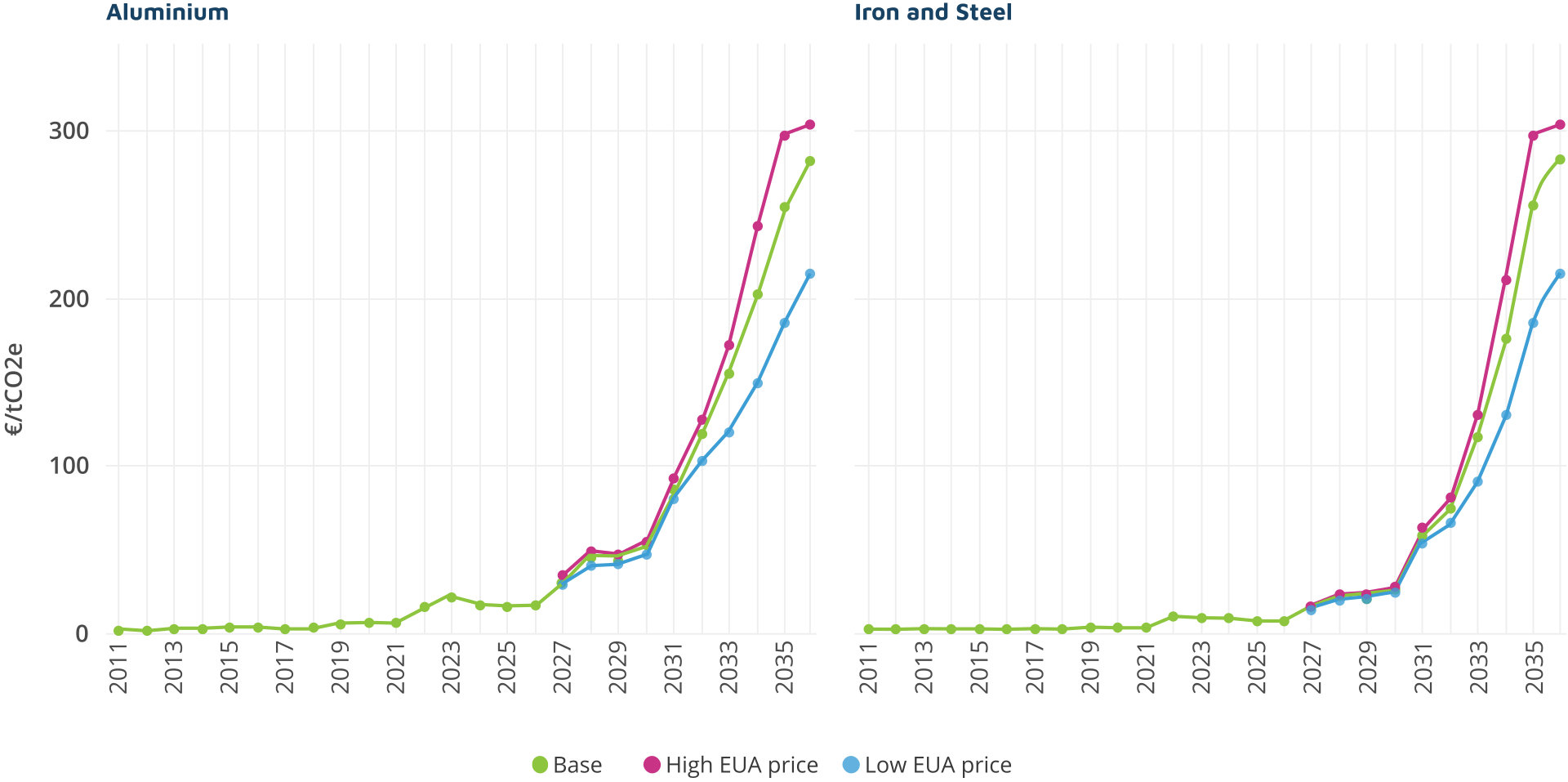
Until recently, carbon costs under the EU ETS remained relatively low because most emissions allowances were allocated free of charge to prevent carbon leakage. According to Fastmarkets — a cross-commodity price reporting agency — in 2025 around 78% of allowances for the aluminium sector and 90% for the iron and steel sector were still provided for free, reducing the effective carbon cost to around €16/tCO₂e and €7/tCO₂e, respectively, equivalent to only a small share of current product prices.
This is set to change as free allocation is phased out under the Carbon Border Adjustment Mechanism (CBAM) and ends by 2034, exposing EU producers to the full cost of their emissions. At the same time, carbon prices are expected to rise as the EU continues to tighten the supply of emissions allowances. Together, these changes are expected to increase carbon costs for European producers sharply over the coming decade, as illustrated in Figure 1.
Figure 1. Projected effective carbon costs for selected EU industries under the phase-out of free allocation and rising carbon prices.
Source: Fastmarkets
Power shoring: reframing industrial competitiveness
The debate surrounding the EU ETS review raises a broader strategic question about the future geography of European industry. Much of the current discussion assumes that Europe’s competitiveness challenge can be addressed primarily through adjustments to carbon pricing, free allocation, state aid or industrial subsidies. Yet these measures do little to address a more fundamental reality: Europe faces structurally higher energy costs than many renewable-rich regions of the world. As electrification and renewable hydrogen become the dominant pathways for decarbonizing sectors such as steel, aluminium, and chemicals, access to abundant, affordable renewable electricity is emerging as a key determinant of industrial competitiveness.
This has given rise to the concept of power shoring, developed by economist José Arbache and colleagues. The concept proposes organizing industrial value chains around locations with the greatest renewable energy advantage. Rather than seeking to retain every stage of energy-intensive production within Europe, a power-shoring approach would allow electricity-intensive upstream activities to develop in renewable-rich partner countries, while Europe retains downstream manufacturing, engineering, technology development, research, and other high-value industrial activities. The objective is not deindustrialization, but the optimization of low-carbon value chains across multiple geographies in ways that strengthen both competitiveness and resilience.
From a European perspective, power shoring also offers a new way of thinking about energy security. In the fossil-fuel era, energy security largely meant securing access to coal, oil and gas. In an increasingly electrified economy, however, competitiveness depends on reliable access to low-cost renewable electricity and the industrial products produced with it. Rather than importing fossil fuels, Europe could secure access to low-carbon industrial inputs — including green hydrogen, green ammonia, direct reduced iron (DRI), low-carbon steel and processed critical minerals — through diversified partnerships with renewable-rich economies. Such an approach could reduce exposure to volatile energy markets while avoiding some of the costs associated with locating all electricity-intensive production within Europe.
The example of green steel illustrates how a power-shoring approach could work in practice.
Green steel production based on direct reduced iron and electric arc furnaces requires large quantities of renewable electricity and green hydrogen, making energy costs a decisive factor in competitiveness. Production costs are expected to be significantly lower in renewable-rich economies than in Europe because of lower electricity and hydrogen costs. Under a power-shoring model, countries with abundant renewable resources could specialize in producing green hydrogen and direct reduced iron, while European industry focuses on higher-value downstream steel processing, advanced manufacturing and engineering. Such an approach could reduce the overall cost of decarbonization while strengthening the competitiveness of European industrial value chains.
Importantly, this vision aligns closely with the EU’s Global Gateway strategy. By supporting investments in renewable energy, industrial infrastructure, ports, certification systems, and logistics corridors in partner countries, Global Gateway could become a key instrument for developing integrated low-carbon industrial value chains. Rather than viewing climate policy, industrial competitiveness, energy security, and development cooperation as separate agendas, power shoring offers a framework that brings them together.
Looking beyond carbon pricing
The EC’s proposal for the next revision of the EU ETS marks an important stage in the evolution of European climate policy. The question is no longer whether carbon pricing works — it has proven effective in reducing emissions — but how it can continue to support decarbonization while strengthening industrial competitiveness in a more fragmented and geopolitically uncertain world.
As free allocation is progressively phased out and carbon costs become a more significant factor in industrial decisions, Europe will need to complement the EU ETS with broader industrial, energy and international cooperation strategies. In this context, power shoring deserves greater consideration. By developing strategic partnerships with renewable-rich economies, Europe could secure access to affordable low-carbon energy and industrial inputs while creating more resilient and diversified supply chains.
Rather than representing a retreat from European industrial activity, power shoring offers a framework for reorganizing low-carbon value chains around complementary strengths. Europe can continue to focus on areas where it has significant competitive advantages — including technology, innovation, engineering, and advanced manufacturing — while partnering with countries that possess abundant renewable resources to develop key industrial inputs such as green hydrogen, low-carbon materials, and renewable-based commodities.
This approach could also provide a foundation for deeper industrial cooperation with strategic partners, including through trade and investment frameworks such as the EU–Mercosur Trade Agreement. By linking market access, investment facilitation, renewable energy development, and industrial value chains, such partnerships could help align European climate objectives with competitiveness, energy security, and sustainable development goals.
Although many practical questions remain, power shoring offers a framework for exploring how climate ambition, industrial competitiveness, energy security, and international partnerships can be pursued together.