
Add us as your preferred source on Google to see more of our content in Search.
 Add to Preferred Sources
As the Rohingya crisis in Bangladesh enters its tenth year, Oxfam has warned that shrinking humanitarian resources risk undoing years of progress and placing already stretched essential services in Cox’s Bazar under even greater pressure, according to a press release published on August 24, 2026. Nearly 1.2 million Rohingya refugees are living in Bangladesh, including some 150,000 who have fled renewed violence in Myanmar since early 2024. The recalibrated 2026 Joint Response Plan requests $710.5 million, 26 percent below last year’s appeal. This amount covers little more than the minimum needed to sustain lifesaving assistance. Oxfam is urging the international community to renew commitments before critical services collapse.
Since the mass displacement of 2017, Bangladesh, host communities and international partners have sustained one of the world’s largest humanitarian responses. The response has provided food, safe water and sanitation, shelter, healthcare, protection, education and disaster preparedness to Rohingya refugees. What began as an emergency operation has become a prolonged crisis. Mallika, 36, has lived with her family in Camp 19 in Cox’s Bazar since 2017. She recalled that early support was limited before NGOs stepped in with lifesaving services, which are now decreasing.
Funding gaps remain substantial. According to UNOCHA, donors met less than half of the $934.5 million UN appeal for Rohingya refugees in 2025. In 2025, the first year of the 2025–26 Joint Response Plan, donors covered just 46 percent of the appeal. The shortfall is now compounding across sectors. The cuts have already gutted vital services in water, sanitation and hygiene (WASH), food, health and protection.
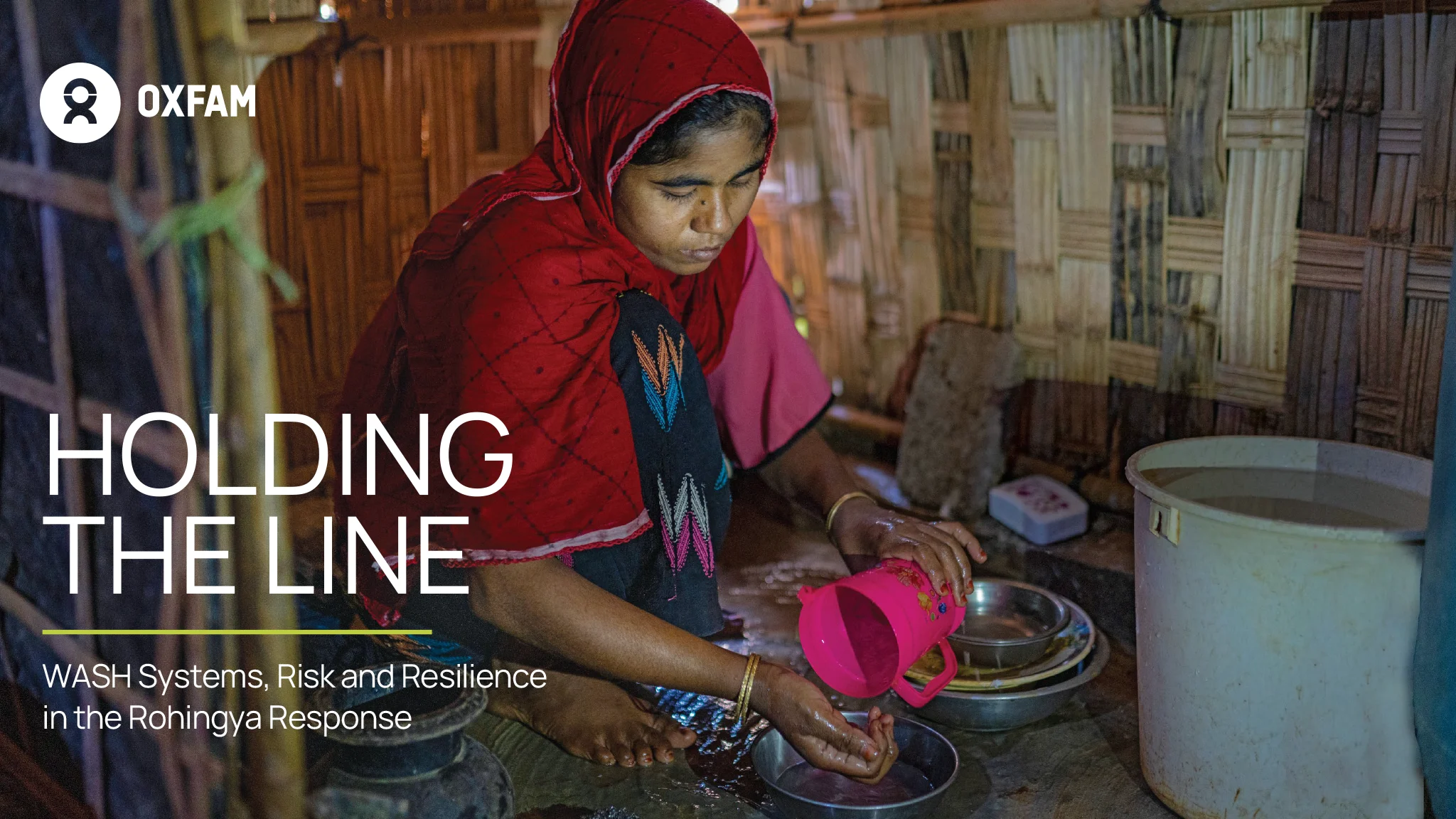
Oxfam’s new report, Holding the Line: WASH Systems, Risk and Resilience in the Rohingya Response, details what is at stake. Across Cox’s Bazar, emergency WASH interventions have grown into a humanitarian public-health system that includes 298 water networks, 320 production boreholes, 768 reservoir tanks, more than 7,000 tapstands, nearly 49,500 latrines, and 167 faecal sludge treatment plants.
Anil Pant, Country Director of Oxfam in Bangladesh, said: “The greatest danger is becoming accustomed to this crisis. Funding pressure now threatens systems built over nearly a decade.”
He called for protecting lifesaving services, strengthening resilience and local capacity, and supporting host communities.
The report argues that holding the public-health line depends on steady financing for maintenance, water quality control, sewage treatment, waste clearance and rapid disease response. Since 2017, Oxfam has worked with Rohingya and host communities, local partners, government institutions, UN agencies and donors across WASH, protection, livelihoods, food security, gender and community engagement. Oxfam is calling on the international community to provide predictable financing, protect essential services, strengthen locally led responses and build host-community resilience. A decade of international solidarity has saved lives and built critical systems. The tenth year, Oxfam stressed, must not become one of retreat but of renewed commitment and shared responsibility.