


Add us as your preferred source on Google to see more of our content in Search.
 Add to Preferred Sources
If previously having high digital skills meant knowing how to turn on a computer, then today the bar is so high that even if an individual owns a smartphone and a working data plan, they must still know how to spot a fake job posting or verify the information provided by a chatbot to be considered digitally skilled.
Today, being digitally literate means knowing how to find, analyze, and manage data safely, create content effectively using digital technologies, and verify whether a chatbot got the information right.
Using a device is the simple part now. The harder part is judgment: knowing what to trust, what to look for, and what to do next.
What digital literacy actually means
Digital literacy is a term that describes a person’s ability to understand digital technologies and use them effectively.
As the European Centre for the Development of Vocational Training puts it, digital literacy is the ability to use information and communication technology to locate, critically evaluate, generate, and convey information, which necessitates both cognitive and technical skills.
Digital literacy sits at the intersection of several older concepts:
- Computer literacy: a term attributed to Andrew Molnar, the director of the Office of Computing Activities at the National Science Foundation, in the early 1970s. Back then, the term was mostly about operating hardware and software correctly.
- Information literacy: the ability to find and evaluate the reliability of information.
- Media literacy: the capacity to figure out a message’s objective, whether it comes from a paid social media post or a story in the newspaper.
Digital literacy connects all of the above-mentioned and applies them to networked, connected tech, simultaneously addressing online safety and ethical behavior, which none of the previous terms fully cover.
The six core components of digital literacy
Most national and international frameworks, like UNESCO’s Digital Literacy Global Framework and the European DigComp model, define digital literacy as a collection of connected skills. Applied realistically, their explanation is highlighted in the table below.
It should be noted that no single item on the list defines digital literacy by itself, which means that if a person can write a text and send an email but can hardly distinguish a phishing link from a legitimate web address, they are not considered digitally literate.
Who can be considered a digitally literate person?
A person who is digitally literate possesses five essential characteristics, according to the North Carolina Department of Information and Technology:
- Technical and cognitive abilities needed to discover digital information, understand, assess, produce, and convey it in a variety of formats (text, images, video, charts).
- The ability to use technologies effectively enough to obtain data, interpret outcomes, and express their opinion on the quality of that data.
- Understanding the connection between technology, continuous education, personal privacy, and information responsibility.
- Ability to apply the skills and necessary tech to interact and work together with family, friends, coworkers, and occasionally the general public.
- Usage of digital skills to engage in public life and support a thriving, knowledgeable, and active community
Digital literacy vs. Digital citizenship, and the Digital divide
You may find the terms “digital literacy” and “digital citizenship” being used interchangeably, which may confuse.
Digital divide is about the tech access gap
It describes the gap between people who benefit from access to reliable electricity, technology, and the internet, as well as digital literacy training, and people who lack such access.
Digital literacy is about the skills
Say, a person has access to technology – what they can do with that technology can show their level of digital literacy.
Digital citizenship goes a step further
The term covers people’s online behavior, which includes mutual respect, following local rules around data and speech, and showing responsibility when taking part in digital public life.
Suggested reading: Internet access and digital divide: global statistics
How wide is the global digital skills gap?
To understand the dimension of the digital skills gap, let’s first examine global connectivity.
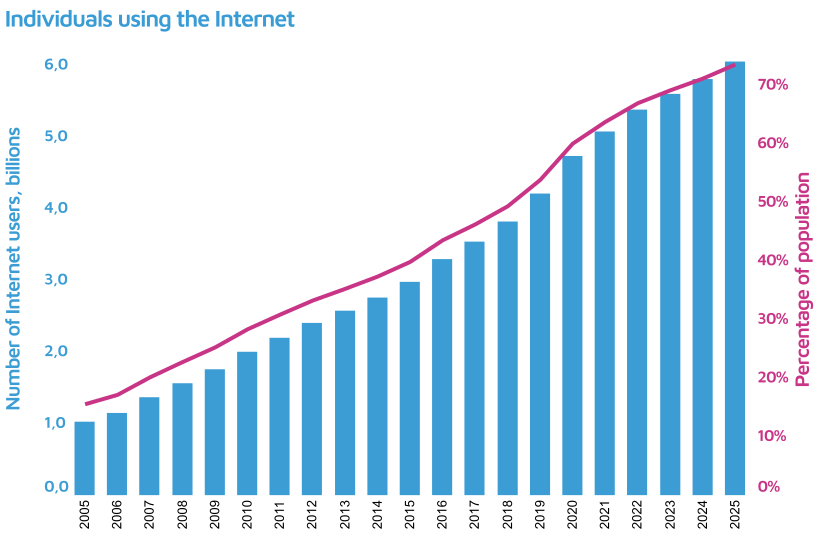
Global connectivity has improved quickly, according to the International Telecommunication Union (ITU) Facts and Figures 2025. The latest data shows that nearly three-quarters of the world’s population are now online, but that is not enough, since 2.2 billion people do not benefit from Internet access.
Short statistics on the connectivity gap, based on the ITU 2025 report:
The graph below shows the number of people (in billions) using the Internet and their share of the total population:
Source: ITU
The skills gap behind the access gap
Despite people having access to the internet, that doesn’t close the gap, because they still lack the necessary skills. The European Union can serve as an illustration of this.
The region boasts good connectivity – based on Eurostat data for 2025, around 95% of EU citizens between 16 and 74 years went online at least once within 12 months.
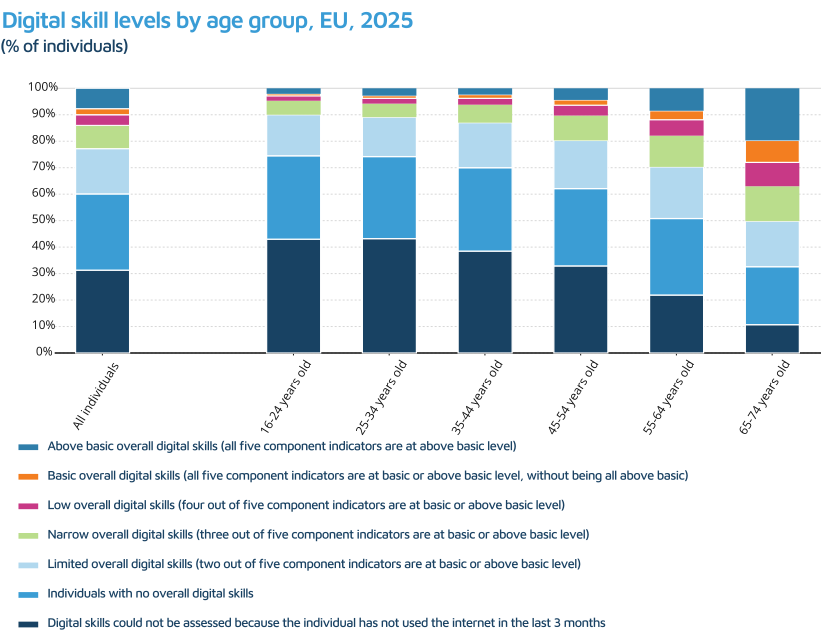
At the same time, 60% of people aged 16-74 had shown at least basic digital skills, which is well under the EU’s target of 80% by 2030.
It’s worth noting that socio-demographic characteristics matter a lot. In the EU, for instance, among people aged 65-74, only 33% have a minimum set of basic digital skills. At the same time, the share of people aged 16-24 and 25-34 with basic digital skills reaches 75%.
European authorities calculate people’s digital skills via the Digital Skills Indicator (DSI), which measures five areas:
- Information and data literacy.
- Communication and collaboration.
- Digital content creation.
- Online safety.
- Problem solving.
A person with a basic skill level can perform a limited number of relevant activities. Above the basic skills level means a person can carry out a wider range of activities.
The graph below shows digital skills in the EU by age group (% of people)
Source: Eurostat
On the international level, the picture is harder to accurately illustrate because global data on digital skills is much thinner than data on connectivity.
Digital literacy’s starting point should be the school
The Centre for Strategic and International Studies outlines the importance of starting digital literacy at school. However, the problem is that many education systems lack the necessary technological equipment and proper teacher training that could help provide children with digital skills.
In a 2020 study carried out in Chile, Ecuador, Mexico, and Peru, experts attempted to evaluate teachers’ digital skills along with their preparedness for remote learning.
The findings showed that:
- 39% of teachers could also perform basic tasks.
- 40% already possessed the basic skills and could browse the internet or send email.
- 13% of teachers were able to perform more complex operations.
7% lacked any kind of computer skills.
Despite the fact that around three-quarters of the world’s population benefit from Internet access, closing the digital coverage gap by 2030 may require investments that go well beyond the US$428 billion estimated back in 2020 by the International Telecommunication Union (ITU).
The AI layer: What changes, and what doesn’t
The appearance and popularity gain of large language models (LLMs) introduced a new layer on top of digital literacy. Some refer to this extension as AI literacy (or generative AI literacy) as a natural evolution of digital literacy.
And while people still need to know the basics like how to operate a device, how to use search engines, and how to protect their own data, it’s now become important to be able to check the data provided by chatbots and LLMs.
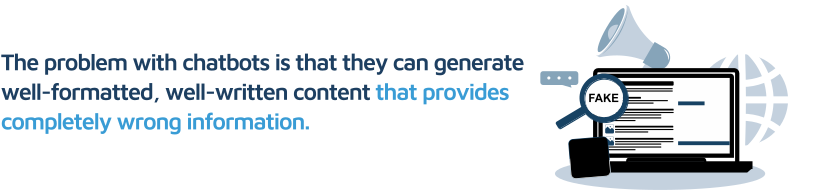
Eventually, this issue of chatbots led to a new skill that a digitally literate person has to have – recognize AI-generated misinformation and disinformation and verify an AI-sourced claim or data against an independent source.
Why digital literacy matters for development jobs, tenders, and aid programs
Digital literacy is already an important requirement in a variety of fields, especially in hiring, donor-funded programming, and procurement.
When it comes to employment, for example, an ADB study that examined nearly 6 million job postings across six countries within the Asia-Pacific region found that digital skills are now required in over 85% of jobs.
- ~45% of jobs require basic digital skills (e.g., email, spreadsheets, office software).
- ~28% intermediate (e.g., data analysis, CRM tools, digital content).
- ~13% advanced (e.g., programming, cloud, AI/ML).
- Only ~13% require none.
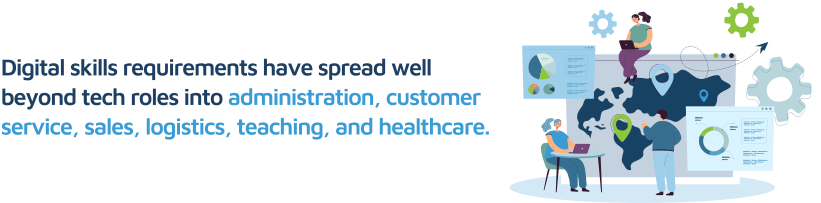
Based on the World Bank analysis of over 67 million job postings from 29 countries (2021–2024), around 47% of postings require at least one digital skill.
In addition, wages rise by 2.6% in low- and middle-income nations and by 0.5% in high-income countries for every extra digital skill.
Between 2022 and 2024, generative AI skill requirements rose ninefold, reaching ~0.2% of all online job postings. The demand is steadily expanding beyond information and communications technology (ICT) professions into content development, marketing, education, and health care, according to another World Bank Digital Progress and Trends report.
But certain labor markets show unmet demand. The EU has set a target of 20 million employed ICT specialists by 2030, but according to the 2025 data, just around 10 million people held ICT specialist roles across the EU, according to Eurostat.
The graph below shows the share of ICT professionals in 2025, compared to total employment (by EU country)
Source: Eurostat
Closing the digital literacy gap
In addition to offering people access to technology, closing the digital literacy gap also implies that people have enough skills to use that technology as effectively and safely as possible.
What individuals can do to improve their digital skills
National programs, learning platforms, and special initiatives offer free or low-cost digital skills training, including ITU Academy and Cisco Networking Academy.
Remember: Digital literacy is also about forming good habits when utilizing digital tools and knowing how to spot risks like scams and misinformation.
For example, when it comes to AI-generated content, it’s crucial to verify data, so you need to develop a habit of questioning the information chatbots generate and verify information against reliable sources.
According to the report entitled “Enhancing digital literacy in the AI era” from GSMA Intelligence, the ability to assess and utilize AI ethically is becoming an increasingly important component of digital literacy.
What organizations can do to reduce the digital skill gap of their workforce
The first thing that NGOs, employers, and donor agencies should do is make the closing of the digital literacy gap part of their workforce development strategy and not assume that everyone automatically has all the necessary digital skills.
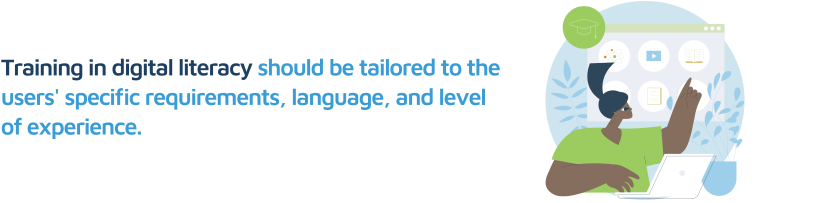
The report from GSMA Intelligence, especially its analysis of DigiTruck*, shows that initiatives become much more effective when adapted to local communities and assisted by local organizations and trainers.
Learn more about how mobile classrooms in Uganda help close the gap in basic computer literacy
What governments and policymakers can do
Governments can:
- Fund and maintain national digital-skills initiatives.
- Assist teacher training and adult education.
- Guarantee that training is accessible to those who are not enrolled in traditional schooling.
According to the GSMA Intelligence report, it’s important to incorporate practical AI awareness into national digital-skills programs, which in turn will help:
- Improve online safety.
- Make AI-powered public services clearer for everyone.
Governments should also focus on affordable devices, reliable connectivity, and, not least, access to electricity so more people can put their skills into practice.
What technology providers can do
By enhancing accessibility, support for different languages, and interface design, technology companies can make their products simpler to use for everyone.
This is especially crucial as AI enters everyday digital services. Adoption of inclusive AI (equitable and advantageous for people with various backgrounds, cultures, languages, and skill levels) will rely partially on whether technology makes things simpler.
Frequently Asked Questions
What is the difference between digital literacy and computer literacy?
Computer literacy refers mostly to operational skills, including using hardware and software correctly and efficiently and knowing how the two interact at a user level. Digital literacy is a broader term, and it builds on those operational skills. Digital literacy includes:
- Accessing and using digital tech.
- Assessing information.
- Creating and communicating digital content.
- Handling issues linked with privacy, online safety, fraud, false information, and ethical use.
What are the core digital literacy skills?
Some of the core digital skills include using hardware (for instance, physically connecting devices, typing) and software (file organizing, driver installing, word processing, etc.) effectively, as well as performing various internet/ICT tasks, like emailing and internet browsing. If you can produce information or critically assess technology, you have at least intermediate digital skills.
How is digital literacy measured?
The main international tool is the OECD’s PIAAC* (Programme for the International Assessment of Adult Competencies) survey, an international computer-based home survey for people aged 16-65 that takes place every 10 years.
There are also ICT skill indicators analyzed by the ITU. These indicators may help establish a connection between the information and communications technology (ICT) usage and influence.
Many lower-income countries don’t often collect data on digital literacy, and when they do, the methods and standards differ. Considering that the global depictions mainly rely on higher-income countries or those that boast better resources for such evaluation, worldwide comparisons only show part of the picture.
How does digital literacy affect employability?
Significantly. According to the International Labor Organization (ILO), nine out of 10 jobs will eventually require digital skills by 2030, and 65% of children who are enrolling in primary education today will eventually obtain jobs that do not currently exist.
Final word
Digital literacy is a topic so big that hardly any article can fully cover it. Furthermore, the topic keeps evolving: think about it – what counted as a baseline digital skill five years ago is already not enough now, and AI is definitely not the last shift that raises the bar.
For individuals, employers, and donor organizations, it is important to treat digital literacy as an ongoing line item (it’s not a one-time training milestone you can reach and mark “checked”).