
Can Public Procurement Contracts Predict the Future? Analyzing Procurement Data with Malcolm Duff | DevelopmentAid Dialogues

Add us as your preferred source on Google to see more of our content in Search.
 Add to Preferred Sources
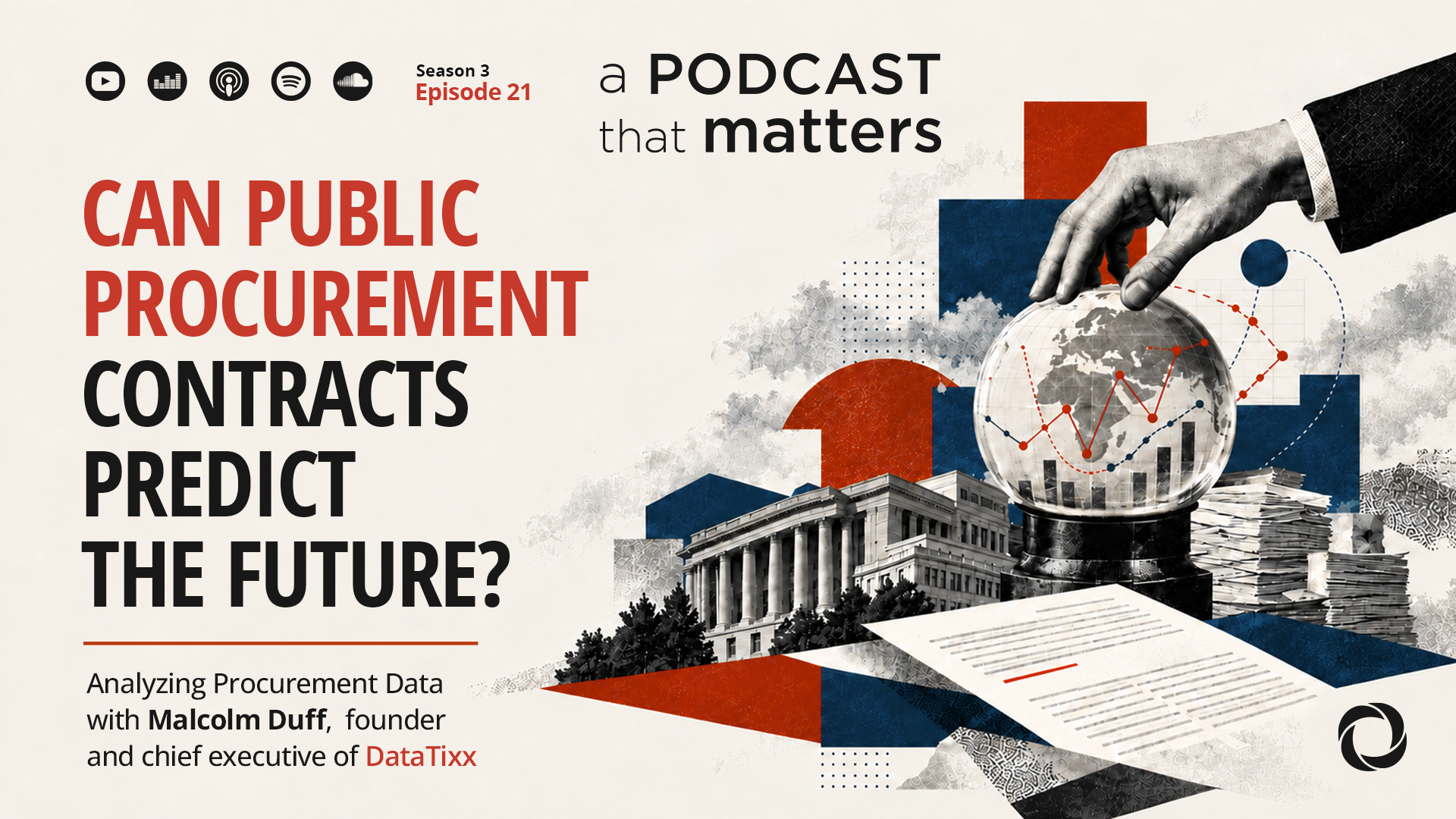
Every day, governments publish thousands of notices announcing who won a public procurement contract, for how much and for how long. These notices are an underused source of economic intelligence. One man has spent years exploring how they can help reveal future economic activity. In this episode of the DevelopmentAid Dialogues podcast, host Hisham Allam speaks with Malcolm Duff, founder and chief executive of DataTixx, the company behind the economic intelligence platform datixxia, about what public procurement data can predict and what it cannot see. A translator for nearly four decades before he became a technology founder, Duff came to the idea through a single contract that transformed his own small company.
Download the transcript of this episode.
Why — public procurement contracts? Because, he argues, they are commitments rather than forecasts. datixxia analyses published contract awards as signals of committed expenditure and prospective economic activity; those records do not, by themselves, verify subsequent delivery or payment. Twenty years ago, Duff’s translation firm, then four people, won a contract with the European Commission.”Everything changed after that,” he said. One translator on a short contract was made permanent.
“The secretary we had wanted to buy a small apartment, and she hadn’t been able to until we got that contract.”
That, he says, is the cascade. He puts public procurement at around 13% of EU GDP directly, and 40 to 60% once the subcontracts it generates are counted. His illustration is the start of the pandemic, when a Chinese municipality, he says, began ordering large volumes of the cheapest wood available to make coffins. Had his platform existed then, he argues, the data and AI’s capacity to interpret it would have flagged a medical emergency before the world knew there was one.
Asked about countries where contracts are still awarded on paper, he did not hedge.
“Until those countries start using digital systems, then it is impossible. We can’t keep track of paperwork.”
And asked how wide the gap is between a contract signed and a contract delivered, his answer was shorter still.
“I don’t know. I simply do not know.”
He hopes investigative journalists, several of whose networks he has invited to test the platform, will be the ones to find out. Pushed on whether he is therefore measuring promises rather than results, he rejected the framing outright. “It’s not promises, it’s contracts.”
Access costs 100 euros a month for up to five users, which he argues puts it within reach of a small firm in Nairobi or Dhaka. And why build it at all? His wife died of Alzheimer’s in 2022, five years after she stopped recognising him.
“I probably could make a lot of money, but I’m not particularly interested in that. What I’m interested in, is it being used.”
 Listen to the full episode with Malcolm Duff, founder and chief executive of DataTixx, the company behind the economic intelligence platform datixxia, on DevelopmentAid Dialogues. Stay informed. Stay engaged.