
FAO report calls for scaling up forest restoration to secure food systems and development goals | Report
Add us as your preferred source on Google to see more of our content in Search.
 Add to Preferred Sources
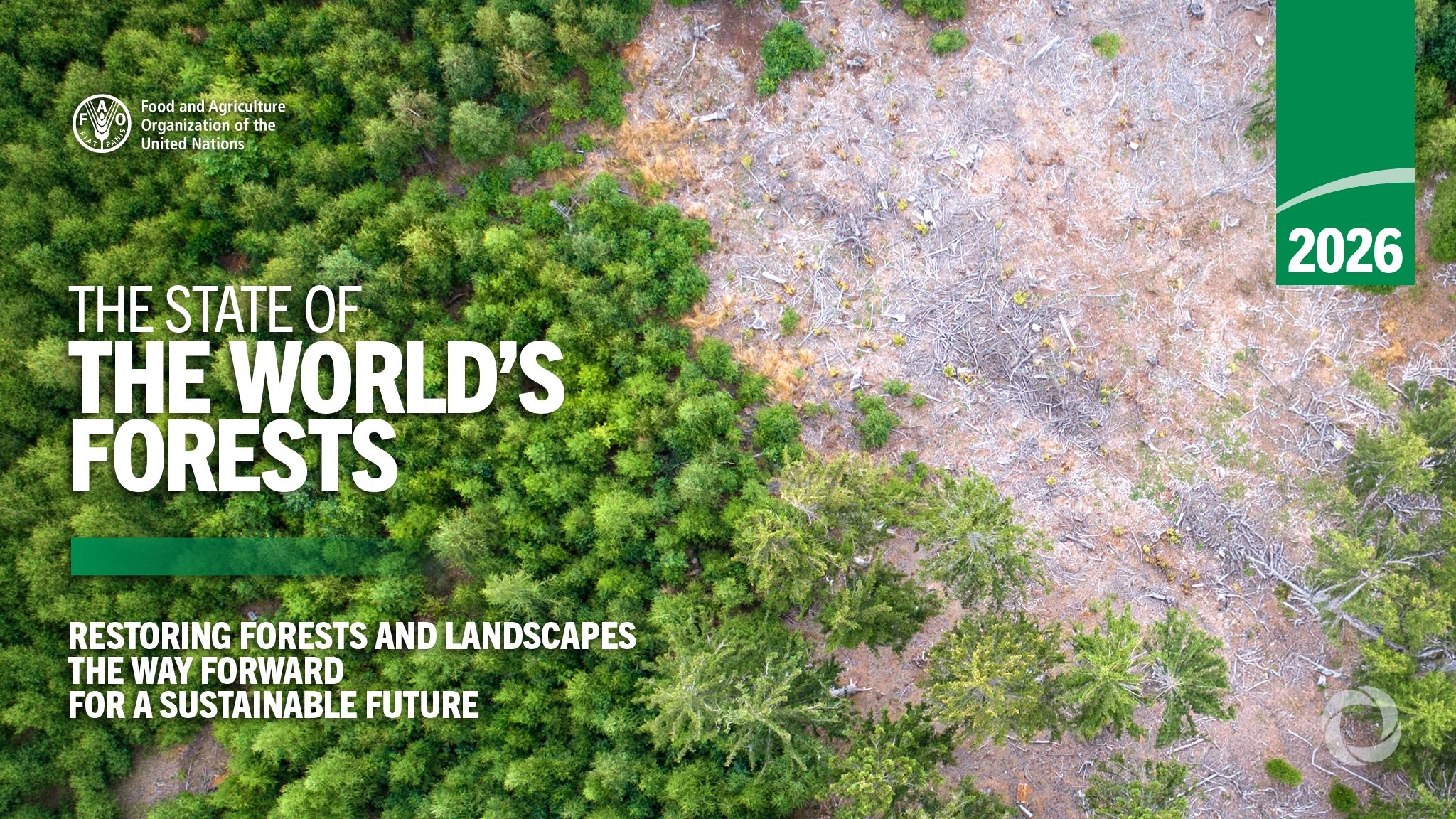
Forest and landscape restoration is a cost-effective response to food security, biodiversity, climate, and other development challenges, according to a new press release by the Food and Agriculture Organization of the United Nations (FAO). The flagship State of the World’s Forests (SOFO) 2026 report was published on 28 September 2026 in Rome as part of FAO’s 28th Session of the Committee on Forestry (COFO 28) and its 10th World Forest Week. The report warns that scaling up action will require greater investment, inclusive governance and sustained political commitment. It examines how forest and landscape restoration can be expanded to deliver lasting benefits for people and the environment. It identifies restoration as a strategic investment in resilient agrifood systems and rural development.
Forests cover 4.14 billion hectares, or about 32 percent of the Earth’s land surface, and store 714 gigatonnes of carbon. They host up to 80 percent of the world’s terrestrial biodiversity and support nearly one-third of the global population for food security and livelihoods. However, an estimated 489 million hectares of forest were lost between 1990 and 2025 through deforestation, while more than 460 million hectares are degraded worldwide. In total, 1.56 billion hectares of land are degraded, driven by population growth, land-use change and rising demand for natural resources. Every year, around 127 million hectares of forest are affected by fires, with further damage caused by insects, diseases and severe weather events.
The annual global impact of failing to restore degraded ecosystems is estimated at $878 billion to $6.3 trillion, equivalent to 2 to 8.3 percent of annual GDP. Restoring more than 1 billion hectares of degraded land could instead generate $1.8 trillion per year in benefits, including enhanced biodiversity, improved water regulation and healthier soils. The report notes that investing $2.6 trillion over 15 years in land degradation and drought mitigation could yield an eight-to-one social return. Under favourable conditions, restoration can generate returns of up to $30 for every $1 invested. It also creates jobs, revitalizes production systems and strengthens social cohesion.
Governments across 91 countries and areas have pledged more than 190 million hectares for forest restoration, though only 206.5 million hectares of forests are currently under restoration. Case studies analysed in the report include the Great Green Wall for the Sahara and the Sahel Initiative, the Three North Programme of China, and the Trinational Atlantic Forest Pact across Argentina, Brazil and Paraguay. The report outlines four pathways to scale up progress: empowering people, implementing restoration at the landscape scale, mobilizing finance, and creating coherent policies and laws. FAO Director-General QU Dongyu wrote in the Foreword that restoration “is a strategic investment in resilient agrifood systems and rural development.” He warned that “the window for action is narrowing.”
The report concludes that delayed or poorly designed restoration will increase long-term costs and exacerbate inequalities. It stresses that inaction carries a far greater economic burden than restoration itself. Large-scale restoration is increasingly recognized as crucial for achieving global targets on land degradation neutrality, climate mitigation, biodiversity conservation and ending hunger.
“The remaining years to 2030 must be defined by high-quality implementation – scaling up forest and landscape restoration that is people-centred, science-based and supported by coherent policies,” QU Dongyu wrote.
He expressed confidence that collective action can restore degraded lands at scale and build a better future for all.