
Add us as your preferred source on Google to see more of our content in Search.
 Add to Preferred Sources
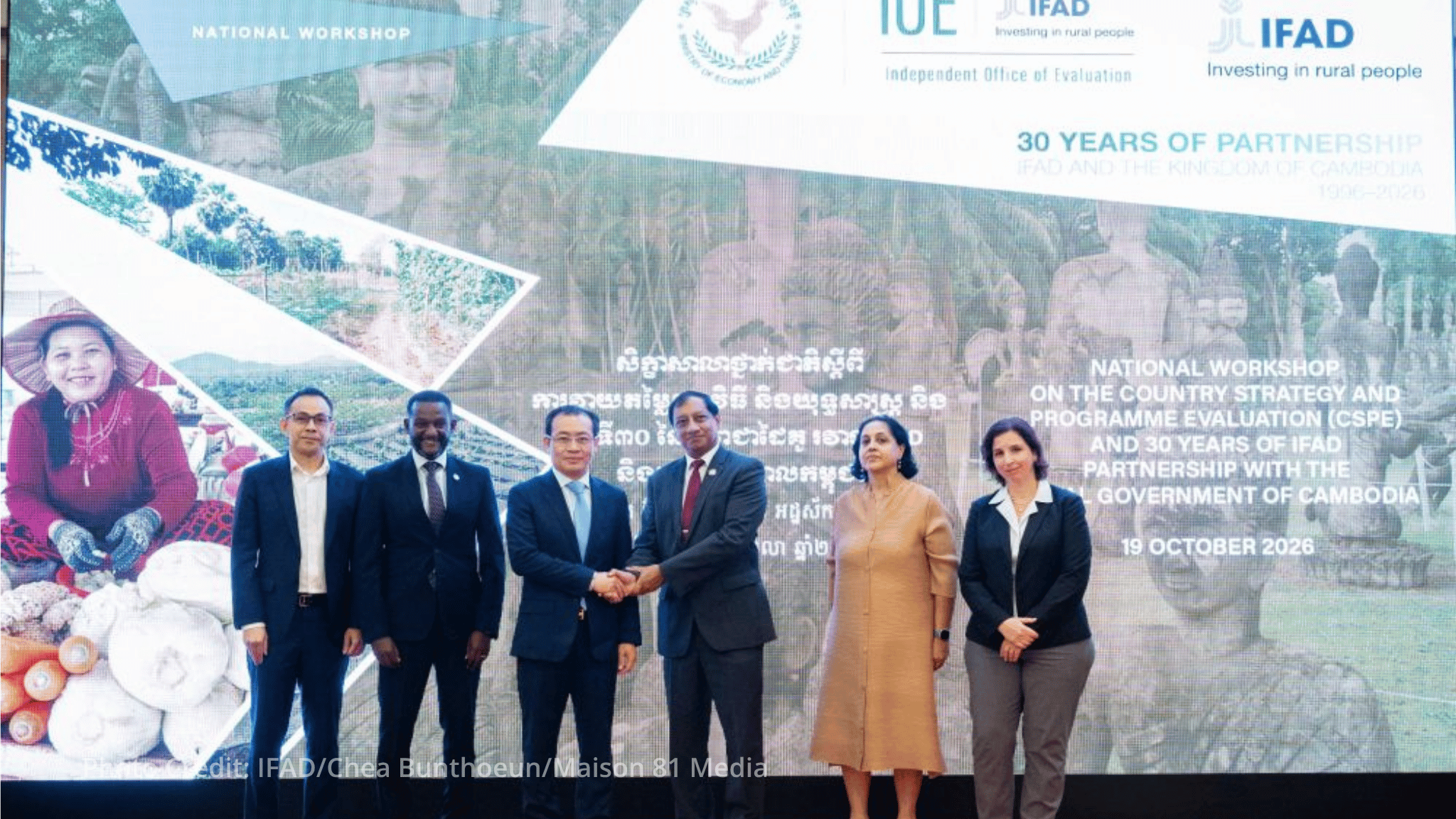
An evaluation report by the International Fund for Agricultural Development’s (IFAD) Independent Office of Evaluation found that IFAD-cofinanced programs reached more than 450,000 rural people in Cambodia between 2018 and 2025, improving their productivity, assets, and incomes, according to a press release. The findings were presented at the Country Strategy and Programme Evaluation (CSPE) National Workshop in Phnom Penh on 19 October 2026. The event also marked 30 years of partnership between IFAD and the Royal Government of Cambodia. It gathered government officials, development partners, private-sector actors, and Indigenous Peoples’ representatives. The workshop examined results, lessons, and priorities for future cooperation.
Since its first loan approval for Cambodia in 1996, IFAD has financed 12 projects with a combined value of US$1.05 billion, including US$389.1 million in IFAD financing, according to the evaluation. The partnership has focused on rural transformation and agricultural development. The CSPE process reviewed how investments have shaped outcomes for rural communities. It also provided a platform for dialogue on remaining challenges. The workshop placed evidence alongside national priorities.
The evaluation assessed seven investment projects implemented between 2018 and 2025, worth a total of US$948.6 million, of which US$338.2 million was financed by IFAD. It found that integrated packages combining extension, irrigation, inputs, productive assets, farmer organization, and finance generated strong productivity and diversification gains. The portfolio strengthened value-chain coordination through business clusters, Multi-Stakeholder Platforms (MSPs), contract farming, and private-sector engagement. The report also calls for stronger measures to sustain results after projects close. It recommends tailoring support to poorer rural households with fewer assets so they can benefit from market-oriented development.
Further recommendations include strengthening coordination across projects, improving access to appropriate rural finance, and integrating climate resilience and natural resource management more fully into future investments.
“As we mark 30 years of partnership with the Royal Government of Cambodia, we are looking ahead to how our cooperation can respond to the changing needs of rural people,” said Reehana Raza, IFAD Regional Director for Asia and the Pacific.
She added that learning from experience is essential to directing investment where it can make the greatest difference. Indran A. Naidoo, Director of IOE, noted that independent evaluation offers an opportunity to examine achievements alongside remaining challenges. He said the workshop helped turn lessons into practical actions for the future.
Representatives from the Ministry of Agriculture, Forestry and Fisheries (MAFF) and ASPIRE-AT, FAO Cambodia, AMRU Rice, the Cambodia Indigenous Peoples Organization (CIPO), and the Agricultural and Rural Development Bank (ARDB) discussed next steps in response to the recommendations. IFAD Country Director Frew Behabtu shared reflections on IFAD’s future work in the country. Houl Bonnaroth, Director General of the Ministry of Economy and Finance, presented the Royal Government of Cambodia’s priorities for future cooperation. The dialogue connected evaluation findings with national development goals. Participants aligned on directions for the next phase of partnership.