

Add us as your preferred source on Google to see more of our content in Search.
 Add to Preferred Sources
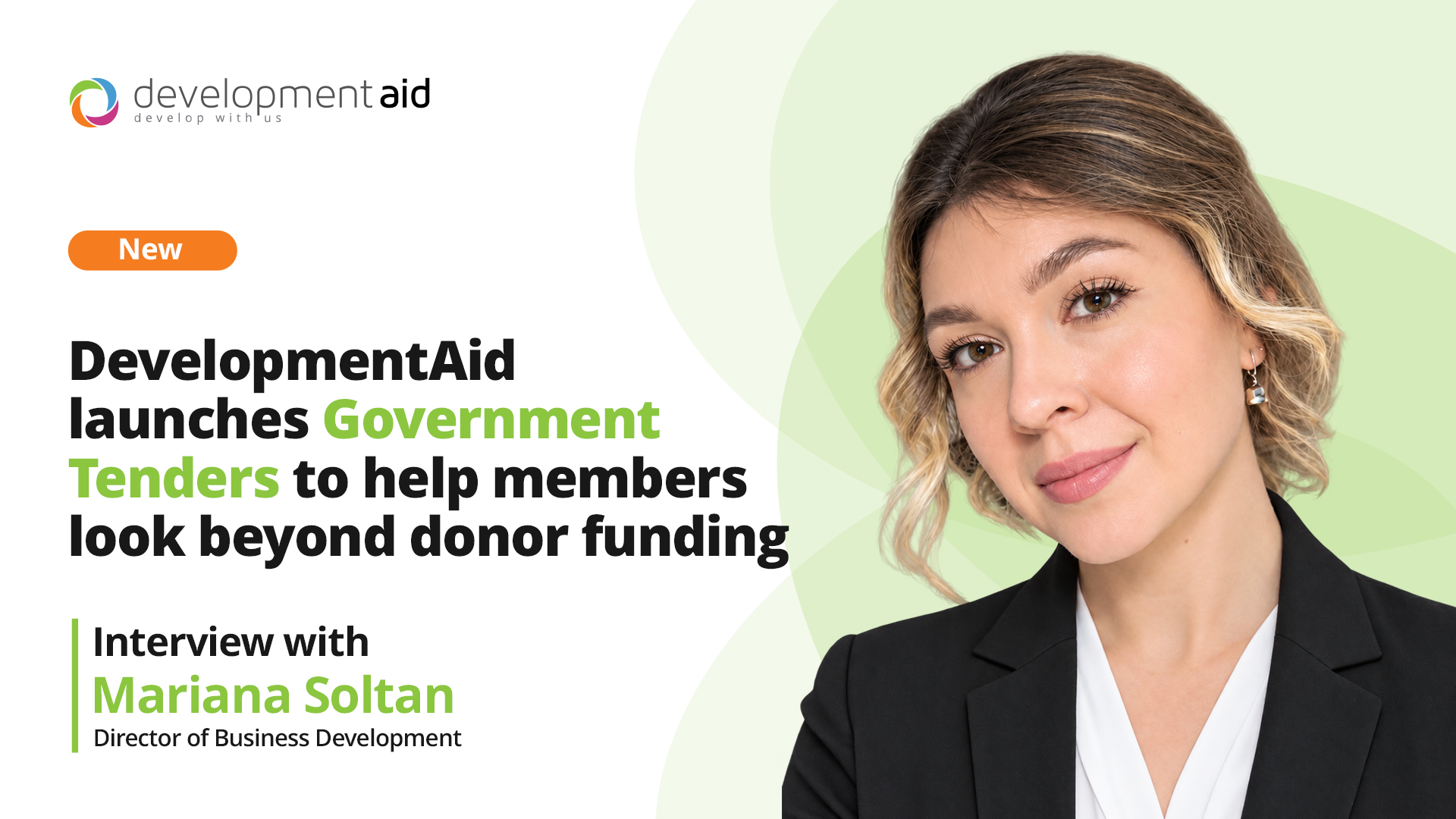
DevelopmentAid has added a new Government Tenders menu to its platform, bringing public procurement opportunities into the same place as the donor-funded tenders its users already follow. The expansion answers requests from long-standing platform members. It comes at a time when pressure on aid budgets is pushing many organizations to rethink where their next contracts will come from.
Our members asked. We listened.
For years, DevelopmentAid has given organizations working in the aid sector access to opportunities funded by international development agencies, donors, and financial institutions. Many long-standing members kept asking for one more thing: tenders published directly by governments.
“We have always believed that listening to our members is one of the most important ways to improve our services,” said Mariana Soltan, Director of Corporate Sales at DevelopmentAid. “Government Tenders is a direct response to that feedback and a natural next step in the evolution of DevelopmentAid.”
Diversification is no longer optional
The timing of launching Government Tenders matters. Since 2025, the international development sector is going through a period of significant uncertainty, with increasing pressure on official development assistance budgets and funding stagnating or declining in major donor markets.
For consultancies, engineering firms, and suppliers that have traditionally relied on donor-funded projects, this creates a clear need to diversify their business development strategies. Government procurement represents an additional market, and many of these organizations are already interested in exploring it.
“When the market changes,” Soltan noted, “your business development strategy needs to evolve with it.”
Soltan points to one organization that learned this lesson the hard way.
“One long-standing DevelopmentAid member built its business largely on projects funded by the United States Agency for International Development (USAID),” she said. Following the funding cuts, the company had to lay off most of its team. According to Soltan, for that particular firm the past year has been about survival, restructuring, and “practically reinventing the business.”
Since then, the company has started exploring new markets, diversifying its services, and started pursuing government-funded opportunities. It is still recovering, and the challenges haven’t disappeared, but it is moving in the right direction.
“Companies are realizing that relying too heavily on a single donor or funding source can put their entire business at risk,” Soltan said. “We want to give our members more options and help them build stronger, more diversified pipelines.”
Same expertise, larger market
Most of DevelopmentAid member organizations have spent years building strong expertise in infrastructure, healthcare, education, IT, engineering, and consulting, mostly through donor-funded projects. Those same capabilities are often equally relevant to government-funded contracts.
Moving into this market does not require a fresh start.
“It doesn’t mean abandoning international development or completely changing their business model,” Soltan explained. “It means applying their existing expertise to a broader range of clients and funding sources.”
Government procurement comes with its own challenges, of course. But the first step is knowing where the opportunities are, and that is where DevelopmentAid comes in.
Less time searching, more time pursuing
The biggest hurdle companies face when looking for government tenders internationally is fragmentation. Procurement information is spread across hundreds of national and regional platforms, each with its own structure, search tools, and publication practices. For a business development team operating in several countries, monitoring these sources one by one can quickly become extremely time-consuming.
Government Tenders brings opportunities from multiple sources into one place, where companies can identify tenders that match their expertise and target markets. Coverage is global, and the data comes straight from original government procurement portals, such as SAM.gov in the United States and the European Union’s Tenders Electronic Daily (TED).
Each tender is published in its original language and currency (converted into US$ by DevelopmentAid). Government tender alerts (allowing members to customize alerts based on their needs) are on the way as well and are expected to become available in the coming weeks.
“We want our members to spend less time searching for opportunities and more time pursuing them,” Soltan said.
Not only for development organizations
Existing members were the main driving force behind the launch of Government Tenders, but the service reaches well beyond the development sector. Consulting companies, engineering firms, IT providers, construction companies, suppliers, and other service providers may all find opportunities in public procurement.
“For our traditional members, it means diversification,” Soltan said. “For companies outside the development sector, it creates another reason to explore DevelopmentAid as a business development tool.”
None of this signals a move away from DevelopmentAid’s roots.
“International development remains at the core of our business and expertise,” Soltan stressed. “We are not replacing our existing services. We are complementing them.”
Many members already have the technical expertise, international experience, and operational capacity to compete for government-funded contracts. With Government Tenders, DevelopmentAid aims to help them apply those capabilities to a broader range of opportunities, whether an international donor or a government is paying for the work.
Organizations interested in Government Tenders can request a trial by contacting [email protected].