
IOM, WHO, DR Congo Ministry of Health partner to stop ebola from spreading to neighbouring countries
Add us as your preferred source on Google to see more of our content in Search.
 Add to Preferred Sources
Last week, in the Democratic Republic of the Congo (DRC), cases of Ebola were confirmed in Mbandaka, a city with a population of 1.2 million people some 150 kilometers from where the outbreak originated in Bikoro Health Zone, Equateur Province.
The fact that Mbandaka is connected by river routes to DRC’s capital Kinshasa as well as cities in the Republic of Congo and the Central African Republic, has fuelled concerns that the disease could spread more widely.
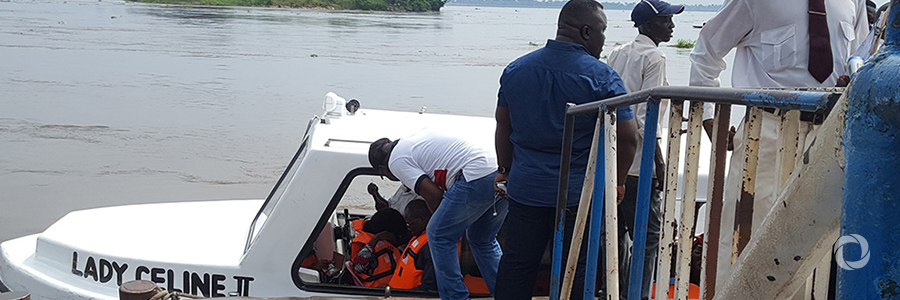
In order to mitigate this risk, IOM, the UN Migration Agency, the DRC Ministry of Health and the World Health Organization (WHO) conducted this week joint assessments at various points of entry to the capital to gauge the strength of the area’s epidemiological surveillance system. The assessment focused on migration routes from the affected province of Equateur through the ports of Maluku and Kinkole on the Congo River and at the Beach Ngobila in the capital Kinshasa.
The assessment team found boats in the ports, which often travel between Kinshasa and the Equateur Province, stopping at several ports and carrying a few hundred people at a time. Sanitary conditions were very poor and health screenings non-existent at these ports.
One boat captain told IOM that his “boat carries hundreds of passengers to different localities along the Congo river from Kinshasa, Kisangani through Mbandaka.” He added “I often bring people from Mbandaka and Bikoro with hunting meat for sale.”
These assessments, carried out with the National Border Health Program, enabled response teams to immediately identify practical measures to strengthen health surveillance around the capital city.
These include training, equipping and deploying response teams to the river ports, whilst carrying out community mobilization activities in villages upstream on the Congo River.
“There is a need to ensure that there are strong health screening, hygiene and sanitation measures in place in this environment where there is high risk for transmission,” said Jean Philippe Chauzy, IOM’s Chief of Mission in the DRC. “These ports do not meet international standards for boarding and disembarking and the lack of effective surveillance could lead to Ebola cases being found in Kinshasa,” added Chauzy.
“It is important that ports in Kinshasa are included in preparedness efforts. Kinshasa is connected to Mbandaka and Bikoro through the Congo River – and Lake Tumba for Bikoro. From Kinshasa, travelers can reach any place in the world. Kinshasa is a home of more than 60 private and small ports along way Congo river. Travel and trade of cities along the Congo, Kasai and Ubangi rivers are intense. Strengthening public health capacities for early detection and response to Ebola, as well as other infectious diseases, is important in points of connection such as these two ports,” said Dr. Teresa Zakaria from the WHO surge team.
IOM is appealing to donors USD 1.3 million to continue and expand its response to the Ebola outbreak.
Original source: IOM
Published on 25 May 2018