

Add us as your preferred source on Google to see more of our content in Search.
 Add to Preferred Sources
An international initiative to improve early warning systems against extreme weather and support climate change adaptation is gaining momentum to protect more people in more places. Financing has been extended to cover the Caribbean and West African regions.
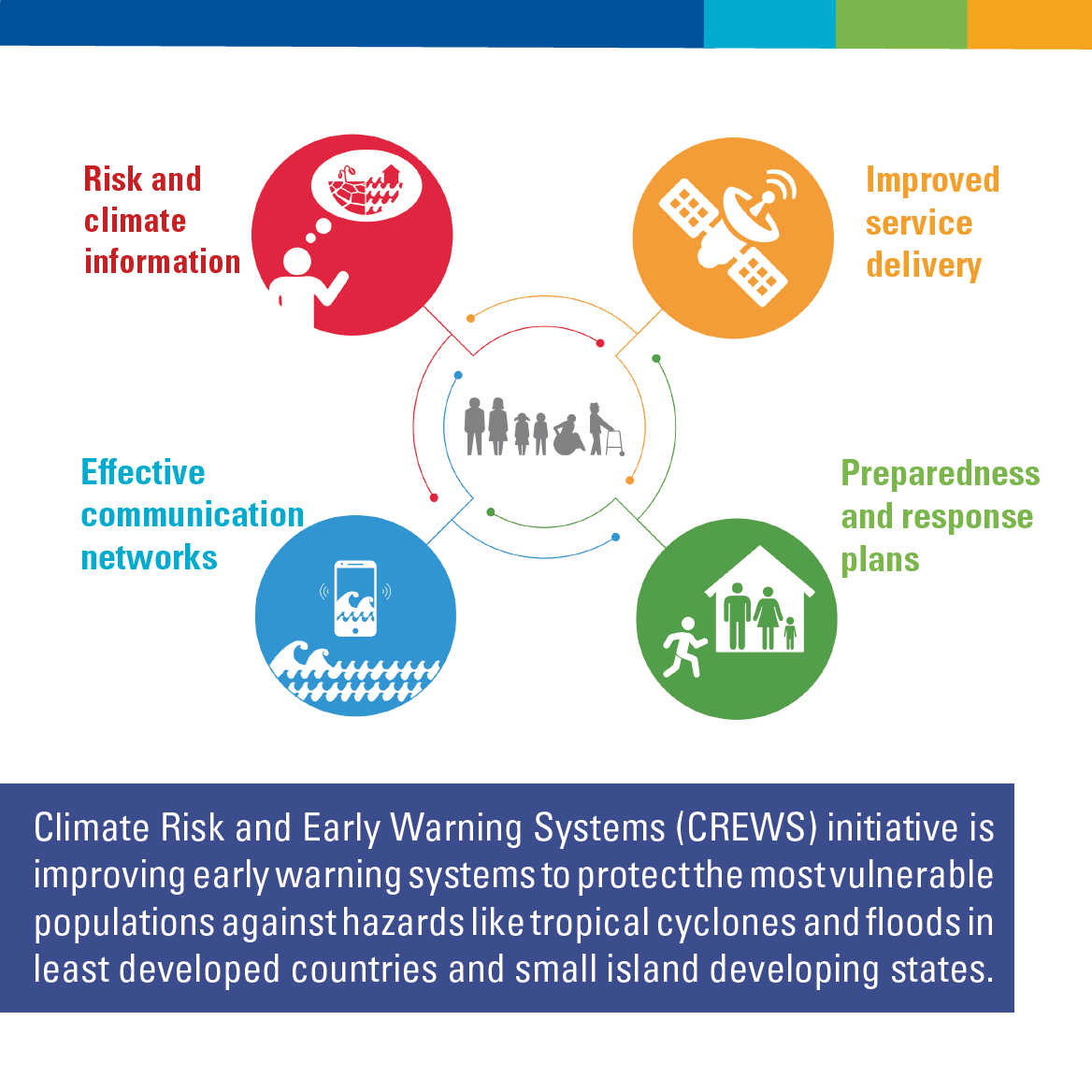
The Climate Risk and Early Warning Systems (CREWS) initiative, launched in 2015, has been operating in 19 countries in Africa and the Pacific. It is improving early warning systems to protect the most vulnerable populations against hazards like tropical cyclones and floods in Least Developed Countries and Small Island Developing States.
“This international initiative is reaching out to exposed populations in order to strengthen awareness, save lives and reduce the impact of extreme weather and climate-related disasters. Early warning systems are an essential part of climate change adaptation,” said Brigitte Collet, France’s Ambassador for Climate Change Negotiations, Renewable Energy, and Climate Risk Prevention.
Ms. Collet chaired a CREWS Steering Committee meeting, held on 14 June, to review ongoing activities and approve future projects.
“Most Least Developed Countries and many Small Island Developing States have inadequate weather observation networks and only a basic early warning system. The World Meteorological Organization is striving to close the capacity gap on weather, climate and water services by scaling up effective partnerships for investment in support of climate change adaptation, disaster risk reduction, and sustainable development. CREWS embodies that ambition,” said WMO Secretary-General Petteri Taalas.
UN Special Representative for Disaster Risk Reduction, Ms. Mami Mizutori, said: “Tragically, lives continue to be lost in disasters because of lack of access to early warning systems. Timely, actionable warnings and access to information are key to reducing the loss of life and minimizing the impact of disasters on people’s health and safety.”
The Sendai Framework for Disaster Risk Reduction 2015-2030, the global plan for reducing disaster losses, includes a specific target for improving access to multi-hazard early warning systems.
CREWS is being rolled out in a number of African countries. In the Democratic Republic of Congo, Burkina Faso, Mali and Niger, CREWS is supporting the improvement of operational hydro-meteorological forecasts and early warning services, with an emphasis on flood and drought-related risks. There is a special focus on early warnings for agriculture, food security and civil protection, and a specific alignment with investments by the World Bank and the Africa Development Bank and other partners in line with respective national frameworks for climate services.
In the Pacific, CREWS is strengthening hydro-meteorological and early warning services for islands including Fiji, Cook Islands, Kiribati, Niue and Tuvalu, Federated States of Micronesia, Samoa, Solomon Islands, Tonga, Palau, Nauru, Marshall Islands, Tokelau, and Vanuatu. In Papua New Guinea, it is improving control and maintenance of the existing drought and flood monitoring network, as well as early warnings for the agriculture sector and disaster managers.
The Steering Committee meeting identified new countries in Africa and Asia where projects could be financed in the coming two years.
CREWS is being implemented by the World Meteorological Organization (WMO), the World Bank, and the Global Facility for Disaster Reduction and Recovery (GFDRR) with the support of the UN Office for Disaster Risk Reduction (UNISDR).
Original source: WMO
Published on 15 June 2018