
Add us as your preferred source on Google to see more of our content in Search.
 Add to Preferred Sources
There has been global progress in accelerating towards the 90–90–90 targets—whereby, by 2020, 90% of people living with HIV will know their HIV status, 90% of people who know their HIV-positive status will be accessing treatment and 90% of people on treatment will have suppressed viral loads—since their launch at the International AIDS Conference in 2014 in Melbourne, Australia.
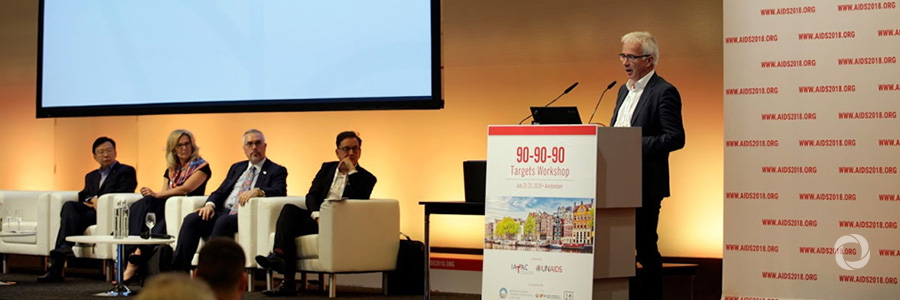
Four years later, global leaders from civil society, governments, the private sector and academia came together for a two-day workshop, on 21 and 22 July in Amsterdam, Netherlands, to highlight the successes, identify gaps and share best practices in order to reach 90–90–90.
By the end of 2017, the world had achieved 75–79–81. Globally, 75% of people living with HIV know their status, 79% of people living with HIV who know their status are accessing antiretroviral therapy and 81% of people accessing treatment had suppressed viral loads.
The participants at the workshop reviewed the progress made with the rapid adoption of global policies, political commitment, the engagement of civil society and regular evaluation of progress and gaps.
Despite the global successes, evidence presented at the workshop showed that entire regions and populations are still being left behind. Progress in eastern Europe and central Asia, western and central Africa and the Middle East and North Africa is falling behind. Key populations, adolescents, and men are not being reached by traditional health facility-based HIV testing services. Lack of political commitment, user fees and stigma and discrimination are some of the barriers to progress.
During the session, the participants discussed ways to identify and correct gaps and direct resources to where they are most needed, including by investing in data collection, reducing the turnaround time from testing to treatment initiation, prioritizing adherence and retention in care, increasing access to affordable viral load testing and the meaningful engagement of civil society in order to reach the people currently being left behind.
The participants also called for the political commitment and financial resources needed to make 90–90–90 a reality everywhere.
Original source: UNAIDS
Published on 24 July 2018