
Add us as your preferred source on Google to see more of our content in Search.
 Add to Preferred Sources
FAO Director-General José Graziano da Silva has urged countries to unite behind a campaign to promote indigenous women’s rights and encourage their participation in policy discussions to achieve the Sustainable Development Goal of Zero Hunger.
“We call on countries to stand up and guarantee a place at the table for indigenous women in policy-making processes. Without them, we cannot achieve the Zero Hunger goal and we will not achieve Sustainable Development,” Graziano da Silva said in a video message ahead of International Day of the World’s Indigenous Peoples on 9 August.
There are some 400 million indigenous peoples in the world; about half of them are women. Indigenous peoples play an important role in ending hunger.
“Indigenous peoples are the custodians of the world’s biodiversity. They are the defenders of lands and territories which they care for, for future generations,” Graziano da Silva said. “However, too often indigenous peoples have not seen respected their collective rights to their ancestral lands, territories and resources.”
Indigenous women raise livestock, farm, fish and hunt to gather food for their communities. They are also considered guardians of seeds and medicinal plants.
Despite their contributions, indigenous women are not part of policy and decision-making processes affecting their lives. Often, social protection policies fail to include their views and needs. And, despite their wealth of expertise, their work, knowledge and needs are not represented in statistics.
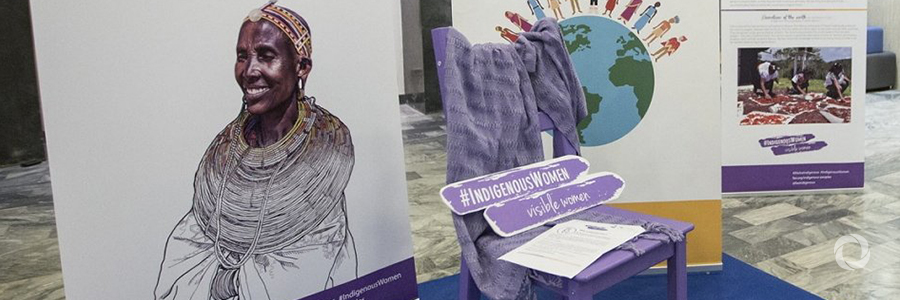
#VioletChair
In January, FAO launched the Global Campaign for the empowerment of Indigenous Women for Zero Hunger with the International Indigenous Women’s Forum and the News Agency of Indigenous and Afro-descendent Women.
One highlight of the campaign has been the Violet Chair initiative – a call to authorities, policy makers, organizations, the international community, academia and civil society to guarantee the full and effective participation of indigenous women in policy discussions and decision-making processes that affect them and their communities.
To make them visible, a violet chair is placed at a meeting to highlight that an indigenous woman is participating, or, all too often, when the chair is empty, that she is not.
“Placing a violet chair at a meeting is a simple but effective reminder that indigenous women must have a seat at those negotiation tables where policies affecting indigenous communities are being discussed,” said Marcela Villarreal, Director of FAO’s Partnerships and South-South Cooperation Division.
Original source: FAO
Published on 8 August 2018