
Add us as your preferred source on Google to see more of our content in Search.
 Add to Preferred Sources
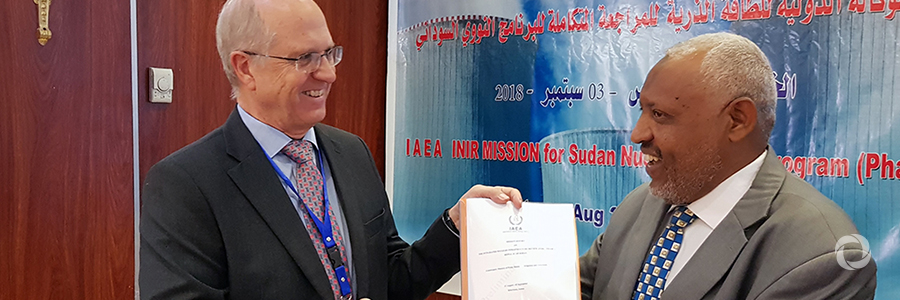
An International Atomic Energy Agency (IAEA) team of experts has concluded an eight-day mission to the Republic of Sudan to review its development of infrastructure for a nuclear power programme.
The Integrated Nuclear Infrastructure Review (INIR), which ended on 3 September, was conducted at the invitation of the Government of Sudan.
Sudan, a country of approximately 40 million people, is seeking to increase its installed electricity capacity to support socio-economic development, particularly in the industrial, agricultural and mining sectors. The government has projected that demand for electricity will more than double to around 8500 MWe by 2031.
The INIR mission reviewed the status of nuclear infrastructure development using the Phase 1 criteria of the IAEA’s Milestones Approach, which provides detailed guidance across three phases (consider, prepare, construct) of development. The end of Phase 1 marks the readiness of a country to make a knowledgeable commitment to a nuclear power programme. The INIR team was hosted by Sudan’s Nuclear Energy Programme Implementing Organization (NEPIO), which is chaired by the Undersecretary of the Ministry of Water Resources, Irrigation and Electricity (MWRIE).
“We had good discussions during the mission which provided additional information to the team for each of the 19 infrastructure issues that are addressed during an INIR mission,” said team leader Anthony Stott, Operational Lead of the IAEA’s Nuclear Infrastructure Development Section. “It is evident that there is a strong commitment from the government of Sudan to developing the infrastructure needed for a safe, secure and peaceful nuclear power programme.”
The IAEA team made recommendations and suggestions, highlighting areas where further action would benefit Sudan, including finalizing national policies to support the nuclear power programme; strengthening plans to join international legal instruments and assessing and developing the country’s legal and regulatory framework; implementing plans to support the development of key organizations and to enhance public awareness about the nuclear power programme; and further analyzing the preparedness of the electrical grid and approaches to funding, financing and radioactive waste management.
“Sudan has spent more than a decade developing infrastructure for its nuclear power programme, where nuclear safety and security are embedded in every aspect of activities, with excellent support from the IAEA,” he said. “As we are hosting the INIR mission to evaluate Phase 1 of our programme, I would like to provide assurance that we are open to implementing the INIR mission recommendations and suggestions,” said H.E. Musa Omer Abu Elgasim, Undersecretary of MWRIE and Chairman of the NEPIO.
Original source: IAEA
Published on 7 September 2018